
240 Black Softshell Turtle Hatchlings Released in Assam for Conservation

Conservation Efforts for Black Softshell Turtles
Black softshell turtles
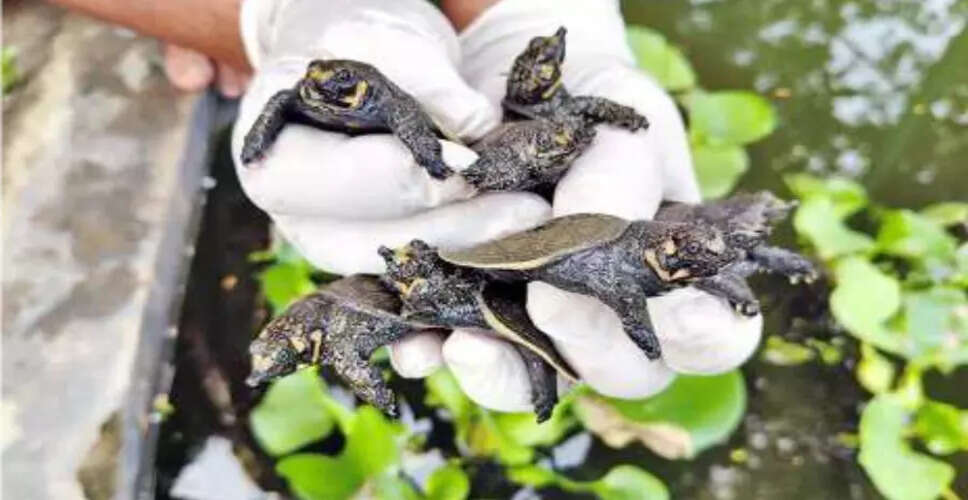
Jamugurihat, Nov 8: A notable initiative aimed at safeguarding the black softshell turtle, known locally as ‘Bormuria Kaso’ (Nilssonia nigricans), saw the release of 240 hatchlings on Saturday at Roumari Beel, a designated protected water body managed by the Biswanath Wildlife Division.
This release was orchestrated by the Wildlife Survival Alliance Foundation India (WSAFI) in partnership with the Biswanath Wildlife Division and the State Forest Department, as part of the long-term project titled ‘Conservation and Recovery of Black Softshell Turtle in Assam,’ which has been active for nearly ten years.
Once considered ‘extinct in the wild’ in the early 2000s, this species has seen a resurgence in the Brahmaputra-Kaziranga region due to ongoing conservation efforts, and it is now classified as ‘critically endangered.’
The initiative was significantly supported by the Nagsankar Temple, where eggs collected during the nesting season in March-April were artificially incubated at Biswanath Ghat under controlled conditions to reduce predation by mongooses and enhance hatching rates.
After hatching in July-August, the young turtles were nurtured in a grow-out facility and fed small fish for about three months to ensure they gained sufficient weight before their release. Since 2021, WSAFI (previously known as TSA Foundation India) has successfully released over 1,000 black softshell turtle hatchlings back into their natural habitat.
The event was graced by Naduar MLA Padma Hazarika, Biswanath Wildlife Division DFO Ritu Paban Borah, range officer Anupam Das, Nagsankar Temple committee secretary Rajib Barua, and WSAFI representatives Upamanyu Chakraborty, Aditya Dey, and Krishna Das.
As a token of appreciation, the guests received handwoven gamosas featuring turtle motifs, crafted by Kaso Sakhi, a local women's group supported by WSAFI’s livelihood initiative aimed at promoting alternative income sources and reducing reliance on river-based livelihoods.
Softshell turtles, often dubbed ‘water vultures,’ are crucial for maintaining the health of aquatic ecosystems by scavenging and helping to keep water bodies clean.