
The Remarkable Legacy of Radhabinod Pal: An Indian Judge's Stand in Japan's War Crimes Trial

A Unique Tribute in Tokyo
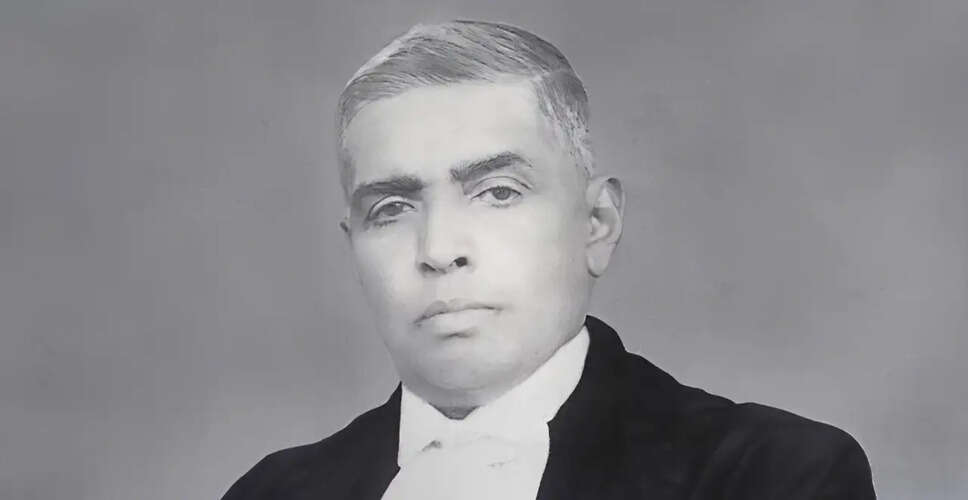
In the bustling heart of Tokyo, a monument honors a figure largely unknown to many Indians. Unlike soldiers, saints, or statesmen, this individual was a judge from Calcutta. His enduring legacy in Japan stems from a remarkable act of defiance over seventy years ago, where he stood alone among eleven judges in refusing to condemn the leaders of a defeated nation to death. This man was Radhabinod Pal, whose story is one of the most poignant in the historical ties between India and Japan.
Who Was Radhabinod Pal?
Who Was Radhabinod Pal?
Born in 1886 in a modest Bengal village, now part of Bangladesh, Pal's journey was marked by intellect and determination. He earned degrees in mathematics before shifting his focus to law, mastering international law to a degree that would later place him at a pivotal moment in history. By 1941, he had become a judge at the Calcutta High Court and was appointed vice-chancellor of the University of Calcutta in 1944. His reputation was that of a scholar, more comfortable with legal principles than political maneuvering.
Pal's Role in Japan's War Crimes Tribunal
How Did An Indian Judge End Up At Japan's War Crimes Trial?
Following World War II, the Allied forces established the International Military Tribunal for the Far East, akin to the Nuremberg trials, to prosecute Japan's wartime leaders. Eleven judges were selected from the victorious nations, and India, still under British rule, appointed Pal as its representative. He was the last judge added to the panel, following protests regarding the lack of Asian representation. The tribunal accused twenty-eight high-ranking Japanese military and political figures, including Prime Minister Hideki Tojo, with a strong inclination towards conviction. However, Pal took a different stance.
The Significance of His Dissent
What Did His Lone Dissent Actually Say?
Pal authored a dissenting opinion spanning approximately 1,235 pages, asserting that all defendants should be acquitted of the most serious charge: conspiracy to wage aggressive war. While two other judges from France and the Netherlands expressed partial dissent, Pal uniquely maintained that the accused were not guilty on any count. His objections were grounded in legal principles rather than sympathy, arguing that the tribunal was applying laws retroactively, violating the principle that no one should be punished under laws that did not exist at the time of the alleged offenses. He characterized the proceedings as victor's justice, a legal performance aimed at satisfying a desire for retribution, while highlighting the absence of accountability for the colonial actions of Western powers and the atomic bombings of Hiroshima and Nagasaki.
Pal's Enduring Legacy in Japan
Why Does Japan Still Honour Him?
For a nation grappling with defeat and shame, Pal's dissent provided a crucial lifeline. While many around the globe labeled Japan as purely malevolent, this Asian jurist stood in the courtroom, asserting that the trial was biased and politically motivated. His actions were met with profound gratitude; in 1966, the Emperor of Japan awarded him the Order of the Sacred Treasure, First Class, one of the nation's highest honors. Monuments in his memory were later erected at the Yasukuni Shrine in Tokyo and another shrine in Kyoto. The affection for Pal has endured, exemplified in 2007 when Japanese Prime Minister Shinzo Abe traveled to Kolkata to personally thank Pal's son, Prasanta, on behalf of the Japanese people.
Complexities of His Legacy
Is His Legacy As Simple As It Seems?
However, Pal's legacy is not without complications. His dissent has been embraced in Japan not only as a symbol of friendship but also, more troublingly, by nationalists who misinterpret it to suggest that Imperial Japan was blameless. The Yasukuni monument, where his memorial stands, is a focal point of contention across Asia. It is said that Tojo left a haiku in Pal's honor before his execution. Pal would likely have disapproved of how his words have been appropriated, as he condemned the atrocities while questioning the tribunal's fairness. His legacy, much like his dissent, defies simplistic interpretations.
A Forgotten Figure in India
Why Have So Few Indians Heard Of Him?
It is worth noting that while Pal is nearly a household name in Japan, quoted by prime ministers and honored at shrines, he remains largely unknown in India, the country he represented. His story was brought to a broader audience in 2016 through a television dramatization featuring actor Irrfan Khan. This disparity highlights a poignant lesson: moral courage is often unrecognized in its own time, and those who stand alone may be forgotten by their own people. The next time the term 'victor's justice' is mentioned, it is essential to remember the Calcutta judge who penned over a thousand pages to articulate it, and the nation across the ocean that has not forgotten him.