
The Remarkable Journey of Srinivasa Ramanujan: From Clerk to Mathematical Genius

Introduction to Ramanujan's Early Life
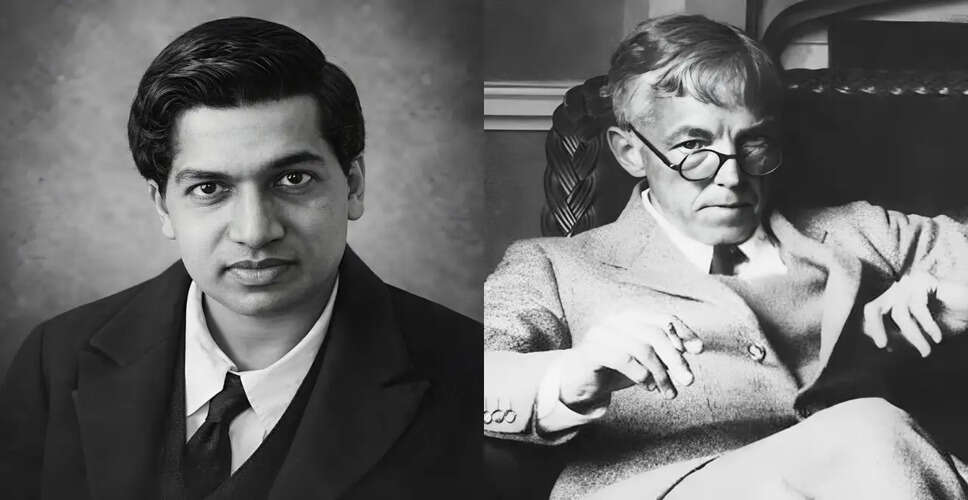
In late January 1913, G.H. Hardy received a peculiar letter at Trinity College, filled with mathematical assertions but lacking any proofs. The sender, a clerk from the Port Trust Office in Madras, identified himself as someone with no formal academic qualifications and a meager salary of £20 a year. Hardy often dismissed such correspondence, but this case was different; two other mathematicians at Cambridge had previously received similar submissions from the same individual and had returned them without comment.
Srinivasa Ramanujan: A Life of Passion for Mathematics
Born in Erode in December 1887 and raised in Kumbakonam, Ramanujan came from a humble background. His fascination with mathematics consumed him, leading to his downfall in other subjects. Despite securing a spot at Government Arts College, he lost his scholarship due to neglecting non-mathematical courses. After failing his exams twice, he found himself without a degree, married, and working as a clerk at the Madras Port Trust, where he struggled to make ends meet. Nevertheless, he dedicated his spare time to filling his notebooks with mathematical ideas.
Fortunately, he had supportive colleagues. S.N. Aiyar, the chief accountant, had a background in mathematics, and C.L.T. Griffith, a civil engineering professor, took an interest in Ramanujan's work. In November 1912, Griffith wrote to M.J.M. Hill at University College London, who responded positively but suggested Ramanujan read a standard textbook on infinite series. Ramanujan then reached out to two Cambridge mathematicians, E.W. Hobson and H.F. Baker, but received no replies.
The Pivotal Letter to Hardy
On January 16, 1913, Ramanujan made a third attempt, sending a letter to Hardy that contained around 120 theorems, all derived from his notebooks, but without any proofs. He mentioned having discovered a near-exact expression for the number of primes below a certain number, a claim he had read about in Hardy's 1910 work, Orders of Infinity. He requested that if his theorems held any value, they be published, and inaccurately stated his age as twenty-three when he was actually twenty-five.
Hardy's Initial Doubts and Subsequent Realization
Hardy's first reaction was skepticism. While some formulas seemed familiar, others appeared implausible. Unsure if he was dealing with a hoax or groundbreaking work, he reviewed the pages with his colleague J.E. Littlewood. They concluded that the theorems must be valid, as it was unlikely anyone could have the creativity to fabricate such ideas if they were false. Hardy responded on February 8, and soon rumors spread in Cambridge that they had discovered a second Newton working as a clerk in Madras.
Overcoming Cultural Barriers
However, bringing Ramanujan to England proved challenging. As a traditional Brahmin, he was not permitted to cross the sea, and his mother was opposed to the idea. The impasse was resolved in an unexpected manner when she claimed to have dreamt of her son in a grand hall with Europeans, guided by their family goddess to allow him to pursue his destiny. When E.H. Neville, a young fellow from Trinity, extended an invitation to Ramanujan, he eagerly accepted. He departed Madras on the S.S. Nevasa on March 17, 1914, arriving in London on April 14, just three months before the outbreak of World War I.
Ramanujan's Struggles in Cambridge
Ramanujan's time at Cambridge was remarkable yet arduous. He earned a BA in 1916 and became one of the youngest Fellows of the Royal Society in 1918. However, his strict vegetarian diet became increasingly difficult to maintain during wartime rationing, leading to severe health issues in 1917. He spent time in sanatoria in Wells, Matlock, and London, and at one point, he attempted suicide on the London Underground. He returned to India in 1919 and passed away in April 1920 at the young age of thirty-two.
The Missed Opportunity
Hobson and Baker are now primarily remembered for returning Ramanujan's work unread. The mathematics they overlooked continues to be explored over a century later, and the notebook discovered at Trinity in 1976 has kept mathematicians engaged. Robert Kanigel's biography popularized Ramanujan's story in 1991, followed by a film adaptation. However, the arithmetic of the situation often gets overshadowed: three mathematicians in England received letters from the same clerk, yet two deemed it unworthy of their time.