
The Legacy of Subrahmanyan Chandrasekhar: A Pioneer of Black Hole Physics
A Journey Begins
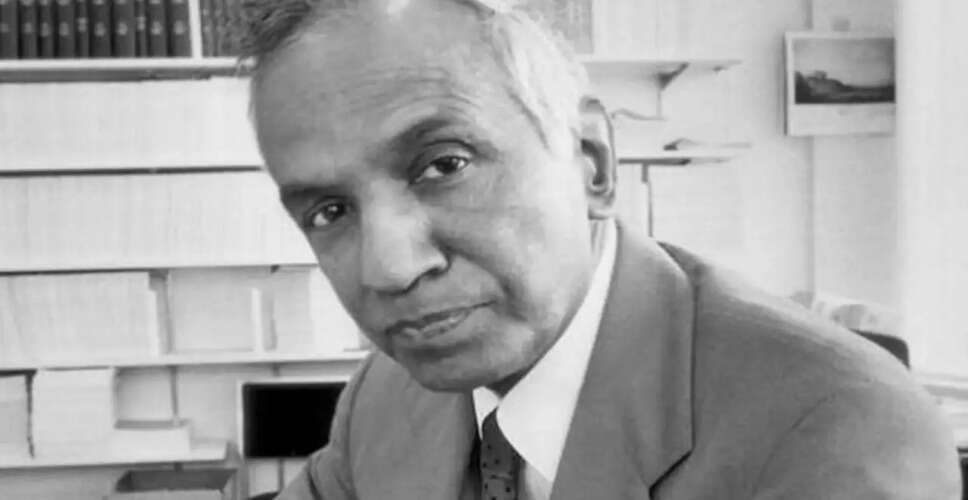
In 1930, a young man from Madras, just 19 years old, embarked on a steamship to England, armed with a government scholarship and a notebook filled with equations. By the time the vessel reached Southampton, Subrahmanyan Chandrasekhar had formulated a groundbreaking calculation that would take the scientific community over fifty years to fully embrace. He demonstrated mathematically that certain dying stars could not merely shrink into stable remnants; instead, they would collapse into an entity so extreme that not even light could escape its grasp. This concept, which we now refer to as black holes, was articulated decades before the term was even coined.
The Calculation That Changed Everything
The Calculation That Changed Everything
Chandrasekhar, affectionately known as Chandra, was born on October 19, 1910, in Lahore, which was then part of British India. His uncle, C.V. Raman, received the Nobel Prize in Physics the same year Chandra set sail for Cambridge. At just 15, he enrolled in Presidency College in Madras, published his first research paper at 18, and secured a scholarship to Trinity College before reaching the age of 20.
During his voyage, Chandra tackled a problem that had perplexed physicists for years. It was known that dying stars collapse under their own gravity into dense objects called white dwarfs. However, by applying Einstein's theory of relativity to the equations, he reached a shocking conclusion: a star with a mass exceeding approximately 1.4 times that of our Sun could not stabilize as a white dwarf. Instead, it would continue to collapse into an unknown entity. This critical threshold, now known as the Chandrasekhar limit, is a cornerstone of modern astrophysics.
The Betrayal at the Royal Astronomical Society
The Betrayal at the Royal Astronomical Society
What transpired next is one of the most distressing chapters in scientific history. Chandra dedicated four years at Cambridge to refining his calculations, during which the English astronomer Arthur Eddington took a keen interest in his work. When Chandra was invited to present at the Royal Astronomical Society on January 11, 1935, Eddington arranged for him to receive double the usual speaking time and scheduled his own talk right after.
However, Eddington did not support Chandra's findings. Instead, he publicly mocked the work, deeming the notion of a star collapsing into infinite density as absurd. Many prominent physicists of the time, including Bohr, Dirac, and Pauli, privately sided with Chandra but refrained from confronting Eddington publicly. At a later lecture at Harvard, Eddington dismissed the findings even more harshly. During the 1939 International Astronomical Union meeting in Paris, Chandra was not even permitted to respond. Eddington passed away in 1944 without retracting his stance. Remarkably, when Chandra penned an obituary for his former mentor, he regarded Eddington as one of the greatest astronomers of his era.
Vindication That Took a Lifetime
Vindication That Took a Lifetime
Chandra left England for the University of Chicago, where he would spend nearly sixty years. He described his work in terms of "decades," mastering a new field every ten years, authoring definitive texts, and moving on. He supervised 45 doctoral students, two of whom, Tsung-Dao Lee and Chen-Ning Yang, received the Nobel Prize before he did. It took an entire generation for the scientific community to accept the Chandrasekhar limit. The discovery of Cygnus X-1 in 1972, the first confirmed black hole, validated that stars exceeding his limit indeed collapsed into something other than a white dwarf. In 1983, 53 years after his initial calculation aboard the steamship, Chandrasekhar was awarded the Nobel Prize in Physics. He passed away on August 21, 1995, in Chicago. Four years later, NASA launched the Chandra X-ray Observatory in his honor, a space telescope designed to explore the very phenomena he had predicted as a teenager on that ship. His biography, 'Chandra' by Kameshwar C. Wali, remains the definitive account of his life and is essential reading for anyone wishing to understand how one quiet, determined mind transformed our understanding of the universe.