
The Legacy of Gauhar Jaan: India's First Recording Star
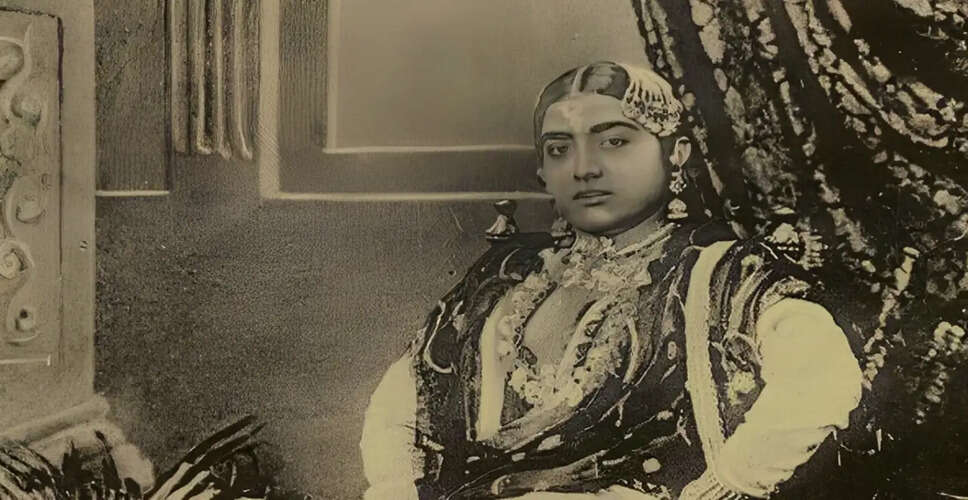

A Historic Recording
In November 1902, a woman entered a makeshift recording studio located in a hotel in Calcutta, adorned in black gauze drapes embellished with genuine gold lace. Frederick William Gaisberg, the recording engineer from the Gramophone Company in London, instructed her to stand on a table, lean into a recording horn attached to the wall, and sing as loudly as possible within a three-minute timeframe. At the conclusion of her performance, she introduced herself: "My name is Gauhar Jaan." This marked the first commercial recording by an Indian artist.
From Eileen Angelina Yeoward to Gauhar Jaan
Born on June 26, 1873, in Azamgarh, Uttar Pradesh, Eileen Angelina Yeoward hailed from a diverse background. Her father, Robert William Yeoward, was an Armenian Christian engineer, while her mother, Victoria Hemmings, was the daughter of a British soldier and a Hindu woman from Allahabad, trained in music and dance from a young age. Following her parents' separation in 1879, Victoria relocated with her daughter to Banaras, where they found sanctuary with a Muslim nobleman named Khursheed. Both converted to Islam, with Victoria adopting the name Malka Jaan and Angelina becoming Gauhar Jaan.
Musical Training and Early Fame
In Banaras and later in Calcutta, Gauhar honed her skills under the tutelage of some of the era's most esteemed classical musicians. She studied khayal with Kale Khan of Patiala, Kathak with the renowned Bindadin Maharaj, dhrupad with Srijan Bai, and Bengali kirtan with Charan Das. Under the pseudonym "Humdum," she composed ghazals. By the age of fifteen, she had already performed at the Darbhanga court, and by the dawn of the 20th century, she had become the most renowned courtesan vocalist in Calcutta.
The Gramophone Company's Discovery
When the Gramophone Company sought to capture "native voices" in India, Gauhar Jaan emerged as their most valuable discovery. She requested Rs 3,000 for her recording session, a sum the company readily agreed to. Over the years, she recorded nearly 600 songs in over ten languages, including Hindustani, Bengali, Tamil, Marathi, Arabic, Persian, Pashto, French, and English. She innovated a technique to condense the expansive forms of Hindustani classical music into the three-minute format suitable for records. Her recordings were produced in Hanover, Germany, and shipped back to India, where they sold in vast quantities. Her voice was a significant factor in many Indians purchasing gramophones, and her image graced postcards, matchboxes from Austria, and gramophone needle tins, establishing her as India's first celebrity.
A Life of Extravagance
Gauhar Jaan led a life of opulence that shocked the conservative society of her time. She traveled through Calcutta in horse-drawn carriages, a luxury reserved for the elite, and often paid hefty fines to the British authorities for her indulgences. She owned real estate and hosted extravagant parties, including a famously elaborate celebration for her pet cat. Each recording session saw her donning a different, increasingly extravagant gown, a detail noted with surprise by Gaisberg in his diaries.
A Grand Performance and a Downfall
In December 1911, she performed at the Delhi Durbar for King George V's coronation, sharing the stage with Jankibai of Allahabad. At this peak of her career, she enjoyed immense visibility. However, her success was short-lived. A tumultuous marriage to a much younger man led to a court battle that cost her much of her wealth and property. As her financial situation deteriorated, so did her health. In her later years, she accepted an invitation from Krishna Raja Wadiyar IV, the Maharaja of Mysore, to serve as a palace musician. She passed away on January 17, 1930, suffering from depression and poor health, largely forgotten by the city that once celebrated her. At the age of fifty-six, the woman who had introduced Indian classical music to the gramophone and whose recordings had reached across the British Empire died as a guest of state in a court that was not her own.
A Lasting Legacy
The next time you listen to a record, download, or stream Indian classical music, remember that its lineage traces back to a woman in a Calcutta hotel room in 1902, standing on a table, singing into a horn, and declaring her name as if she knew the world needed to hear it. And indeed, it did.