
The Legacy of Cyril Radcliffe: A Boundary That Changed Lives

Introduction to a Historic Decision
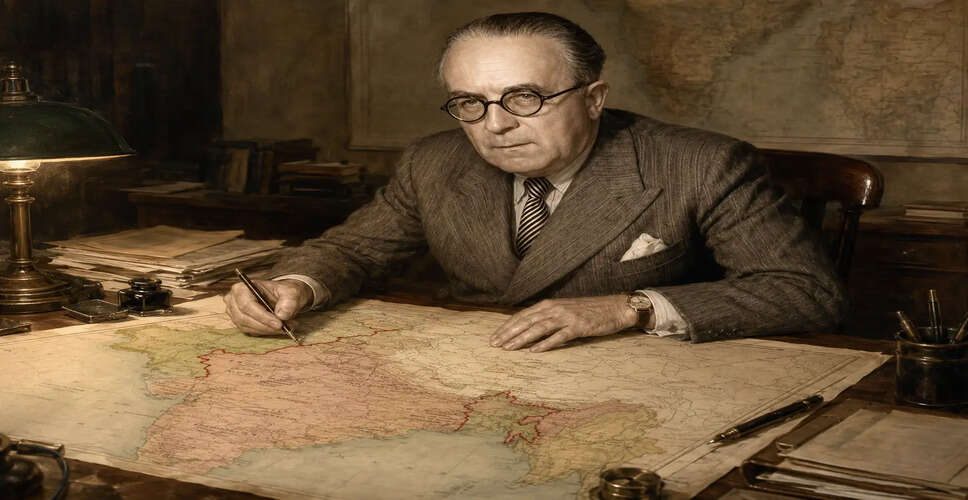
Despite never having visited India or being familiar with its geography, Cyril Radcliffe, a barrister from London, was tasked in the intense summer of 1947 with a monumental responsibility. He was given outdated maps and a mere five weeks to delineate a boundary that would separate one of the world's oldest civilizations. The line he drew would impact the lives of approximately eighty-eight million individuals, a burden he would carry for the rest of his life.
The Mountbatten Plan and Its Implications
The Mountbatten Plan That Started a 73-Day Clock
Radcliffe's role was not solitary; it was orchestrated by Lord Louis Mountbatten, the last Viceroy of India, who arrived in March 1947 with the urgent task of concluding British rule. On June 3, 1947, he unveiled the partition plan, gathering leaders from both the Indian National Congress and the Muslim League to secure their agreement. This plan stipulated the division of Punjab and Bengal, allowing provinces to vote on their futures, and established a Boundary Commission to determine the new borders. Most notably, it advanced the date of independence to August 15, 1947, with the Indian Independence Act being ratified on July 18, sealing the fate of millions.
Cyril Radcliffe: The Unlikely Architect of Division
Who Cyril Radcliffe Was, and Why He Was Chosen
By the time of partition, Radcliffe had established himself as a prominent barrister in London, known for his intellect and lack of colonial ties. This impartiality was crucial for the Boundary Commission, as both Nehru and Jinnah accepted him as a neutral figure. He presided over two commissions for Punjab and Bengal, each comprising equal representation from both communities. However, when these panels reached an impasse, the ultimate decision fell solely on him.
The Challenges of Boundary Drawing
Five Weeks, Old Maps and No Way to Check Them
Arriving in Delhi on July 8, 1947, Radcliffe faced the daunting task of drawing a border exceeding two thousand miles in just five weeks. The challenges were immense: outdated maps, unreliable census data, and no opportunity to visit the contested areas or engage with the local populations. Working in isolation amidst rising violence, he was tasked with balancing geographical features against religious demographics in an impossibly short timeframe.
The Impact of the Radcliffe Line
The Line That Split 88 Million Lives
The outcome was the Radcliffe Line, a boundary that divided around eighty-eight million people. It severed communities in Punjab and Bengal, displacing villages and separating families from their ancestral lands. Major cities like Lahore and Amritsar found themselves on opposite sides of this new frontier, leading to the largest mass migration in history, with estimates of ten to fourteen million people displaced and up to a million casualties resulting from the ensuing violence.
The Timing of the Announcement
A Boundary Announced Only After the Celebrations
Interestingly, Radcliffe completed his work before independence, but the announcement of the boundary was delayed until August 17, 1947, two days after India and Pakistan celebrated their newfound freedom. This postponement was strategic, allowing the celebrations to proceed without the shadow of impending violence. Controversy surrounded the border's finalization, particularly regarding the Muslim-majority Ferozepur area, which was initially designated for Pakistan but switched to India just before the announcement, allegedly at Mountbatten's behest.
Radcliffe's Regret and Legacy
The Man Who Burned His Papers and Never Came Back
Radcliffe's story is marked by profound remorse. As the violence escalated, he declined his fee of forty thousand rupees, refusing to profit from the division he had facilitated. He destroyed his documents and left India on the day of independence, never to return, fearing the repercussions of his decisions. He expressed that he might have made better choices given more time, yet he rarely spoke of India again after that.
Reflections on Partition
What Radcliffe's Line Left Behind
In 1966, poet W. H. Auden captured Radcliffe's ordeal in a poignant poem titled "Partition," reflecting on the emotional toll of such a monumental task. The narrative of partition is not merely about one individual’s actions; it illustrates the consequences of hurried decisions made under pressure. The borders of South Asia were not shaped by historical or geographical considerations but by the urgent demands of a timeline. The next time one observes the delineation between India and Pakistan on a map, it is essential to remember that it was drawn hastily by a man who never set foot on the land and who spent his later years wishing he could undo his actions.