
The Legacy of Christopher Latham Sholes: The Man Behind the Typewriter

The Origins of the QWERTY Keyboard
Take a moment to glance at your keyboard. The peculiar arrangement of letters, particularly the sequence of Q, W, E, R, T, and Y, was established over 150 years ago by a Milwaukee newspaperman named Christopher Latham Sholes. His invention revolutionized writing, work, and business practices in the modern world. Despite this monumental impact, Sholes ultimately distanced himself from his creation, receiving a modest sum for it and passing away with little wealth, while others profited immensely from his idea.
Who Was Christopher Latham Sholes?
Born in 1819 in Pennsylvania, Sholes began his career as a printer before relocating to Wisconsin. Throughout his life, he worked as a printer, journalist, and newspaper editor. He was also politically active, serving in the state legislature and helping to establish the Republican Party in Wisconsin. His background in printing played a crucial role in his journey towards inventing the typewriter, which initially stemmed from a different kind of machine.
From Page-Numbering Machine to Typewriter
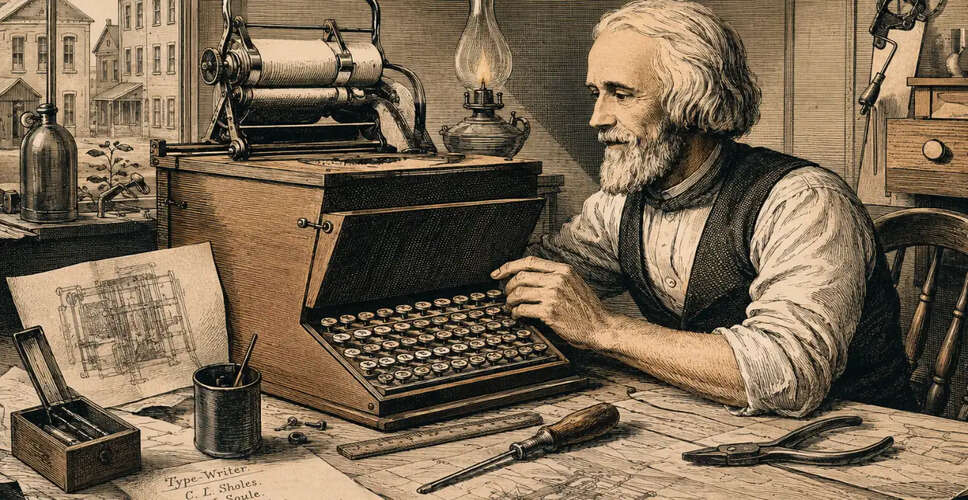
In 1866, while working in a Milwaukee machine shop, Sholes created a device intended for printing page numbers in books. A colleague suggested adapting it to print letters, leading Sholes to collaborate with Carlos Glidden and Samuel Soule to develop a writing machine. They filed for a patent in October 1867, which was granted on June 23, 1868, and Sholes named it the typewriter.
The QWERTY Layout: A Solution to Jamming
Early typewriters faced a significant issue: when keys were pressed rapidly, the metal typebars would jam. To address this, Sholes rearranged the keyboard layout to separate frequently paired letters, resulting in the QWERTY configuration. This design was intended to mitigate the mechanical limitations of the time and has persisted long after the original problem was resolved. Today, this layout remains the standard for typing.
The Sale of His Invention
Sholes was more of an inventor than a businessman, struggling to secure funding for his project. James Densmore, a dedicated supporter, invested in the typewriter's development. In 1873, Densmore presented a Sholes machine to the Remington Arms Company, which agreed to manufacture it. Sholes sold his remaining rights for $12,000. The Sholes and Glidden Type-Writer hit the market in 1874, paving the way for the typewriter's dominance in offices worldwide, while Sholes received little of the financial success.
Did He Regret Selling His Invention?
Sholes' story is not merely one of a man wronged by history. He continued to innovate, adding the shift key in 1878, which allowed for both uppercase and lowercase letters. Even as his health declined, he worked on touch typing and a portable version of the typewriter. He valued his invention not by the wealth it could have brought him but by its impact on others. Before his death, he expressed to his daughter-in-law that he had contributed something significant to the world, particularly for women who worked hard and could benefit from his invention.
Sholes' Enduring Legacy
Sholes passed away in 1890, having lived a life of modest means, while his invention transformed the workforce, particularly for women, and altered the landscape of written communication for generations. While it may be tempting to view him as an inventor who was cheated by his own creation, Sholes recognized his legacy in a broader context. The true measure of his contribution was not the $12,000 he received but the enduring influence of the keyboard you use today and the countless lives it has changed.