
The Legacy of Babur: A Journey Through History and Emotion
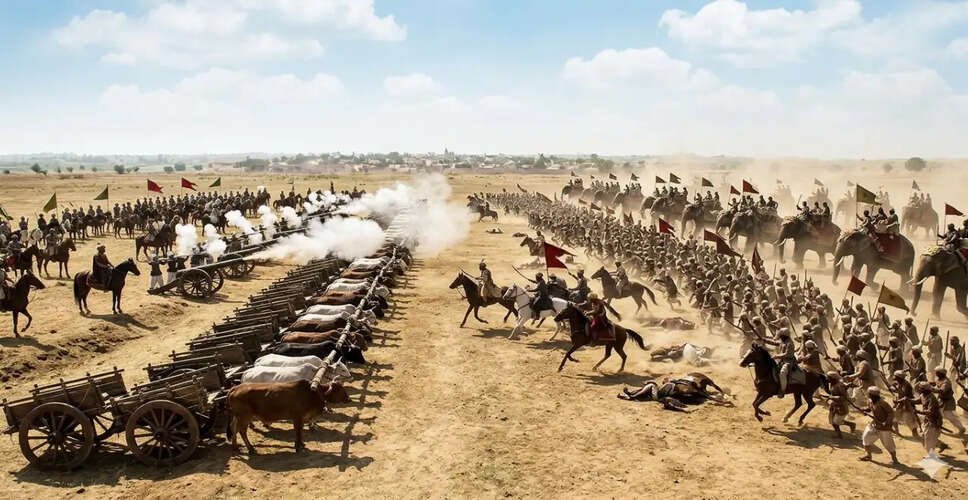

A Historic Day: The Battle of Panipat
On April 21, 1526, a pivotal battle unfolded in Indian history, led by a man who famously shed tears at the sight of a melon. Babur, commanding around 12,000 troops, faced off against Ibrahim Lodi, the Sultan of Delhi, who boasted an army of 50,000 to 100,000 soldiers, supported by nearly a thousand war elephants. By midday, Ibrahim lay dead on the battlefield, marking the end of the Delhi Sultanate. The man who had wept over a melon would later establish an empire renowned for its architectural marvels, including the Taj Mahal and the Red Fort. His name was Zahir ud-Din Muhammad Babur, and his life story is one of the most fascinating narratives of conquest.
Babur's Reluctant Journey to India
The Man Who Did Not Want India
Born in 1483 in the Fergana Valley, present-day Uzbekistan, Babur was a descendant of both Timur and Genghis Khan. He ascended to the throne at the tender age of twelve after his father's accidental death. His ambitions were set on Samarkand, which he captured and lost twice. Driven out by the Uzbeks, he retreated to Kabul, seeking a way back north, but found all routes blocked. India was not his first choice; it was merely the last option left.
In his memoir, the 'Baburnama', written in Chagatai Turkic and considered the first Islamic autobiography, Babur expressed his views on Hindustan candidly. He found little beauty in its people, lamented the absence of good horses, grapes, and cold water, and noted the lack of schools and baths. While often interpreted as disdain, it reflects more of a longing for the Central Asia he had lost.
The Strategic Battle of Panipat
The Battle
By late 1525, Babur crossed the Indus River and advanced southward. Despite being heavily outnumbered, he took advantage of the discontent among Ibrahim Lodi's Afghan nobles. Babur strategically positioned his forces at Panipat, creating a defensive setup that included 700 carts forming a barricade, behind which he placed matchlock muskets and field cannons—one of the earliest uses of gunpowder artillery in the region. He left gaps for cavalry charges and secured his right flank against the town.
As Ibrahim's forces advanced, the cannons fired, causing panic among the elephants. The cavalry executed a flanking maneuver, leading to the collapse of Lodi's army. Ibrahim fought valiantly but was ultimately killed, and the battle concluded before noon.
The Unique Autobiography of Babur
The Autobiography Nobody Expected
What sets Babur apart from other conquerors is not just his victory at Panipat but his introspective writings. The 'Baburnama' transcends a mere military account; it is a deeply personal observation of his experiences. Babur meticulously documented the flora and fauna of the regions he traversed, often commenting on the quality of melons before discussing fortifications. He noted the humid climate of Agra affecting his equipment and wrote candidly about his indulgences and relationships.
His gardens, particularly the charbagh style, were his way of recreating the landscapes of his lost homeland, leaving a lasting legacy in India.
The Homesick Emperor
The Homesick Empire
Following the battle, Babur's troops longed to return home, struggling with the oppressive heat of India. Despite this, Babur managed to maintain their morale through determination, religious vows, and promises of riches. He captured Delhi and Agra and defeated the Rajputs at Khanwa in 1527. However, he spent his later years in India yearning for Kabul, expressing in his poetry a desire for wealth but questioning the value of being enslaved by the land.
Babur passed away on December 26, 1530, at the age of 47. Initially buried in Agra, his remains were later moved to Kabul, where he rests in the Bagh-e-Babur, a garden he designed, overlooking the city he cherished more than his empire.
The Enduring Legacy of Babur
What Five Hundred Years Has Made
The dynasty established by Babur ruled northern India for over three centuries. His grandson, Akbar, expanded it into one of the largest empires globally, while his great-great-grandson, Shah Jahan, constructed iconic monuments that symbolize India. The British later adopted the administrative frameworks set by the Mughals, and the cultural influences—from cuisine to architecture—remain integral to the subcontinent's daily life. All of this began on a battlefield in Haryana, five centuries ago, when a homesick poet, out of options, tied his carts together and altered the trajectory of Indian history, documenting the entire journey in his own words.