
The Historic Custodians of Jerusalem's Church of the Holy Sepulchre
A Legacy of Guardianship
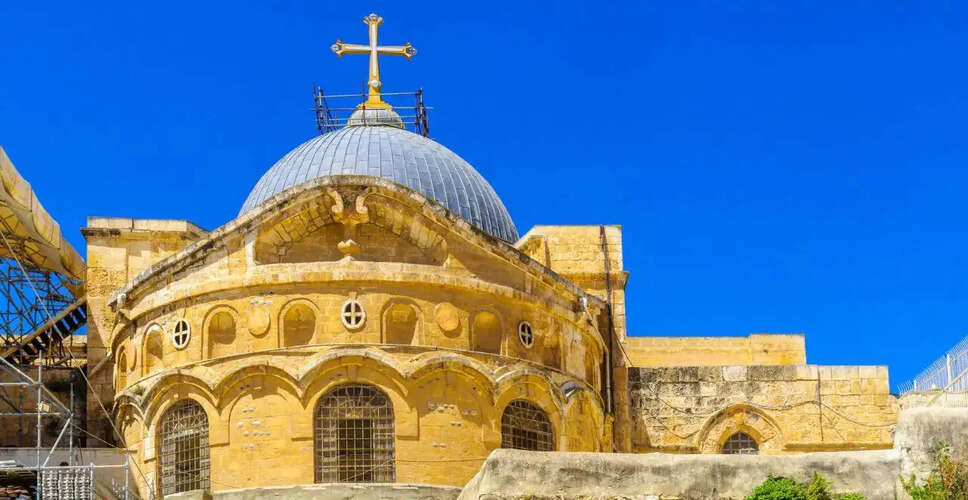
For over 850 years, the keys to the Church of the Holy Sepulchre in Jerusalem have been held by two prominent Palestinian Muslim families. This church, revered as one of the holiest sites in Christianity, is situated at the site of Jesus’ crucifixion and burial. Each year, it attracts thousands of pilgrims during the Easter season.
Historian Dr. Aref Al Aref, in his work Al-Mufassal fi Tarikh al-Quds (The Detailed History of Jerusalem), notes that the Joudeh AlHusseini family received the keys to this sacred church in the 12th century, specifically in 1187, under the leadership of Salahuddin Ayyubi. This key is the sole means to unlock the church's doors, which were originally constructed between 330 and 335 CE by Emperor Constantine I. Ayyubi reclaimed Jerusalem from the Crusaders in 1187.
According to Adeeb Jawad Joudeh AlHusseini, the current deputy governor and custodian of the church keys, their family has been entrusted with this responsibility since the time of Salah Elddin. They have upheld this duty in accordance with numerous faramans (royal decrees) issued by successive sultans governing Jerusalem.
Another family integral to the church's operations is the Nuseibeh family, which has been responsible for the opening and closing of the church doors since 637, when Caliph Omar introduced Islam to Jerusalem. Khaled Hazem Nuseibeh mentions that one of their notable ancestors, ‘Ubada Ibn Al-Samet, settled in Jerusalem during the 7th century following the Arab-Islamic conquest and was appointed governor by ‘Umr Ibn Al-Khattab, the second rightly guided caliph.
While historical evidence is limited, it is believed that the keys to the Church of the Holy Sepulchre have been held by the AlHusseini family, while the Nuseibeh family manages the door operations. The church opens at 4 am, with representatives from both families present to fulfill their roles. A Muslim representative unlocks one door, while a clergyman from one of the Christian denominations pulls open the other door from inside, with clergy from other denominations overseeing the process. This procedure is mirrored when the church closes at 7 pm.
The governance of the church is characterized by a unique arrangement known as the Status Quo, which was established through various Ottoman decrees in the 18th and 19th centuries and is recognized internationally in the Treaty of Berlin (1878). Six Christian denominations share control of the church: the Greek Orthodox Patriarchate of Jerusalem, the Latin Patriarchate (Roman Catholic), the Armenian Apostolic Church, the Coptic Orthodox Church, the Syriac Orthodox Church, and the Ethiopian Orthodox Church. This shared governance has often led to disputes.