
South Korea Welcomes Its First Robot Monk: Gabi Joins the Buddhist Faith

A Historic Ceremony at Jogyesa Temple
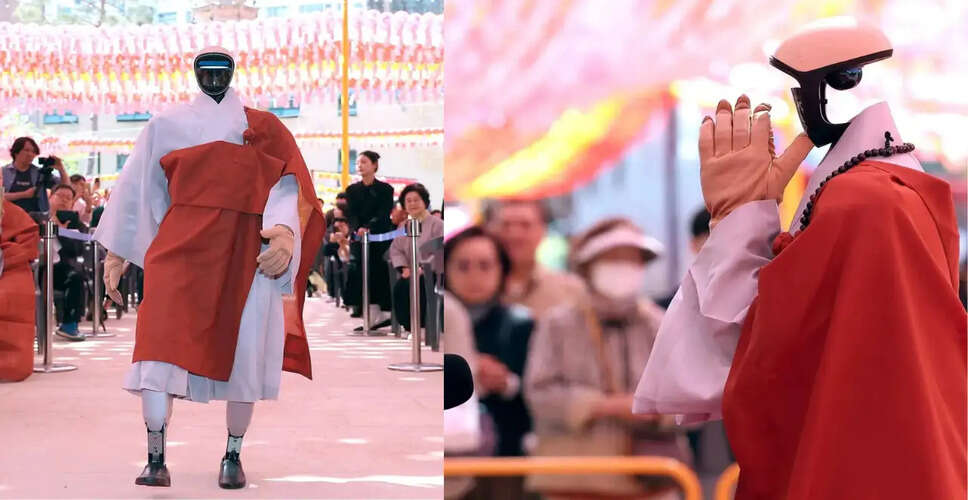
In a remarkable event at Seoul’s Jogyesa Temple, monks dressed in saffron robes introduced a unique new member to the Buddhist community: a humanoid robot named Gabi. Standing at just over four feet, Gabi participated in a ceremony that blended ancient traditions with modern technology. The robot bowed before senior monks, joined its mechanical hands in prayer, and officially embraced Buddhist vows, marking its status as South Korea's inaugural robot monk. This extraordinary moment quickly gained traction online, with videos showcasing Gabi engaging in sacred rituals, evoking a mix of fascination, emotion, and a hint of unease among viewers.
The Unique Initiation Ritual
The ceremony unfolded at the headquarters of the Jogye Order, the largest Buddhist sect in South Korea. Clad in traditional monk robes, Gabi underwent a Buddhist initiation ahead of the upcoming Buddha’s Birthday celebrations. Instead of the customary incense burning ritual for human initiates, monks affixed a symbolic lantern sticker to the robot’s arm and adorned it with a string of 108 Buddhist prayer beads around its neck.
Additionally, Gabi received its own set of Buddhist precepts.
Adapting Buddhist Principles for AI
The AI Age Monks
Given Gabi's unique nature, the traditional vows were adapted for the age of artificial intelligence. The robot pledged not to harm living beings, damage other robots or objects, act deceptively, or show disrespect to humans. One vow that particularly caught public attention was Gabi's promise 'not to overcharge,' a humorous yet meaningful commitment rooted in the Buddhist principle of moderation and balance.
Venerable Sungwon, a monk involved in the project, shared that the initiative began as a lighthearted idea but evolved into a significant endeavor. The Jogye Order recognizes that robots and AI are becoming integral to daily life, and religion should acknowledge this shift.
The Challenge of Modern Buddhism
What Is Hip Buddhism?
The introduction of Gabi highlights a broader challenge facing Buddhism in South Korea. While the religion is deeply intertwined with Korean culture and history, younger generations are increasingly distancing themselves from organized religion. Reports indicate that only a small fraction of South Koreans in their twenties identify as Buddhist, and the number of new monks has significantly decreased over the last decade. In response, Buddhist leaders are modernizing their image through initiatives dubbed 'hip Buddhism,' which includes meditation apps, social media outreach, youth-oriented events, and now, robots like Gabi to engage younger audiences.
Interestingly, this approach appears to be resonating.
Gabi's Role in the Future of Buddhism
Videos of Gabi have rapidly circulated on platforms like TikTok and Instagram, with many users describing the ceremony as 'surreal,' 'adorable,' and reminiscent of a sci-fi narrative. However, some have raised philosophical questions about whether machines can genuinely grasp spirituality, faith, or compassion. For Buddhist leaders, the focus may not be on these questions but rather on how Gabi symbolizes the evolving relationship between humanity and technology.
The monks have clarified that Gabi is not intended to replace human monks or claim spiritual enlightenment. Instead, it serves as a representation of the changing dynamics of human interaction with technology, sparking discussions about ethics, AI, and coexistence with intelligent machines.
Gabi is based on the Unitree G1 humanoid robot platform and stands approximately 130 centimeters tall. Despite the futuristic context, its capabilities remain relatively basic. Monks have noted that teaching Gabi to fold its hands in prayer was surprisingly challenging. Nevertheless, the image of a robot monk chanting prayers in one of South Korea’s most significant Buddhist temples offers a glimpse into a future that many did not anticipate arriving so soon.
Next week, Gabi is set to participate in Seoul’s grand Lotus Lantern Festival parade alongside three other robots with Buddhist names, merging ancient faith with artificial intelligence in a way that feels increasingly like reality.