
Rabindranath Tagore's Cultural Journey in Iran: A Historical Connection
Tagore's First Encounter with Persia
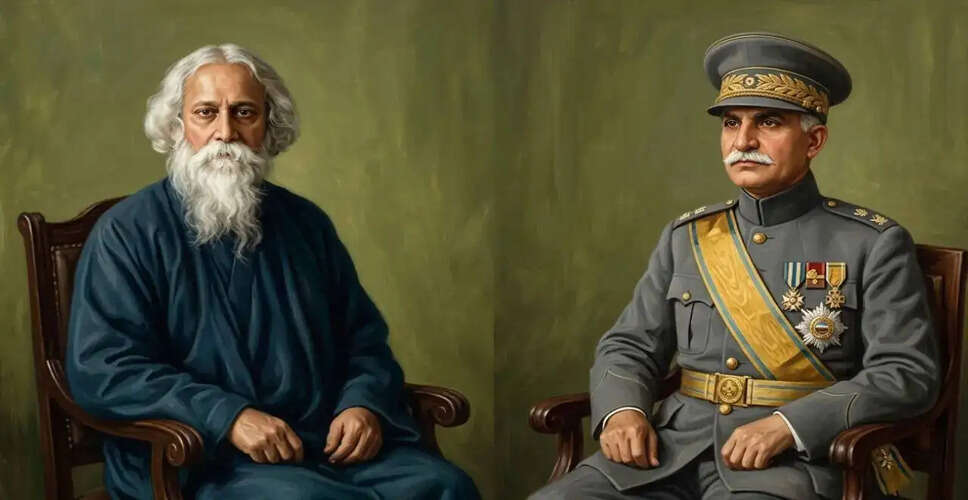
Rabindranath Tagore's inaugural visit to Persia, now known as Iran, took place in 1932, following an invitation from Reza Shah Pahlavi, the Shah of Iran. However, Tagore's bond with Iran dates back to his childhood, influenced by his father, Debendranath Tagore, who had a deep appreciation for the 14th-century Persian poet Hafez. During his stay in Esfahan, Tagore reminisced about his father's evenings filled with Brahmo Sangit and Hafez's poetry. Joobin Bekhrad, writing for the British Library's Untold Lives blog, highlighted Tagore's reflections on those formative nights, stating, "I spent half the night reciting hymns and the verses of Hafez. I had my first introduction to Hafez through my father, who used to recite his verses for me. They seemed to me like a greeting from a faraway poet who was yet near to me."
In the 19th century, Persian culture significantly impacted the lives of Bengal's Hindu elites, influencing their fashion, social customs, and literary preferences. Raja Ram Mohan Roy initiated India's first Persian newspaper, Mirat-ul-Akhbar, in 1822, and published Tuhfat-ul-Muwahhidin, a monotheistic treatise, between 1803 and 1804. Tagore's fame soared after he was awarded the Nobel Prize for Literature in 1913, making him the first non-European recipient of this honor. His work captivated Iranian intellectuals, including Colonel Muhammad Taqi Khan Pessian, who translated Tagore's poetry into Persian while in Berlin from 1918 to 1920.
By 1931, Iranian publications began featuring articles about Tagore, expanding his influence and the reach of his literary contributions. His Iranian hosts promoted his work within the context of Iran's 'Pahlavi' nationalism, as noted by Pranav Gogwekar for Peepul Tree.
Tagore's invitation by the Shah in 1932 was part of a broader initiative to celebrate Iran’s cultural heritage and reestablish connections with the Persianate world, including India. His global acclaim as a Nobel laureate and his engagement with Persian literary traditions positioned him as an ideal cultural ambassador. This invitation also illustrated Iran's desire to foster intellectual exchanges with Asian thinkers during its modernization efforts, bridging the historical ties between Persian and Indian literary cultures. It provided Iranian admirers of Tagore's work an opportunity for direct interaction with the poet.
Moreover, the invitation signified Iran's defiance against British colonial rule in India at that time.
During his visit, Tagore explored the tombs of Hafez and Saadi Shirazi in Shiraz, a city renowned for its poetic heritage. This setting allowed Tagore to connect with the literary past in a profound way. He noted in his diary, "I had the distinct feeling that after a lapse of many centuries, across the span of many births and deaths … another wayfarer … had found his bond with Hafez." Reports indicate that his visit to Saadi's shrine drew large crowds, necessitating police intervention to manage the throngs. Tagore reflected in his diary, "In my country … only my relations were there to rejoice and receive me. Today, on the anniversary of my birth date, the recognition that you have given me in a foreign land has made me a truly universal man."