
Innovative Weddings in Himachal: Brothers Embrace Constitutional Values
A Unique Approach to Marriage
Munish Sood
Sirmaur: In a remarkable demonstration of social evolution from the Himachal Pradesh hills, two brothers from Kalog village in the Nainidhar panchayat of Shillai constituency have celebrated their marriages in an unconventional manner — devoid of priests, rituals, and the customary seven rounds around the sacred fire.
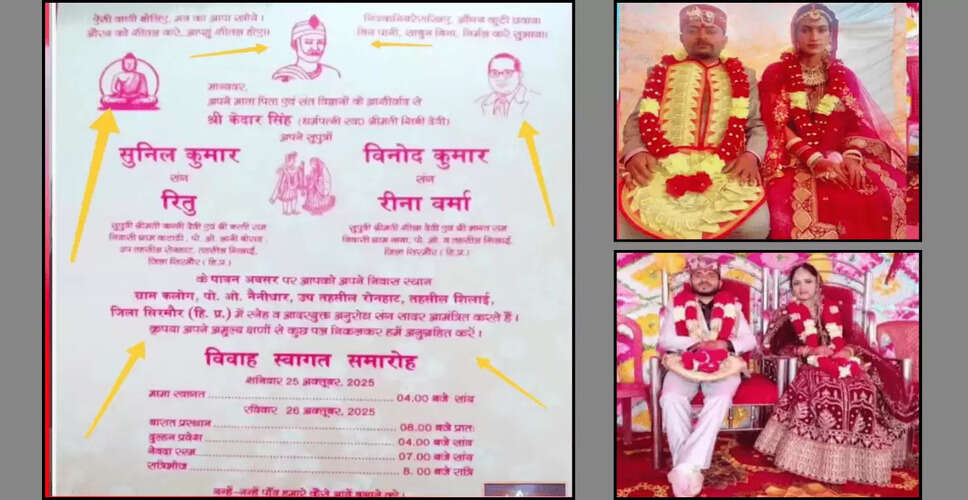
Sunil Kumar Bauddh and Vinod Kumar Azad chose the Indian Constitution as their sole witness, vowing to live together with their partners based on principles of equality, dignity, and mutual respect. The brothers expressed that they were significantly influenced by Dr. B.R. Ambedkar's philosophies, opting for what they termed a “constitutional marriage” to advocate for liberty, equality, and fraternity over traditional religious customs.
Ceremony Highlights
The two-day celebration commenced on October 25 with the traditional Mama Swagat (welcome ritual). The following day, their individual wedding processions took place — Sunil wed Ritu from Katari village, while Vinod married Reena Verma from Naya village.
The festivities included lively barats and varmala ceremonies but completely omitted any priestly rituals. Instead, both couples took an oath on the Constitution, committing to uphold the values of equality and mutual respect throughout their lives.
The wedding invitations themselves conveyed a message of reform, showcasing images of Dr. B.R. Ambedkar, Mahatma Buddha, and Saint Kabir, along with the words: “We are beginning a new chapter of life with the values of equality, liberty, and fraternity.”
Local residents gathered in large numbers to witness the ceremony, praising the brothers for their groundbreaking approach. One attendee remarked, “It’s a powerful message against unnecessary rituals and extravagant wedding culture.”
Both brothers, who are government employees, emphasized their goal of demonstrating that marriage should be based on personal choice and constitutional principles rather than rigid traditions.
A Contrast in Marital Traditions
Interestingly, just months prior, another set of brothers from the Shillai area, Pradeep Negi and Kapil Negi, gained national attention by marrying the same woman, Sunita Chauhan, in accordance with the ancient Hatti tribal custom of polyandry.
This wedding was publicly celebrated as a revival of a long-standing practice once prevalent in the Trans-Giri region of Sirmaur. The brothers viewed it as a vital aspect of their community’s heritage, a tradition believed to maintain family unity and land inheritance in the challenging mountainous terrain.
Tradition Meets Modernity
In a span of just a few months, Sirmaur district has witnessed two marriages that represent contrasting ends of the social spectrum — one reinforcing tradition, while the other redefines it.
While one pair of brothers upheld an ancient tribal custom, the other chose to let the Constitution guide their union. Together, these narratives illustrate how the hill communities of Himachal are not only preserving their cultural roots but also embracing thoughtful change — balancing the weight of tradition with the ideals of equality and contemporary values.