
Honoring Pingali Venkayya: The Unsung Hero Behind India's National Flag

A Historic Day for India
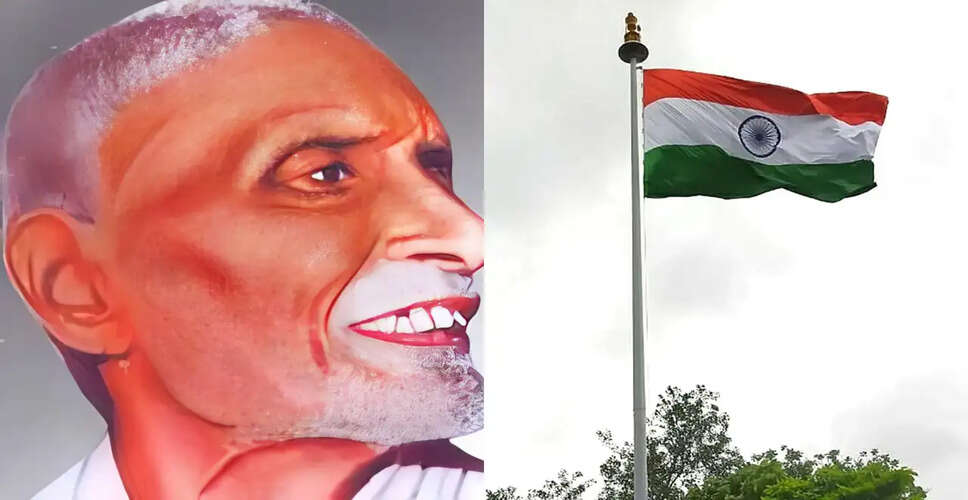
On July 22, 1947, the Constituent Assembly of India officially adopted the tricolor as the national flag, marking a significant moment in the country's history. The saffron, white, and green colors, along with the Ashoka Chakra at the center, would soon be displayed across the nation, from the Red Fort to schools and post offices. However, the designer of this emblematic flag, Pingali Venkayya, was not present during this historic event and received little recognition for his contribution. He passed away in 1963 in Vijayawada, largely forgotten, with a simple wish to be wrapped in the flag he had created for his country.
The Journey of a Soldier
The Soldier Who Wanted A Flag Of His Own
Born in 1876 near Machilipatnam in present-day Andhra Pradesh, Venkayya joined the British Indian Army at the age of nineteen. His service in the Boer War in South Africa sparked a profound question in him: Where was India's flag? It was during this time that he met Mohandas Gandhi, a meeting that would significantly influence his life.
A Multifaceted Genius
The Polymath They Called By Many Names
Venkayya was a man of many talents. He became an agriculturist, geologist, educator, and linguist, mastering languages such as Japanese, Sanskrit, and Urdu. His proficiency in Japanese earned him the nickname 'Japan Venkayya,' while his work with cotton and precious stones led to other monikers like 'Patti Venkayya' and 'Diamond Venkayya.' However, he is best remembered as 'Jhanda Venkayya,' or Flag Venkayya, due to his lifelong dedication to the flag.
The Birth of the Swaraj Flag
Three Colours On Khadi
In March 1921, during a Congress session in Vijayawada, Gandhi asked Venkayya to design a flag for the freedom movement. Venkayya, who had been contemplating this for years, presented a design featuring red and green bands representing the Hindu and Muslim communities, respectively. Gandhi suggested adding a white band for all Indians, along with a spinning wheel symbolizing self-reliance. This Swaraj flag, crafted from khadi, became the precursor to the current national flag.
Final Adjustments and Legacy
The Last Change, and The First Forgetting
As time passed, the flag's design evolved. The red was changed to saffron, and on July 22, 1947, the Constituent Assembly made a final adjustment by replacing Gandhi's charkha with the Ashoka Chakra. Despite these changes, the essence of Venkayya's original design remained intact. However, he faded from the narrative almost immediately after the flag was adopted.
A Life of Humility
An Old Man In A Small House
Venkayya lived a life of simplicity, adhering to Gandhi's teachings, which led to significant hardships in his later years. He spent his final days in obscurity in Vijayawada, while the flag he designed flew proudly over a free India. His family described him as a man forgotten by the state. Upon his death on July 4, 1963, at the age of eighty-six, he requested to be draped in the tricolor he had created.
Recognition Long Overdue
What The Country Owed Him
Although recognition for Venkayya's contributions came slowly, it eventually arrived. A memorial was established in 1992, followed by a commemorative stamp in 2009, and a radio station in Vijayawada was named in his honor. In recent years, calls for him to receive the Bharat Ratna have increased, highlighting the discomfort surrounding the delay in acknowledging his legacy. Each time the tricolor is raised, it serves as a reminder of the soldier-turned-scholar who passed away with little to his name, yet whose design has become one of the most recognized symbols worldwide.