
Homai Vyarawalla: The Trailblazing Female Photojournalist of India
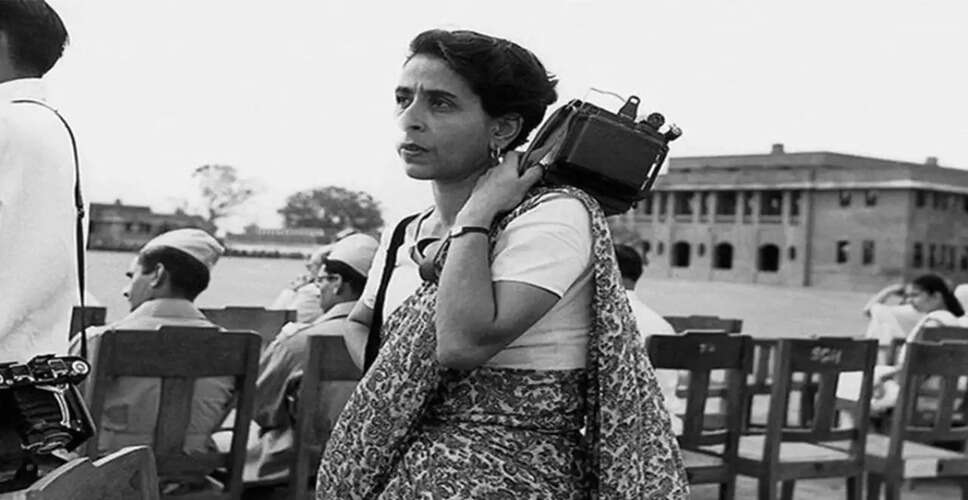
A Pioneering Spirit
Homai Vyarawalla, a petite Parsi woman, navigated the bustling streets of Delhi, her nine-kilogram Speed Graphic camera secured on her back. Surrounded by male photographers and politicians, she often went unnoticed, which she cleverly utilized to her advantage. "Women were not taken seriously," she remarked, "allowing me to capture high-quality, revealing images." As India's first female photojournalist, she operated under the radar of the country's most influential figures.
Roots in Navsari
The Girl from Navsari
Born on December 9, 1913, in Navsari, Gujarat, Homai hailed from a humble Parsi family. Her father, Dossabhai Hathiram, was an actor in a traveling theater, leading to a childhood filled with movement until they settled in Bombay. Despite financial constraints, her parents prioritized her education. Among thirty-six students, she was the only girl to complete her matriculation, often walking long distances to school due to frequent relocations. She later attended the Sir J. J. School of Art, where she honed her skills in visual composition and met her future husband, Manekshaw Vyarawalla, who introduced her to photography.
Breaking Barriers
A Sari Among Suits
In 1942, as World War II altered the global landscape, the British Information Services sought photographers in Delhi. The Vyarawallas were recommended by Stanley Jepson, editor of The Illustrated Weekly of India. Homai became a full-time photographer, often the only woman in press gatherings for the next thirty years. Dressed in a sari, she maneuvered through male-dominated crowds, earning the affectionate nickname "Mummy" from younger colleagues. Politicians often overlooked her, which worked to her advantage, as she believed that "a picture must speak for itself" and that the best images emerged when subjects were unaware of her presence.
Capturing History
Her lens documented pivotal moments in India's history, including the Allied Forces' victory parade in 1945, Lord Mountbatten's inauguration as the first Governor General of independent India, and Nehru's inaugural address as Prime Minister on August 16, 1947. She also captured Mahatma Gandhi's funeral in 1948 and India's first Republic Day parade in 1950. In 1956, she photographed the young Dalai Lama crossing into Sikkim for Life magazine, having traveled extensively to reach the location. Most of her work was published under the pseudonym "Dalda 13," a playful nod to her birth year and significant milestones in her life.
A Unique Relationship
The Prime Minister and the Photographer
Among the leaders she photographed, Jawaharlal Nehru stood out. She found him "the easiest and most natural person to photograph," and he allowed her to capture candid moments. One of her most famous images depicts Nehru lighting a cigarette for a British diplomat's wife, with a cigarette of his own hanging from his lips—an image only someone invisible could capture.
The End of an Era
The Camera Goes Silent
After Manekshaw's passing in 1969, Homai set aside her camera a year later, at the age of fifty-seven. The photography landscape was evolving, and she found the new generation's approach to be intrusive. "People changed," she reflected. "That graciousness and dignity were just not there. When that was gone, my interest in photography faded as well." She relocated to Pilani, Rajasthan, to be closer to her son, Farouq, who taught at BITS Pilani. Following his death in 1989, she moved to Vadodara, where she spent her days gardening. Her extensive collection of negatives and prints was entrusted to the Alkazi Foundation for the Arts in New Delhi.
Legacy and Recognition
In 1998, a documentary titled Three Women and a Camera revived her legacy. In 2011, at ninety-seven, she received the Padma Vibhushan, India's second-highest civilian honor, and was previously awarded the Chameli Devi Jain Award for Outstanding Women Mediaperson in 1998. Google honored her with a doodle in 2013, recognizing her as the "First Lady of the Lens." Homai Vyarawalla passed away on January 15, 2012, at the age of ninety-eight. Initially aspiring to be a doctor, she instead became a pivotal figure in documenting India's history, proving that being overlooked can be a powerful advantage.