
Historic Signing of US-Iran Agreement at Versailles: A Look Back

Significance of the Versailles Signing
In a notable event, the President of the United States, Donald Trump, signed a copy of the US-Iran agreement at the iconic Palace of Versailles in France. Following this, the signed document was sent to Iran, where it was endorsed by Iranian President Masoud Pezeshkian. The choice of Versailles for this treaty signing is significant due to its historical role as a hub for political and diplomatic negotiations. Among the many agreements finalized there, the Treaty of Versailles, signed on June 28, 1919, stands out as one of the most crucial.
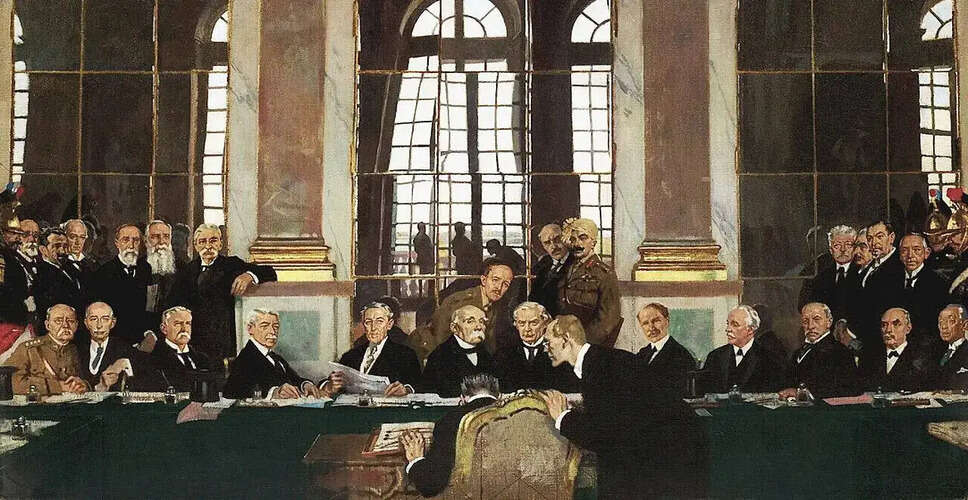
This treaty also holds particular importance for India, as one of its signatories was Sir Ganga Singh, the Maharaja of Bikaner, who was the sole Indian representative to sign the agreement. The artwork titled The Signing of Peace in the Hall of Mirrors, Versailles, 28 June 1919 features Maharaja Ganga Singh in military attire, prominently positioned near key figures such as British Prime Minister David Lloyd George and French President Georges Clemenceau, both of whom were part of the Big Four leaders at the Paris Peace Conference. The other two leaders were Woodrow Wilson, the President of the United States, and Vittorio Emanuele Orlando, the Prime Minister of Italy.
It is noteworthy that Irish artist William Orpen chose to depict an Indian Maharaja in such a significant role within the painting, which is currently housed at the Imperial War Museum in London. Orpen received £3,000 for this oil-on-canvas masterpiece.
Maharaja Ganga Singh was one of only two non-European members of the Imperial War Cabinet, making his presence at the Treaty of Versailles particularly noteworthy. According to Heritage Lab, "As a signatory of the Treaty of Versailles (and other peace treaties), India became a founding member of the League of Nations – the only colony to do so."
The Maharaja ascended to power at the young age of 18. His biography recounts that he addressed the gathered dignitaries with sincerity, stating, "I want you to understand that I am saying what I really mean in this speech and not what I have been told by other people to say." Bikaner, one of the 565 princely states in India, was not the most powerful and often faced famine. However, Maharaja Ganga Singh's reign was marked by progressive reforms. He initiated the construction of the Ganga Canal, addressed the severe famine of 1899–1900, established Sri Ganganagar, which became a fertile agricultural region, and introduced electricity and railways to the state, among other significant advancements. Additionally, he founded the Ganga Risala, or the Bikaner Camel Corps, in 1889, which served in various conflicts, including the Boxer Rebellion in China and both World Wars, contributing to his international recognition.