
Exploring the Legacy of Maharaja Jai Singh Prabhakar: A Historical Portrait

A Glimpse into History
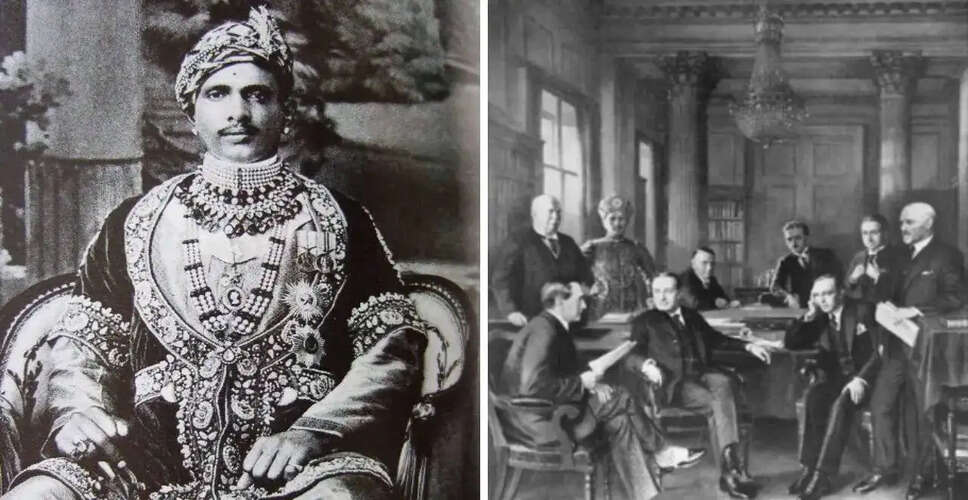
A remarkable painting from 1923, created by the renowned portrait artist Douglas Chandor, features nine distinguished gentlemen gathered in a conference room. Among them is Maharaja Jai Singh Prabhakar (14 June 1882 – 19 May 1937), who ruled the former princely state of Alwar. This artwork, titled Prime Ministers of the Imperial Conference, is an oil on canvas that captures the leaders who attended the Imperial Conference held at 10 Downing Street, London, in 1923. The painting was also showcased at the British Empire Exhibition in 1924.
Ascending to the throne at just nine years old, Maharaja Jai Singh Prabhakar was a gifted orator chosen to represent India at the 1923 conference. The painting illustrates the attendees, including notable figures such as Stanley Bruce from Australia, Stanley Baldwin from the UK, Mackenzie King from Canada, William Massey from New Zealand, Tej Bahadur Sapru and Maharaja Jai Singh Prabhakar from India, W. T. Cosgrave of Ireland, W. R. Warren of Newfoundland, and General Smuts from South Africa.
Often regarded as one of the more enigmatic personalities in Indian history, the Maharaja received his education at Mayo College in Ajmer. He took immense pride in his infantry regiments, even sending them to China during the Boxer Rebellion, where they played a role in the relief of Peking (now Beijing) in 1900. His military contributions during the European War earned him the G.C.I.E. in 1919, as noted by the Malaya Tribune on 21 May 1937. He was honored by Lord Curzon in 1903, albeit with certain limitations on his authority.
Known for his striking appearance and charisma, the Maharaja commanded attention wherever he went. However, he was also deeply superstitious, frequently consulting his astrologer before making decisions. The Malaya Tribune described him as a man of contrasting moods, capable of engaging in both religious fervor and extravagant indulgence within the same day. He was known to participate in religious processions in his capital, walking barefoot with ashes on his head, only to host lavish celebrations in his palace later that evening.