
Exploring the Enduring Cultural Ties Between India and Iran
Historical Connections Between India and Iran
The relationship between India and Iran has a rich history that spans centuries, characterized by trade and cultural exchanges. This interaction has significantly influenced various aspects of culture, literature, architecture, and religion across both regions. The Persian Plateau, which encompasses parts of Central Asia, South Asia, and the Caucasus, has historically served as a bridge between these two areas. As noted in the Scholarly Community Encyclopedia, this region is situated between significant geographical landmarks, including the Zagros Mountains and the Caspian Sea, and has been a melting pot of cultures.
Trade, migration, and intellectual exchanges have fostered the development of what is referred to as the 'Indo-Iranian' cultural sphere. In India, Persian was not merely a foreign language; it was integral to governance and high culture. Richard M. Eaton, in his work 'India in the Persianate Age, 1000–1765', highlights that Persian was the dominant language for administration and culture in northern India, particularly during the Delhi Sultanate and Mughal empires.
Under Islamic rule, Persian became the primary language of administration and culture, especially in the Mughal courts. However, this changed in 1837 when the British East India Company replaced Persian with English and local languages, marking the end of its long-standing use in the region.
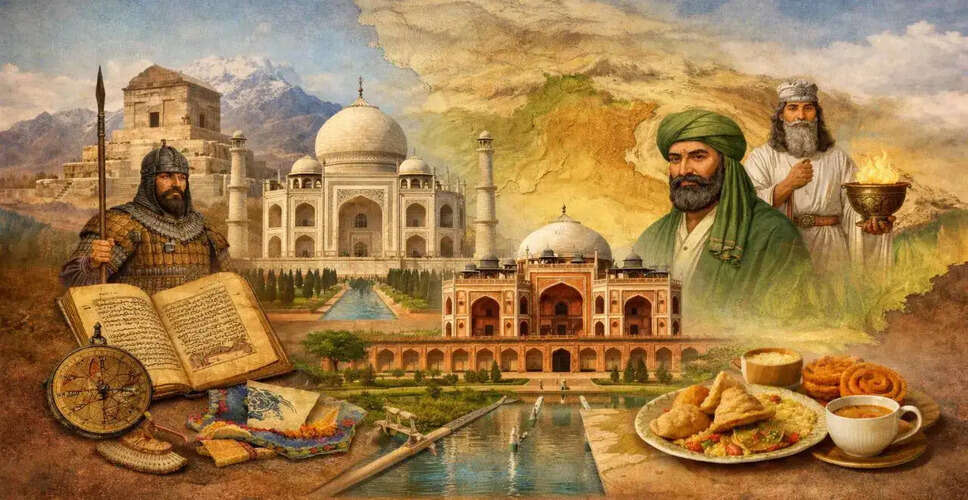
Architectural marvels like Humayun's Tomb in Delhi showcase Persian influences, featuring grand domes and intricate geometric designs. The Taj Mahal, built by Mughal emperor Shah Jahan in 1632, is another prime example, blending Persian design elements with Mughal architecture. The Persian garden style, known for its symmetrical layouts and water features, inspired the iconic 'charbagh' gardens found in royal complexes and mausoleums.
Historian Anirudh Kanisetti describes figures like Mahmud Gawan, who brought a sophisticated Persianate governance model to India in the 15th century. Gawan, initially a horse trader, became a key figure in the Bahmani Sultanate, implementing a structured provincial system and introducing advanced military techniques.
Additionally, the Qanat water system, introduced by Iranian immigrants during the 14th to 17th centuries, showcases the technological exchanges between the two cultures. The Parsi community, followers of Zoroastrianism, migrated to India to escape religious persecution in Iran, settling primarily in Gujarat and contributing significantly to India's modern landscape, including the establishment of the Tata conglomerate.
The culinary influence of Persia on Indian cuisine is notable, with dishes like biryani evolving from Persian pilau and the samosa tracing its roots back to the Persian sambusak. Other culinary contributions include jalebi, derived from Persian zalabia, and Irani chai, a tea variant developed by Zoroastrian Iranians in India during the late 19th and early 20th centuries.