
Exploring the Artistic Legacy of Henri Matisse and His Masterpiece Chapel
Henri Matisse: A Luminary in Visual Art
Henri Matisse, a pivotal figure in the realm of visual arts, is often mentioned alongside contemporaries like Pablo Picasso. The French artist is celebrated for his innovative use of color, form, and line, crafting images that conceal intricate narratives and techniques. His most significant works are displayed in prestigious institutions worldwide, including the Musée Matisse de Nice, Centre Pompidou in Paris, Museum of Modern Art (MoMA) in New York City, the Barnes Foundation in Philadelphia, Russia’s Hermitage Museum, and the National Gallery of Art in Washington D.C.
However, his most cherished creation is the Chapelle du Rosaire de Vence, which adds a surreal touch to the already stunning landscape of the French commune.
A Personal Journey to Creation
A request honoured
The Chapelle du Rosaire de Vence, dedicated to the Dominican Order, was a deeply personal project for Matisse, inspired by a transformative friendship. After undergoing cancer surgery in 1942, he formed a bond with Monique Bourgeois, the nurse who cared for him. Years later, after she joined the Dominican Order as Sister Jacques-Marie, she approached Matisse with the idea of designing the chapel. Interestingly, Matisse was not particularly religious, yet he channeled his life experiences into creating a space of profound significance for the Dominican community and future generations.
The Masterpiece Chapel
Matisse's proudest work
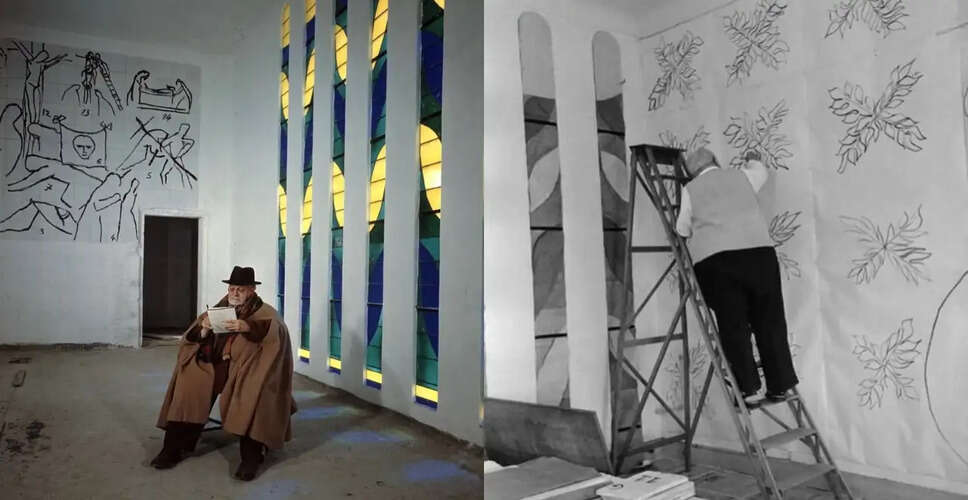
Diagnosed with abdominal cancer in 1941, Matisse's surgery left him largely confined to a wheelchair or bed. Despite this physical limitation, his creative spirit remained unyielding. With the assistance of an aide, he began to explore decoupage, a technique involving gouache-painted paper cutouts arranged into vibrant compositions. This method became instrumental in designing the Chapelle du Rosaire de Vence, which he began conceptualizing in 1948. The chapel's design was revolutionary for its time, featuring white tiles adorned with bold black lines that suggested figures and subtle religious themes. The stained glass windows, in hues of blue, green, and yellow, allowed sunlight to filter through, creating an atmosphere that mirrored the fluidity of Matisse's artistic style.
Matisse's distinctive approach was characterized by a rejection of visual depth, focusing instead on achieving a two-dimensional fluidity. The Chapelle du Rosaire de Vence stands as a testament to his artistic mastery, showcasing a seemingly spontaneous yet meticulously controlled creation process.