
Exploring India's Dinosaur Heritage: Aaliya Sultana Babi's Journey
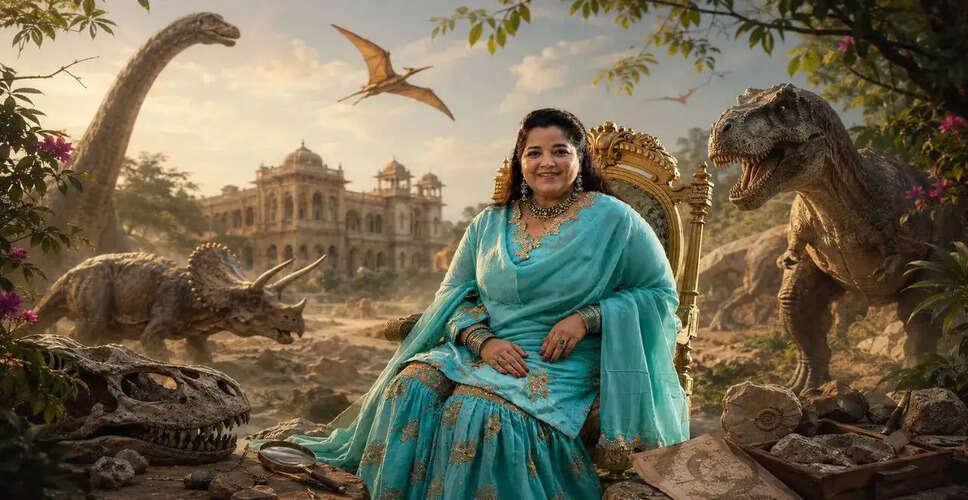

Aaliya Sultana Babi: The Dinosaur Advocate
Aaliya Sultana Babi affectionately refers to the Indian dinosaurs as the 'Gujju dinosaurs.' She highlights two notable species: Rajasaurus narmadensis, a carnivorous dinosaur distinguished by its crown-like horn, and Rahiolisaurus gujaratensis, named after the village of Raiyoli in Gujarat. This area, once relatively unknown, is now celebrated as one of the largest dinosaur hatcheries globally, with over 10,000 dinosaur eggs and fossilized remains discovered. For more than thirty years, Aaliya has dedicated herself to raising awareness about this site and India's ancient history, earning her the nicknames 'Dinosaur Princess' and 'Doctor Dino' among visitors. She notes, 'India has so much to offer, yet many of us are unaware.' Aaliya often finds that when she asks children about their favorite dinosaur, nearly all respond with T-Rex, reflecting their limited exposure to India's own prehistoric creatures.
In Balasinor, a former princely state in Gujarat, Aaliya has devoted her life to unveiling the intertwined royal and prehistoric histories of the region. Her passion for dinosaurs ignited long before the significance of Balasinor's land was recognized. As the daughter of the late Nawab Saheb of Balasinor, she attended Sophia High School in Mount Abu, a convent school, before returning to her quiet hometown. 'When I returned, there wasn't much to do since Balasinor is quite small,' she recalls. 'We knew there was a dinosaur fossil site nearby, but it didn't pique anyone's interest.' This changed in the mid-1990s when a group of paleontologists invited her family to visit the excavation site at Raiyoli. One of the scientists casually suggested that Aaliya's mother might be standing on a dinosaur skull, prompting them to look down at the rocks.
Initially unable to differentiate fossils from ordinary stones, Aaliya has since gained expertise over her 31 years of involvement with the site, now able to identify dinosaur bones with ease. Despite her extensive experience, she humbly refers to herself as an 'amateur paleontologist,' admitting, 'I lack a formal degree, but experience is a great teacher.' The excavation site at Raiyoli has gained international recognition, with over 10,000 dinosaur eggs discovered, representing both carnivorous and herbivorous species. Aaliya explains that this site is unique as it served as both a hatchery and a burial ground for dinosaurs. 'They laid eggs there and died there,' she states, highlighting its distinctiveness.
As interest in dinosaurs surged globally, particularly after the release of Jurassic Park, Balasinor began attracting visitors. Aaliya's family transformed their palace into a heritage hotel, leading to an influx of guests eager to explore the excavation site. 'People came in droves, expecting to see dinosaurs like in the movies, but the area lacked proper roads and infrastructure,' she notes. This realization struck her: while international tourists sought out Balasinor's prehistoric history, many Indians remained unaware of their own country's dinosaur heritage.
Raiyoli, once obscure, is now recognized in paleontological circles worldwide. Collaborative research by Texas Tech University, the Geological Survey of India, and the Indian Statistical Institute has placed Raiyoli on the global scientific map. However, for Aaliya, preserving the site transcends scientific acclaim; she believes the narrative must remain connected to the land where these dinosaurs once roamed. This conviction led to the establishment of the Dinosaur Museum at Raiyoli, which opened in phases from 2019 to 2022. The museum features galleries that explore Earth's history, Indian dinosaurs, fossilization, and prehistoric wildlife, along with engaging attractions like virtual reality experiences and animatronic dinosaurs. 'I describe it as both educational and entertaining,' Aaliya explains. 'Visitors learn about prehistoric subjects while enjoying excitement for families and children.'
The museum has positively impacted the local community, providing employment opportunities to residents of Raiyoli and nearby areas. Aaliya considers this one of the project's most significant achievements, stating, 'We have created jobs right at the villagers' doorsteps, allowing them to stay in their homes while finding work.' Aaliya also travels across India, delivering lectures on paleontology and prehistoric wildlife at schools and universities, often bringing fossils from her collection for students to examine. 'You are touching a piece of prehistoric history,' she emphasizes. Many children she encounters possess impressive knowledge of dinosaurs, fueled by media and literature, but are often surprised to learn about India's own prehistoric giants.
'There is a dinosaur named after Rabindranath Tagore - Barapasaurus tagorei,' Aaliya shares. 'People are often unaware of these facts.' Reflecting on her journey, Aaliya feels her fascination with dinosaurs was innate, as she was captivated by these creatures long before the excavation site gained recognition. 'At five years old, I was doing 'D for dinosaur' instead of 'D for dog,' and I could spell Brontosaurus and Diplodocus, much to my family's astonishment,' she recalls. Today, in Balasinor, where ancient history lies beneath farmland, her connection to dinosaurs feels destined. 'Perhaps it was my calling,' Aaliya concludes. 'Today, Aaliya and dinosaurs are synonymous.'