
Decoding the Diplomatic Handshakes: Xi Jinping, Trump, and Putin

Analyzing Diplomatic Interactions
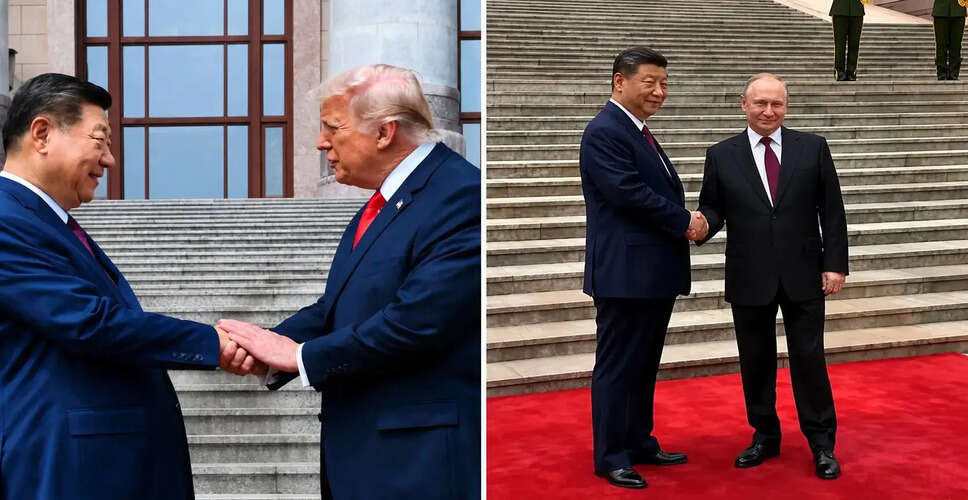
In a remarkable week, Chinese President Xi Jinping welcomed two of the globe's most influential leaders: US President Donald Trump and Russian President Vladimir Putin. While their handshakes may initially appear as typical diplomatic gestures, a closer examination reveals distinct differences in their interactions. Body language expert Kanan Tandi highlights that these differences extend beyond mere politics to psychological nuances.
Kanan notes that the contrasting styles of leadership were evident. Trump's approach was characterized by overt dominance and a performative presence, whereas Putin's demeanor reflected restraint, synchronization, and diplomatic control. Kanan meticulously analyzed various camera angles to decode these interactions, emphasizing that elements like body alignment and emotional economy provide deeper insights.
In the handshake between Putin and Xi, there was a notable absence of physical competition. Unlike Trump's assertive handshake style, which often involves aggressive pulling and pressure, the Putin-Xi greeting was marked by balance and mutual respect. Kanan observed that when powerful leaders engage in greetings, they typically exhibit forceful proximity and subtle dominance, but this interaction felt more coordinated and respectful.
Kanan also noted a significant shift in Putin's body language over the years. Previously, he exhibited a rigid posture and intense gaze, but during this meeting, he appeared more relaxed, with softer shoulder positioning and a slight forward lean, indicating respect for Chinese culture.
Conversely, Xi Jinping maintained his typical public demeanor, which may seem unusual to Western observers due to his limited eye contact. However, Kanan clarifies that this should not be misinterpreted as a lack of confidence. In many East Asian cultures, prolonged eye contact can be perceived as confrontational rather than assertive.
Interestingly, while both leaders turned towards the cameras, their feet remained oriented towards each other, signaling a cooperative rather than competitive interaction. Their movements were synchronized, with Putin nodding gently before Xi concluded the handshake, a subtle cue of mutual understanding.
Kanan emphasizes the concept of 'emotional economy,' where powerful individuals convey authority through controlled movements rather than exaggeration. This contrasts sharply with Trump's more expressive style, which often involves prolonged contact and assertive gestures. Kanan describes Trump's interactions as performative, where he seeks to assert his presence, while Putin's approach is more subdued and cooperative.
Kanan concludes that the differences in handshakes between Trump and Xi, and Putin and Xi, serve as a masterclass in contrasting leadership psychologies. Trump's style is characterized by visible energy and dominance, while Putin's is marked by restraint and strategic calmness. Xi Jinping's role in both interactions reveals his preference for internalizing authority through controlled movements, demonstrating that sometimes the most powerful messages are conveyed through subtlety.