
Yemen's Southern Transitional Council Declares Independence Amid Rising Tensions
A New Chapter for Southern Yemen
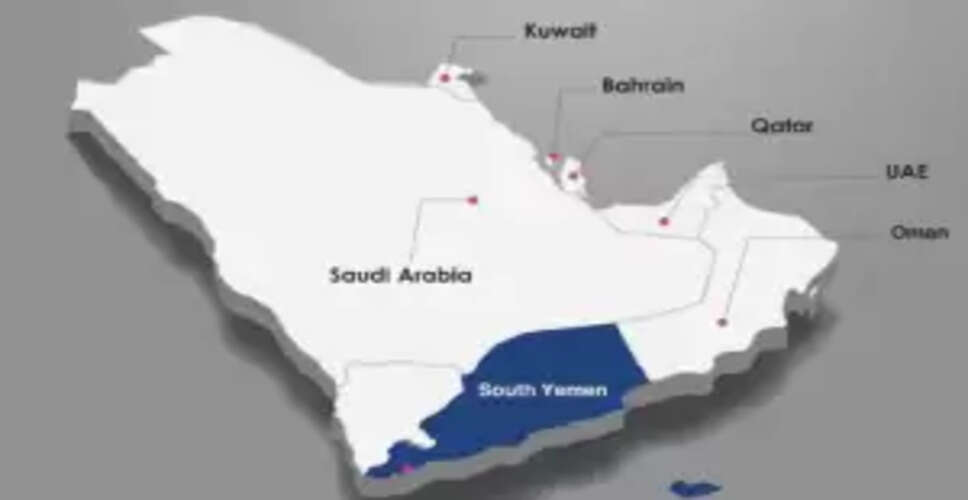
Aden: On Friday, Yemen's separatist faction unveiled a constitution aimed at establishing an independent southern state, urging other groups in the conflict-ridden nation to recognize this development. This announcement marks a significant escalation in the ongoing power struggle between Saudi Arabia and the United Arab Emirates (UAE).
The Southern Transitional Council (STC), which is supported by the UAE, framed this announcement as a declaration of independence for southern Yemen. However, the feasibility of this move remains uncertain, raising questions about its practical implications. Recently, STC-affiliated fighters took control of two southern provinces from Saudi-backed forces and occupied the Presidential Palace in Aden, prompting members of the internationally recognized government to flee to Riyadh.
In response, Saudi warplanes targeted STC-held camps and military positions in Hadramout province, as Saudi-backed fighters attempted to reclaim these facilities. This marks the latest direct intervention by Saudi Arabia, which has recently bombed STC forces and targeted what is believed to be a shipment of Emirati weapons intended for the separatists.
Meanwhile, the UAE announced on Saturday that it had completed the withdrawal of its troops from Yemen, a commitment made following the recent confrontations.
Officially, Saudi Arabia, the UAE, and their allies have been part of a coalition fighting against Iranian-backed Houthi rebels who control northern Yemen in the ongoing civil war. The coalition's stated objective has been to restore the internationally recognized government, which was ousted from the north by the Houthis. However, rising tensions among the factions and between the Gulf nations threaten to unravel the coalition, potentially leading to further conflict and exacerbating the humanitarian crisis in Yemen.
Details of the Declaration
Aidarous al-Zubaidi, the head of the STC, released a video statement on Friday announcing that the newly issued constitution would be effective for two years, after which a referendum would be held to determine the future of self-determination for the southern populace. He emphasized the need for dialogue between the northern and southern factions during this period to establish a framework that respects the rights of the southern people.
Al-Zubaidi warned that if other factions do not comply or resort to military action, 'all options remain on the table.' The 30-article constitution proclaimed the establishment of 'the State of South Arabia,' encompassing the territory of the former People's Democratic Republic of Yemen, which existed from 1967 to 1990.
This declaration represents the most explicit move by the STC towards its long-aspired goal of independence. However, the actual impact of this announcement remains unclear amidst the ongoing chaos in the south, potentially hindering efforts to prevent a full-blown conflict between the separatists and the Saudi-led coalition.
The UAE's Foreign Ministry stated that it is addressing the situation with 'restraint, coordination, and a deliberate commitment to de-escalation,' emphasizing a foreign policy focused on regional stability.
The UAE's Defence Ministry confirmed the complete withdrawal of its troops from Yemen, although it did not disclose the number of personnel or equipment involved. Recent military cargo flights have been observed moving in and out of Yemen.
Continued Fighting in Southern Yemen
The Saudi-led coalition has demanded the withdrawal of STC-affiliated Southern Shield forces from Hadramout and Mahra as part of de-escalation efforts. However, the STC has thus far refused to relinquish its weapons and camps.
Saudi-backed National Shield Forces have advanced on two STC camps in Hadramout, according to Ahmed bin Breik, a senior STC official. The separatist forces have resisted withdrawal, prompting Saudi airstrikes on the camps.
Mohamed al-Nakib, spokesperson for the STC-backed forces, reported fatalities from the strikes, although independent verification of this claim is not possible. He later indicated that 'intense clashes' erupted between STC and National Shield forces across various areas of Hadramout.
It remains uncertain whether Saudi-backed forces succeeded in retaking the camps.
Salem al-Khanbashi, the newly appointed governor of Hadramout by Yemen's internationally recognized government, stated that the operation to reclaim the camps was 'not a declaration of war' and was intended as a 'pre-emptive measure to remove weapons.'
Rising Tensions
In a post on X, Saudi ambassador to Yemen, Mohammed al-Jaber, expressed that the kingdom had made 'all efforts with STC' over the past weeks to de-escalate tensions and urged the separatists to vacate Hadramout and Mahra, only to encounter 'continued intransigence and rejection from Aidarous al-Zubaidi.'
Al-Jaber noted that the STC had prevented a Saudi delegation's aircraft from landing in Aden, despite prior agreements with some STC leaders to facilitate a resolution that serves the public interest.
Yemen's Transportation Ministry, aligned with the STC, criticized Saudi Arabia's recent imposition of inspection requirements for flights to and from Aden International Airport, which has led to the suspension of all flights from and to the UAE until these measures are revoked.