
What’s Next for the South China Sea? Global Powers Challenge China’s Claims
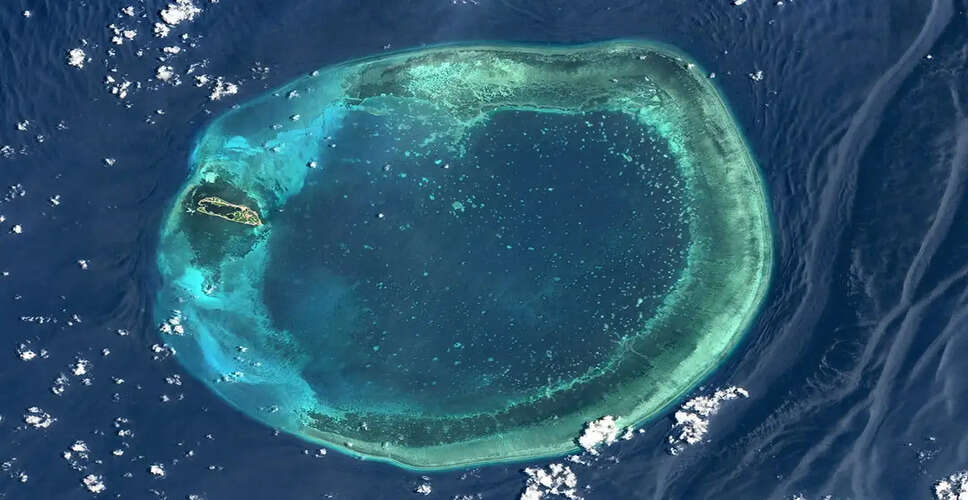

International Response to China's Claims
Manila: On Sunday, the United States, the United Kingdom, and several other Western and Asian nations reaffirmed that China's extensive claims in the South China Sea are unlawful, referencing a 2016 arbitration ruling.
A collective statement from these 14 nations condemned actions in the contested waters that could destabilize the region.
Separately, the European Union, comprising 27 nations, reiterated the significance of the 2016 ruling as a pivotal moment for resolving disputes peacefully.
This joint statement commemorated the arbitration decision made on July 12, 2016, by a tribunal in The Hague, which is recognized as final and legally binding.
In response, China declared the ruling as invalid and stated that it does not recognize its authority.
China had previously opted out of the arbitration initiated by the Philippines in 2013, following a tense standoff that resulted in Beijing taking control of a disputed shoal.
Despite the tribunal's ruling, China continues to assert its claims over nearly the entire sea passage, a crucial global trade route that is often viewed as a potential flashpoint in Asia.
The region has witnessed numerous territorial confrontations involving China, the Philippines, Vietnam, Malaysia, Brunei, and Taiwan.
The US-led statement emphasized that there is no legal foundation for China's broad maritime claims in the South China Sea, particularly those based on 'historic rights.'
The tribunal's decision favored the Philippines, indicating that under the UN Convention on the Law of the Sea, China lacks legal grounds to assert historic rights to resources beyond its recognized territorial areas.
This convention, which governs the world's oceans and seas, has been ratified by over 170 countries, including both China and the Philippines.
Alongside the US and UK, the nations that joined the statement included the Philippines, Japan, Australia, New Zealand, Canada, Germany, Italy, Estonia, Latvia, Lithuania, Romania, and Slovenia.
The nations reiterated their strong opposition to any destabilizing actions, including those involving force or coercion, that threaten regional peace and stability.
They condemned the use of coast guard, military, and maritime militia forces to intimidate or obstruct lawful operations by other states at sea or in the air, which endangers personnel and fishermen and undermines regional security.
The countries stressed the importance of upholding freedom of navigation and overflight, as well as other lawful uses of the sea as outlined in UNCLOS, advocating for peaceful resolutions to territorial disputes based on the 1982 UN Convention.
In Beijing, the Ministry of Foreign Affairs criticized the arbitration tribunal and its ruling, claiming they violate international arbitration norms and infringe upon China's sovereign rights.
China firmly opposes any claims or actions based on these awards and rejects any third-party dispute resolution mechanisms imposed upon it.
In recent years, territorial confrontations in the disputed waters have intensified, particularly between Chinese and Philippine and Vietnamese forces.
Chinese coast guard vessels have employed powerful water cannons, military-grade lasers, and aggressive maneuvers against Philippine forces and fishermen from rival nations, resulting in dangerous encounters at sea and in the air.
The United States has consistently urged China to adhere to the arbitration ruling.
Both the previous Biden administration and the current Trump administration have warned that the US is committed to defending the Philippines, its oldest treaty ally in Asia, should Filipino forces, vessels, or aircraft face armed attacks in these disputed waters.