
What’s Next for Iran After Latest Airstrikes on Natanz Nuclear Facility?
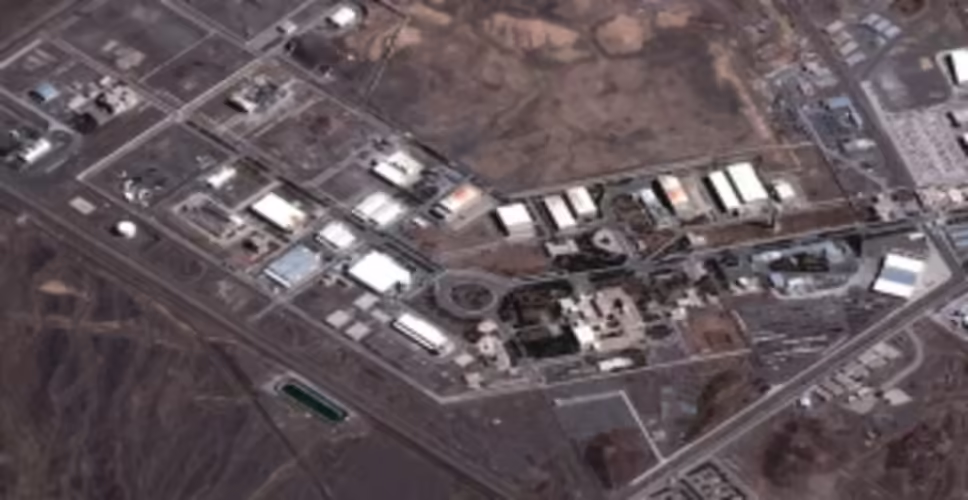
Airstrike Hits Iran's Natanz Nuclear Facility Amid Ongoing Conflict
According to reports from the official Iranian news agency Mizan, an airstrike targeted Iran's Natanz nuclear enrichment facility on Saturday. Fortunately, there were no reports of radiation leaks as the conflict in the Middle East continues into its fourth week.
Natanz, which serves as Iran's primary enrichment site, was previously struck during the initial week of the ongoing war, resulting in visible damage to several structures, as indicated by satellite imagery. The United Nations' nuclear oversight body had previously stated that the earlier attack would not have any radiological consequences.
Located approximately 220 kilometers (135 miles) southeast of Tehran, the facility has been a target of Israeli airstrikes during the 12-day conflict between Iran and Israel in June 2025, as well as attacks from the United States.
This latest strike occurred shortly after U.S. President Donald Trump hinted at a potential reduction of military operations in the Middle East, despite the U.S. deploying three additional amphibious assault ships and around 2,500 Marines to the area.
Trump's social media post came in the wake of an Iranian warning to target recreational and tourist locations globally, alongside ongoing airstrikes, drone, and missile attacks that have engulfed the region.
The mixed signals from the U.S. followed a spike in oil prices that negatively impacted the stock market, coinciding with an announcement from the Trump administration to lift sanctions on Iranian oil already aboard ships, a move aimed at addressing soaring fuel costs.
As the conflict persists, Israel reported that Iran continued to launch missiles at its territory early Saturday, while Saudi Arabia claimed to have intercepted 20 drones within hours in its eastern region, which houses significant oil facilities.
The attacks coincided with Israeli airstrikes in Tehran, occurring as Iranians marked the Persian New Year, Nowruz, a holiday typically filled with celebration that has been overshadowed by the ongoing war.
Trump Claims U.S. Nears Completion of Objectives
The U.S. and Israel have provided varying justifications for the conflict, ranging from aspirations to incite a revolution against Iran's leadership to dismantling its nuclear and missile capabilities. However, there are no visible signs of such an uprising, and the war shows no signs of resolution.
On social media, Trump stated, "We are getting very close to meeting our objectives as we consider winding down our great Military efforts in the Middle East." This statement appears contradictory to his administration's decision to enhance military presence in the region and request an additional USD 200 billion from Congress to support the war.
The U.S. is sending three more amphibious assault ships and approximately 2,500 additional Marines to the Middle East, as confirmed by an official. Two other U.S. officials corroborated the deployment of ships without disclosing their destination. All three officials spoke on the condition of anonymity due to the sensitive nature of military operations.
Recently, the U.S. redirected another group of amphibious assault ships carrying an additional 2,500 Marines from the Pacific to the Middle East, joining over 50,000 U.S. troops already stationed in the region.
While Trump has stated he does not intend to deploy ground forces into Iran, he maintains that all options remain on the table.
Iran Issues Warnings of Global Attacks
Iran's chief military spokesperson, Gen. Abolfazl Shekarchi, issued a warning on Friday that "parks, recreational areas, and tourist destinations" worldwide could be unsafe for the nation's adversaries. This threat raises concerns that Tehran may resort to militant actions beyond the Middle East as a means of exerting pressure.
Supreme Leader Ayatollah Mojtaba Khamenei commended the resilience of Iranians amid the conflict in a statement broadcast on Iranian television to commemorate Nowruz. Khamenei has not made a public appearance since he assumed leadership following Israeli strikes that resulted in the death of his father, Ayatollah Ali Khamenei, and reportedly injured him.
With limited information emerging from Iran, it remains unclear how much damage has been inflicted on its military, nuclear, or energy facilities due to the relentless U.S. and Israeli strikes that commenced on February 28. The true leadership of the country also remains uncertain. Nevertheless, Iran's actions continue to disrupt oil supplies and escalate food and fuel prices well beyond the Middle East.
Israel Intensifies Strikes Against Hezbollah
The Israeli military announced early Saturday that it had initiated a series of strikes targeting Iran-aligned Hezbollah militants in the southern suburbs of Beirut.
Witnesses reported seeing smoke rising, fires igniting, and loud explosions resonating throughout parts of central Beirut, shortly after the Israeli army issued evacuation warnings for seven neighborhoods.
Israeli strikes aimed at Hezbollah in Lebanon have resulted in over 1,000 fatalities and displaced more than 1 million individuals, according to the Lebanese government.
In Iran, more than 1,300 people have died during the conflict. In Israel, 15 individuals have lost their lives due to Iranian missile attacks, with four additional casualties reported in the occupied West Bank. At least 13 U.S. military personnel have also been killed.
U.S. Suspends Sanctions on Iranian Oil
Brent crude oil prices have surged amid the ongoing conflict, reaching approximately USD 106 per barrel, a significant increase from around USD 70 prior to the war.
The recently announced U.S. suspension of sanctions pertains to Iranian oil loaded onto ships as of Friday and is scheduled to conclude on April 19.
This new measure does not enhance production flow, a key factor contributing to rising prices. Iran has successfully evaded U.S. sanctions for years, indicating that much of its exports likely reach buyers.
In an effort to increase global oil supplies during the Iran conflict, the Trump administration previously paused sanctions on certain Russian oil shipments for 30 days, a move criticized for benefiting Moscow while having a minimal impact on markets.