
What Sparked the US and Israel's Bold Military Action Against Iran?
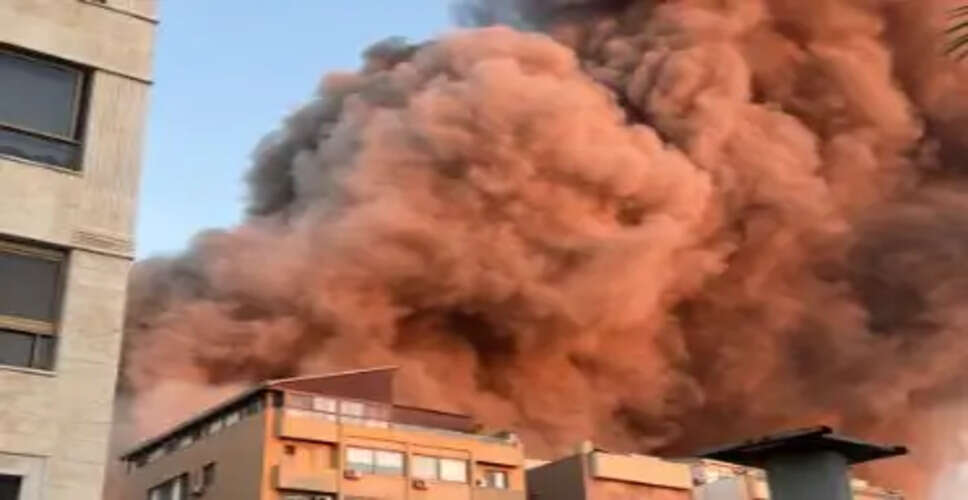
Major Military Operations Unfold
Dubai: A significant military offensive was initiated by the United States and Israel against Iran on Saturday. President Donald Trump urged the Iranian populace to "take charge of your future" and challenge the Islamic regime that has governed since 1979.
Initial strikes targeted locations near the residence of Supreme Leader Ayatollah Ali Khamenei, with reports of explosions across the nation, including visible smoke from Tehran.
"When this is over, take control of your government. This may be your only opportunity for generations," Trump stated in a video announcing the commencement of "major combat operations." He emphasized that for years, the Iranian people had sought assistance from America but had not received it.
Israeli Prime Minister Benjamin Netanyahu supported this vision, asserting, "Our collaborative effort will enable the courageous Iranian citizens to determine their own destiny."
This military action marks a dramatic escalation in US involvement in Iran, being the second instance in eight months where the Trump administration has resorted to military force against the Islamic Republic. The strikes followed a period of heightened tensions, with American naval forces moving into the area, as Trump sought a deal to limit Iran's nuclear ambitions amidst rising domestic unrest in Iran.
In retaliation, Iran launched missiles and drones aimed at Israel, followed by attacks on US military bases in Bahrain, Kuwait, and Qatar. An Iranian missile strike in the UAE resulted in one fatality, prompting the UAE and Iraq to close their airspace.
Iran's Foreign Ministry issued a resolute statement, declaring that the nation "will not hesitate" to respond. The ministry's statement on social media declared, "It is time to defend our homeland and confront the enemy's military aggression."
The airstrikes resulted in the deaths of five students at a girls' school, marking the first confirmed casualties in Iran during this operation, according to state-run IRNA news agency. This incident occurred in Minab, a city in southern Iran where the Revolutionary Guard maintains a base.
'Major Combat Operations'
In justifying the military action, Trump asserted that Iran has persisted in advancing its nuclear program and intends to develop missiles capable of reaching the US.
He acknowledged the possibility of American casualties, stating, "That often occurs in warfare." This was a notable statement from a US leader who campaigned on an "America First" agenda, promising to avoid prolonged military engagements that had entangled his predecessors.
Trump's remarks suggested that the US was acting for reasons extending beyond the nuclear issue, citing grievances dating back to the establishment of the Islamic Republic after the 1979 revolution, which transformed Iran from a close ally of the US into a staunch adversary.
The US president expressed intentions to "destroy" the Iranian navy and eliminate regional proxies supported by Tehran.
He also urged members of the Iranian Revolutionary Guard to disarm, offering immunity while warning of "certain death" for those who resist.
"They have dismissed every chance to abandon their nuclear aspirations, and we can no longer tolerate it," Trump stated.
Iran has claimed it has not enriched uranium since June but has barred international inspectors from accessing the sites targeted during a previous 12-day conflict. Satellite imagery analyzed by news agencies indicates renewed activity at two of those locations, suggesting Iran is attempting to evaluate and possibly recover materials.
Currently, Iran has self-imposed restrictions on its ballistic missile program, limiting their range to 2,000 kilometers (1,240 miles), which encompasses all of the Middle East and parts of Eastern Europe. There is no public evidence indicating Iran's pursuit of intercontinental ballistic missiles, although Washington has criticized its space program as potentially facilitating such ambitions.
Iran aimed to prevent war but insists on its right to enrich uranium and is unwilling to negotiate other matters, such as its long-range missile program or support for militant groups like Hamas and Hezbollah.
Strikes Across Iran
Reports from Iranian media indicated that strikes occurred nationwide. Authorities closed roads leading to Khamenei's compound in central Tehran as additional explosions were reported throughout the capital.
Witnesses in Tehran heard the initial explosion near Khamenei's office, with state television later confirming the blast without providing a cause.
Further explosions were reported in Tehran after Israel announced its attacks.
The Israeli operation targeted Iran's military assets, government symbols, and intelligence facilities, according to an official familiar with the operation, who spoke on the condition of anonymity.
Iran's Retaliation
Shortly after the strikes, Iran's Revolutionary Guard announced it had launched a "first wave" of drones and missiles aimed at Israel, prompting a nationwide alert as the military worked to intercept incoming Iranian missiles.
In Bahrain, a missile attack targeted the US Navy's 5th Fleet headquarters. Witnesses reported hearing sirens and explosions in Kuwait, where US Army Central is stationed. Explosions were also audible in Qatar.
Iraq and the UAE closed their airspace, and sirens were activated in Jordan.
The Iranian-backed Houthis in Yemen declared their intention to resume attacks on shipping routes in the Red Sea and on Israel, according to two senior Houthi officials who spoke anonymously due to the absence of an official announcement from Houthi leadership.
US embassies and consulates in Qatar, the UAE, and Israel advised their personnel to shelter in place and recommended that all Americans do the same until further notice.