
What Led to Venezuelan Leader Maduro's Arrest in New York?
Maduro's Capture and Imprisonment
In a dramatic turn of events, Venezuelan President Nicolas Maduro has found himself imprisoned in a federal facility in New York after being apprehended by U.S. forces at a military base in Venezuela. This capture occurred while he was reportedly mocking former President Donald Trump.
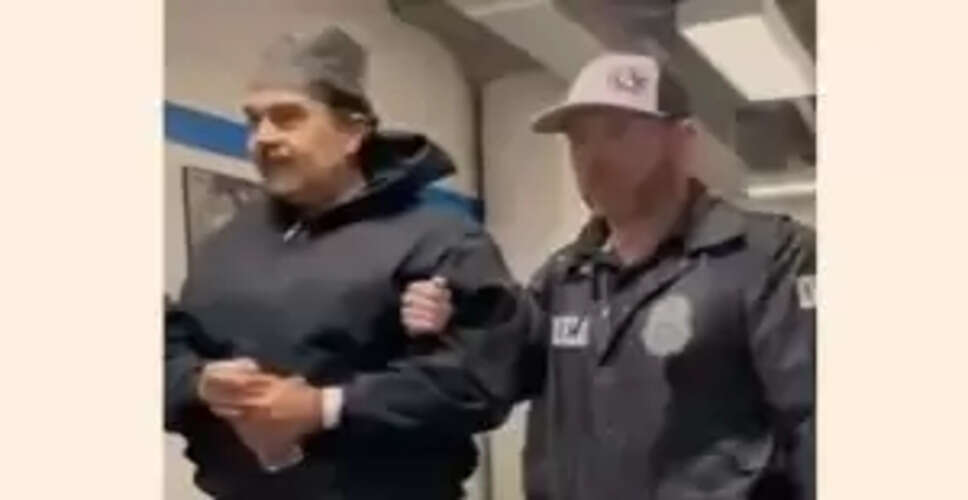
As he was brought into the Drug Enforcement Administration (DEA) office on Saturday night, Maduro, wearing a brown uniform and handcuffed, sarcastically greeted the camera with a 'Good night. Happy New Year.'
Once a dominant figure in Venezuela, Maduro was seen in a video released by the White House, visibly restrained and holding a water bottle, flanked by two DEA agents.
Maduro and his spouse, Cilia Flores, were captured during a raid early Saturday and transported to Stewart Air National Guard Base, approximately 100 kilometers from New York City, before being flown to a heliport in Manhattan.
Due to the serious narco-terrorism allegations against them, their first stop was the DEA office, followed by their transfer to the Metropolitan Detention Centre (MDC) in Brooklyn, where they await their court appearance scheduled for Monday.
A crowd gathered outside the jail, expressing their disdain with jeers and insults.
Maduro, who had a $50 million bounty on his head, was taken from the Venezuelan military base, Fuerte Tiuna, to the USS Iwo Jima, part of the naval fleet surrounding Venezuela, before being flown to the U.S. air base.
Attorney General Pam Bondi announced charges against Maduro and Flores, including narco-terrorism, conspiracy to import cocaine, and illegal possession of firearms.
An indictment from 2020 also accused them of leading the drug trafficking organization known as Cartel de los Soles.
Trump hinted at the possibility of moving the trial to Miami, home to a significant population of Venezuelan exiles, and the news of Maduro's arrest was met with celebration.
He stated, 'A decision will be made, I assume, between New York and Miami or (elsewhere) Florida.'
The MDC, notorious for its harsh conditions, has previously housed high-profile criminals, including terrorists and drug lords.
Maduro's fellow inmates include Luigi Mangione, currently on trial for murder, who has gained a reputation as a folk hero.
The jail's overcrowded conditions have been criticized, with a federal judge in 2024 citing 'exceptional reasons' against remanding individuals there.
Trump has portrayed Maduro's capture as part of a broader anti-drug initiative, attempting to frame it as a standard law enforcement action while bypassing international laws regarding national sovereignty.
Currently, Maduro's Vice President, Delcy Rodriguez, remains in her position, with Trump suggesting she is committed to restoring Venezuela's greatness.
Rodriguez, however, vehemently condemned the U.S. actions, claiming they aim to seize Venezuela's natural resources, asserting, 'There is only one president in this country, and his name is Nicolas Maduro.'
Secretary of State Marco Rubio commented on Rodriguez and the interim administration, stating, 'We’re going to make decisions based on their actions and their deeds in the days and weeks to come.'
Trump has also indicated intentions to 'run the country right,' likely referring to Venezuela's oil wealth, accusing Caracas of 'stealing' U.S. assets due to its nationalization of American oil investments.
He has assured that there will be no ground troops in Venezuela, without clarifying how the U.S. plans to 'run' the country.
Opposition leader Maria Corina Machado, who received last year's Nobel Peace Prize, has also claimed the presidency for Edmundo Gonzalez, who opposed Maduro in the 2024 elections, deemed rigged by the U.S. and international observers.
Gonzalez was the opposition candidate after Maduro barred Machado from running.
While Trump has supported claims of a rigged election and recognized Gonzalez as the legitimate winner, he has remained silent on the matter.
The Justice Department's charging document states that Maduro and his associates have operated a drug trafficking network for 25 years, presiding over a corrupt government that has exploited its power to facilitate illegal activities.
The charges also implicate leaders of Tren de Aragua, a violent Venezuelan gang that has expanded into the U.S. during Biden's presidency, along with Colombian terrorist groups FARC and ELN, and Mexican drug cartels Sinaloa and Zeta, accusing Maduro and his associates of collaborating with these organizations.