
What Happened in the Strait of Hormuz? A Container Ship Runs Aground Amid Tensions
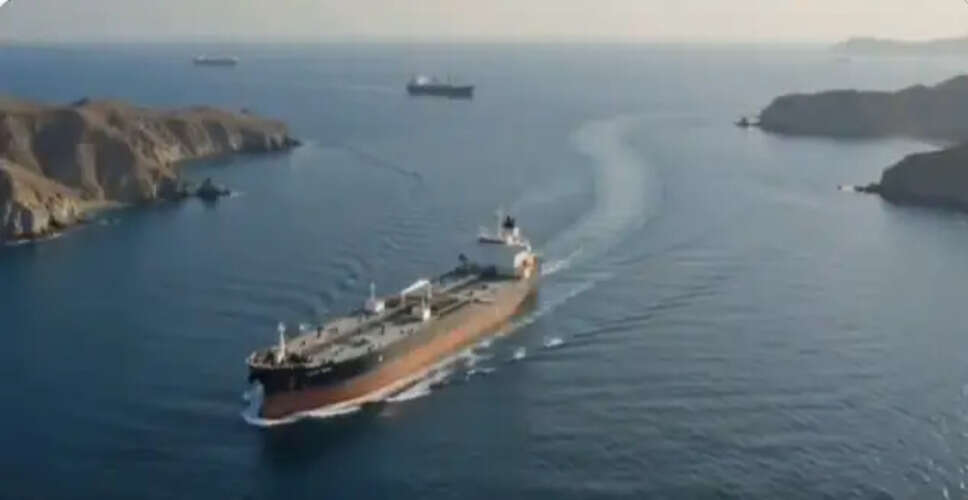

Incident in the Strait of Hormuz
Dubai: A foreign container ship has reportedly run aground in the Strait of Hormuz after deviating from the route sanctioned by Iran, according to Iranian state television on Wednesday. The report did not provide further details about the vessel.
This announcement seems to reinforce Tehran's longstanding claims regarding its authority over the strait, which is recognized globally as an international waterway and is crucial for the passage of a significant portion of the world's oil and natural gas during peacetime.
The timing of this incident coincides with the presence of U.S. Middle East envoy Steve Witkoff and Jared Kushner, son-in-law of former President Donald Trump, who are currently in Doha, Qatar, to discuss a potential resolution to the ongoing conflict with Iran.
Diplomatic discussions commenced in Qatar on Wednesday, as revealed by two regional officials who requested anonymity due to the confidential nature of the talks. The aim is to finalize details that would enable top leaders to reach an agreement, although significant disagreements regarding the strait and Lebanon remain.
Iran has not publicly acknowledged the initiation of these negotiations.
Strait of Hormuz: A Central Issue in Ongoing Talks
The Strait of Hormuz has emerged as a critical point of contention in the negotiations. Iran and the U.S. had previously agreed on a temporary arrangement allowing ships to pass without charges for 60 days. However, Iran has insisted on controlling the shipping routes and imposing fees for passage, disrupting long-standing practices in the strait. The U.S. and several Gulf Arab nations have expressed their refusal to accept these charges. Recent attempts by Oman and a UN agency to establish a new shipping route near Oman's coast have led to increased tensions, evidenced by attacks across the region over the past weekend.
According to Iranian state media, the grounded ship encountered shallow waters due to its chosen route and could not proceed. The report emphasized that shippers must adhere to the directives of Iran's paramilitary Revolutionary Guard while navigating the strait.
The Guard's naval forces have consistently warned captains and shipping companies globally that any attempts to enter or exit through unauthorized routes in the Persian Gulf could result in serious incidents. The report did not mention two vessels that Iran targeted recently for attempting to navigate the strait without permission, including one carrying crude oil from Qatar.
U.S. and Iranian Negotiators in Qatar
Witkoff and Kushner arrived in Qatar on Tuesday for discussions mediated by the Qatari government. Although Iran has claimed it would not engage in direct meetings with U.S. representatives, there remains a possibility for indirect negotiations, where messages could be relayed through Qatari officials, a method previously utilized during talks in the Trump administration.
On Wednesday morning, Qatar confirmed a meeting between the American officials and its foreign minister, Sheikh Mohammed bin Abdulrahman Al Thani. A statement from Qatar's Foreign Ministry indicated that the discussions revolved around the interim agreement and efforts to enhance regional security and stability through dialogue.
The situation in Lebanon was also a topic of discussion, as Iran has demanded an end to hostilities between the Iranian-backed militia Hezbollah and Israeli forces.
Iran has called for Israel to withdraw from the territory it occupies in southern Lebanon, while Israel maintains that it must retain control over the area to counter Hezbollah's attacks into northern Israel.
Iran has not publicly acknowledged any discussions on Wednesday. However, Iranian parliament speaker Mohammad Bagher Qalibaf, a key figure in the negotiations, stated that efforts are ongoing to achieve a permanent resolution to the conflict.
He emphasized that while dialogue is in progress, Iran is prepared for conflict if the agreed terms are not honored.
Increased Ship Movements from the Strait of Hormuz
Following the recent attacks, ship traffic in the Strait of Hormuz has decreased, yet more vessels from various countries have successfully exited the area.
Thailand's Foreign Ministry reported that 10 out of 11 Thai-flagged or chartered vessels have safely departed the Strait. Similarly, South Korean officials indicated that all but two of the 26 stranded vessels have now left the strait without incident.
Iraq Shoots Down Drone Over Baghdad
In a separate incident on Wednesday, Iraqi authorities shot down a small drone over Baghdad's heavily fortified Green Zone, which houses numerous embassies and government buildings. Two Iraqi security officials, who spoke on the condition of anonymity, reported that the drone was unarmed and likely intended for surveillance. No group has claimed responsibility for the drone.
Since the U.S. and Israel initiated their military actions against Iran in late February, Iranian-backed militias in Iraq have frequently targeted U.S. military and diplomatic sites. The downing of the drone marks the first security incident in Baghdad since the U.S. and Iran agreed to a ceasefire.