
What Awaits in Trump's Historic Visit to China? Key Talks with Xi Jinping Unveiled!
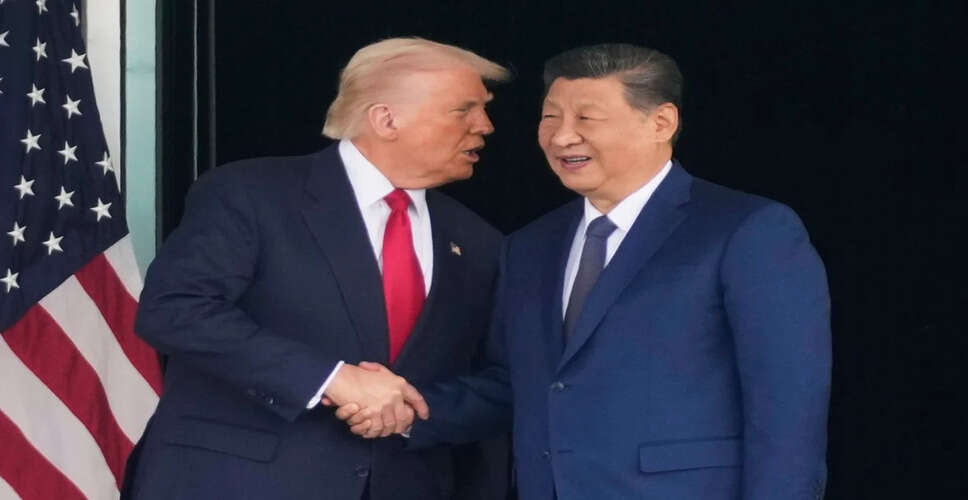

Trump's Arrival in China for Crucial Discussions
In a significant diplomatic move, US President Donald Trump landed in Beijing on Wednesday for a three-day state visit aimed at addressing various global challenges, including the ongoing conflict in Iran, alongside Chinese President Xi Jinping.
Upon his arrival, Trump was welcomed by Chinese Vice President Han Zheng at the airport, marking the beginning of their seventh in-person meeting. Their last encounter took place in October 2025 in Busan, South Korea.
This visit marks Trump's second trip to China in nine years, primarily focused on finalizing a trade agreement to resolve ongoing tariff disputes affecting over $525 billion in US exports.
Accompanied by prominent CEOs, Trump previously visited China in 2017 during his first term.
A bilateral meeting between Trump and Xi is scheduled for Thursday, as confirmed by US Principal Deputy Press Secretary Anna Kelly.
The two leaders will reconvene on Friday for a working lunch and tea, with plans for a reciprocal visit to the US later this year.
Prior to Trump's arrival, Chinese Vice-Premier He Lifeng and Scott Bessent concluded the final round of trade discussions in South Korea, although specific details remain undisclosed.
The agenda for the talks includes trade and tariffs, advancements in Artificial Intelligence and technology, the situation in Taiwan, US arms sales to Taipei, and security concerns in West Asia, particularly regarding Iran and rare earth supply chains.
Trump's itinerary also features a visit to the Temple of Heaven, a historic site where emperors prayed for bountiful harvests.
Before departing for Beijing, Trump expressed to the media that trade discussions would be a primary focus of his talks with Xi.
He aims to finalize agreements for increased purchases of American agricultural products and aircraft from China, alongside establishing a Board of Trade to address bilateral differences.
From a trade perspective, this visit is crucial for China, especially as Trump is joined by influential CEOs from major US corporations, including Tesla's Elon Musk and Apple's Tim Cook, both of whom have significant operations in China.
Apple has recently regained its leading position in China's competitive smartphone market, with a notable 28% increase in iPhone shipments as of early 2026.
In April, Tesla reported a 36% year-over-year rise in sales of its China-made vehicles, reaching 79,478 units, indicating a recovery in production.
Top US business leaders will have the opportunity to network with their Chinese counterparts at an exclusive international business club, as per Chinese officials.
The global spotlight will be on the summit, particularly regarding potential resolutions to the US-Israeli-Iran conflict and the blockade of the Strait of Hormuz.
In anticipation of Trump's visit, Iranian Foreign Minister Abbas Araghchi made his first trip to Beijing since the war, engaging in discussions with his Chinese counterpart, Wang Yi.
The US is closely monitoring this visit, given China's status as the largest importer of Iranian oil and its strategic defense ties with Tehran, which grants it considerable influence over Iran.
Following his talks with Araghchi, Wang urged Iran to reopen the Strait of Hormuz promptly, while acknowledging Tehran's commitment to refrain from developing nuclear weapons, a key demand from Trump to conclude the conflict.
Commenting on the Wang-Araghchi discussions, US Secretary of State Marco Rubio remarked, 'I hope the Chinese convey the necessary message to him. What you are doing in the Strait is leading to your global isolation. You are perceived as the antagonist here.'
China's concerns regarding the Gulf conflict have heightened, particularly after Trump enforced a blockade on Iranian ports, limiting Iran's oil exports to China.
Bert Hoffman, a former World Bank country director for China, noted that China seeks an end to the Iran conflict due to its partnerships in the region, including with Saudi Arabia, the UAE, and Kuwait, emphasizing the need for stability.
In an editorial regarding Trump's visit, the state-run Global Times highlighted Xi's numerous phone calls and meetings with Trump, which have been instrumental in realigning the bilateral relationship and mitigating potential risks during critical periods.
For the future stabilization and improvement of China-US relations, the editorial stressed the importance of fully implementing the consensus reached by both leaders.
From China's perspective, the Taiwan issue is anticipated to be a significant topic of discussion.
Last week, during a phone conversation with US Secretary of State Marco Rubio, China's Foreign Minister Wang emphasized that the US should make prudent decisions regarding self-governed Taiwan.
China asserts its claim over Taiwan and has intensified military pressure on the island through periodic drills.