
Venezuela in Turmoil: What Happens After Maduro's Ouster?
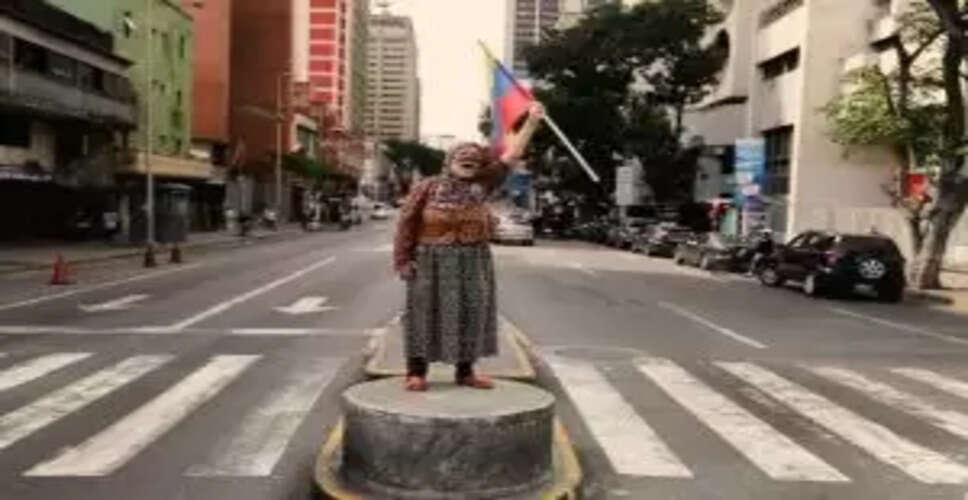
Chaos in Caracas Following Maduro's Capture
Caracas: On Saturday, Venezuelans found themselves in a state of confusion as the US military detained President Nicolás Maduro, a leader who had previously survived numerous coup attempts, military revolts, widespread protests, and economic sanctions in a nation of 29 million.
Juan Pablo Petrone, a Caracas resident, expressed his anxiety, asking, “What will happen tomorrow?” As fear spread, the streets emptied, leaving only long queues at supermarkets and gas stations. “What will happen in the next hour?” he wondered.
In a surprising announcement, President Donald Trump declared that the United States would assume control of Venezuela, potentially collaborating with one of Maduro's closest aides.
Delcy Rodríguez, who has been Maduro's vice president since 2018 and has overseen the country's oil-dependent economy and intelligence services, was ordered by Venezuela's high court to take on the role of interim president.
Trump praised Rodríguez, stating, “She’s essentially willing to do what we think is necessary to make Venezuela great again,” despite her facing US sanctions during his first term for undermining democracy in Venezuela.
In a notable dismissal, Trump indicated that opposition leader Maria Corina Machado, a Nobel Peace Prize laureate, lacked the support needed to govern.
Trump claimed that Rodríguez had a lengthy discussion with US Secretary of State Marco Rubio, during which she allegedly stated, “We’ll do whatever you need.”
“I think she was quite gracious,” Trump remarked. “We can’t take a chance that someone else takes over Venezuela who doesn’t have the welfare of the Venezuelan people in mind.”
Venezuelan Officials Remain Defiant
Despite the military operation, Venezuelan officials appeared to retain their positions for the time being, with no immediate indication that the US was in control.
Rodríguez sought to project strength and unity among the ruling party's factions, downplaying any signs of betrayal. In a state television address prior to the court's decision, she demanded the immediate release of Maduro and his wife, Cilia Flores, condemning the US operation as a blatant violation of the United Nations charter.
“There is only one president in this country, and his name is Nicolás Maduro,” Rodríguez asserted, flanked by top civilian and military leaders.
To calm the anxious public, Venezuelan military officials adopted a defiant stance in video messages, criticizing Trump and pledging to resist US pressure.
Defence Minister Gen Vladimir Padrino López, dressed in military fatigues, stated, “They have attacked us but will not break us.”
Interior Minister Diosdado Cabello, a key enforcer for Maduro, urged citizens to “get out on the streets” to defend the nation’s sovereignty.
“These rats attacked, and they will regret what they did,” he said, referring to the US.
While some Venezuelans responded to his call by rallying in support of the government and burning American flags in various locations across Caracas, many others chose to stay indoors out of fear.
“What’s happening is unprecedented,” remarked Yanire Lucas, another Caracas resident, as she cleaned up glass from an explosion at a nearby military base that shattered her windows.
“We’re still on edge, and now we’re unsure what to do.”
Political Transition Uncertain
Trump suggested that Rodríguez had already been sworn in as Venezuela's president, according to the constitutional transfer of power.
However, state television did not broadcast any swearing-in ceremony.
During Rodríguez's televised address, a ticker at the bottom of the screen still referred to her as vice president. She did not indicate any willingness to cooperate with the US and did not respond to requests for comments.
“What is being done to Venezuela is an atrocity that violates international law,” she stated in her speech. “History and justice will make the extremists who promoted this armed aggression pay.”
The Venezuelan constitution mandates that a new election must be called within a month if the president is absent. However, experts are debating whether this succession scenario applies, given the government's lack of popular legitimacy and the extraordinary US military intervention.
Rodríguez's Background and Challenges
Rodríguez, a lawyer educated in Britain and France, has a long history of representing the revolution initiated by the late Hugo Chávez on the global stage.
She and her brother, Jorge Rodríguez, who leads the Maduro-controlled National Assembly, have strong leftist credentials rooted in tragedy, as their father was a socialist leader who died in police custody in the 1970s, an event that deeply affected many activists, including a young Maduro.
Unlike many in Maduro's inner circle, the Rodríguez siblings have avoided criminal charges in the US.
Delcy Rodríguez has cultivated strong relationships with Republicans in the oil industry and on Wall Street, who are skeptical of US-led regime change.
She has previously engaged with figures like Blackwater founder Erik Prince and Richard Grenell, a Trump special envoy who sought to negotiate a deal with Maduro for increased US influence in Venezuela.
Potential Internal Conflicts
Fluent in English, Rodríguez is often seen as a well-educated, market-friendly moderate, contrasting with the military hard-liners who supported Chávez against Venezuela's democratically elected president in the 1990s.
Many of these individuals, particularly Cabello, are wanted in the US on drug trafficking charges and are accused of serious human rights violations. Yet, they continue to wield significant influence over the armed forces, which traditionally arbitrate political disputes in Venezuela.
This presents significant challenges for Rodríguez in asserting her authority. However, some analysts believe that Venezuela's power brokers will likely unite, as they have in the past.
“These leaders have all recognized the importance of staying united. Cabello has often taken a secondary role, understanding that his fate is tied to Maduro's, and he may do so again,” stated David Smilde, a sociology professor at Tulane University who has studied Venezuela's political dynamics for three decades.
Much will depend on the state of Venezuela's military following the US bombing raid, Smilde added. “If it lacks significant firepower, they become more vulnerable and diminished.”
Opposition's Response
Shortly before Trump's press conference, Machado, the opposition leader, urged her ally Edmundo González—a retired diplomat widely regarded as the rightful winner of the disputed 2024 presidential election—to “immediately assume his constitutional mandate and be recognized as commander-in-chief.”
In a triumphant statement, Machado vowed that her movement would “restore order, free political prisoners, build an exceptional country, and bring our children back home.”
She added, “Today we are prepared to assert our mandate and take power.”
However, Trump seemed to dismiss those plans.
When asked about Machado, Trump bluntly stated, “I think it would be very tough for her to be the leader,” surprising many Venezuelan viewers who anticipated his comments would signal a swift democratic transition.
“She doesn’t have the support or respect within the country.”