
US Pilot's Encounter with Unusual Drone Formation Sparks Concerns Over Iran's Capabilities

Pilot's Remarkable Experience
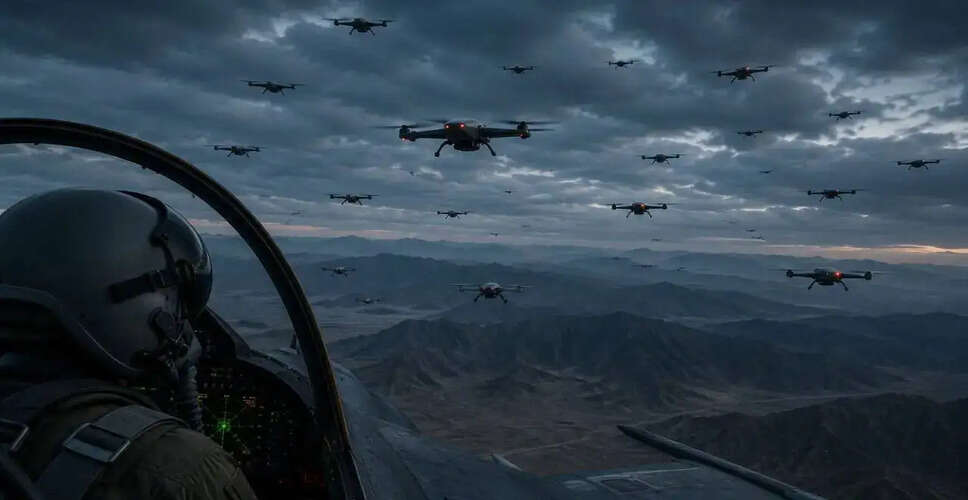
A pilot from the United States Air Force, who was rescued after being shot down in Iran in April, reported seeing an extraordinary arrangement of Iranian drones just before he ejected from his aircraft. This information, revealed during a debriefing following his rescue, has ignited discussions within the US intelligence community regarding the advancements in Iran's drone technology. Sources indicate that the pilot observed several drones operating in a synchronized manner, resembling a single entity. One insider described the formation as comprising "multiple drones interconnected and moving as one with smaller drones positioned beneath larger ones like legs," adding that it was akin to "real alien sh*t." Another source mentioned that the pilot encountered a "minefield of drones" in the sky.
Investigation into Aircraft Loss
The precise details surrounding the downing of the F-15 are still being examined. Initial evaluations suggest that the drone formation might have contributed to the Iranian forces' ability to bring down the aircraft. The pilot was successfully rescued by US special operations several hours after ejecting over Iranian territory. Reports indicate that the weapons systems officer aboard the aircraft managed to evade capture for over a day in rugged terrain before also being rescued. It remains uncertain if the second crew member witnessed the same drone formation. Additionally, an A-10 aircraft involved in the rescue mission was reportedly shot down, but its pilot ejected safely outside Iranian airspace.
Understanding the 'Jellyfish Drone'
Defense analysts have started to label this drone system as a "jellyfish drone" due to its unique operational characteristics. The downed pilot initially found it challenging to grasp what he was observing, as the drones were reported to hover and maneuver in a coordinated fashion, unlike traditional aircraft. Observers analyzing the incident noted that the formation resembled a jellyfish gliding through water, with some likening it to elements from science fiction. Instead of functioning as individual aircraft, the drones seemed to operate collectively, almost like a single organism.
Mechanics of Drone Swarms
Modern swarm technology relies on a communication network that enables drones to share information continuously. Unlike conventional unmanned aerial systems that are controlled from a central point, swarm systems distribute data throughout the network. Some drones may be tasked with intelligence gathering, while others monitor threats, disrupt communications, or carry armaments. Information collected by one drone can be instantly relayed to others, allowing the formation to adapt swiftly to changing circumstances. Typically, a larger drone serves as a command center, with smaller drones operating around it. If one drone is compromised, the remaining units can adjust their formations and continue their mission. This interconnected functionality is a hallmark of drone swarms. Other nations, including Russia and China, are believed to possess similar capabilities. Any advancements in Iran's already sophisticated drone warfare program would raise alarms for US forces and their allies in the region. Iran has actively utilized its attack drones as an asymmetric weapon during conflicts against US and Israeli forces, as well as neighboring Gulf states.
Increasing Military Focus on Swarm Technology
In recent years, military powers globally have made significant investments in swarm technology. Defense experts assert that large numbers of relatively low-cost drones can overwhelm air defense systems originally designed to intercept fewer high-value targets. Swarms can also conduct extensive surveillance and execute perilous missions without risking pilots' lives. Progress in artificial intelligence has further enhanced their capabilities, allowing for greater autonomy and quicker decision-making. The sight described by the downed F-15 pilot has garnered attention as it may suggest that such capabilities are transitioning from experimental phases to active deployment. Concerns regarding Iran's drone capabilities arise as Washington and Tehran engage in negotiations aimed at resolving their ongoing conflict. These discussions commenced following a ceasefire agreement that established a 60-day window for negotiations last week, primarily focusing on Iran's nuclear program while also addressing a broader range of security issues. Defense analysts increasingly regard drone swarms as a potentially pivotal aspect of future warfare, with advancements in artificial intelligence and communication technologies enabling groups of autonomous systems to operate together with increasing sophistication.