
US Military's Covert Operations to Secure Gulf Oil Transfers
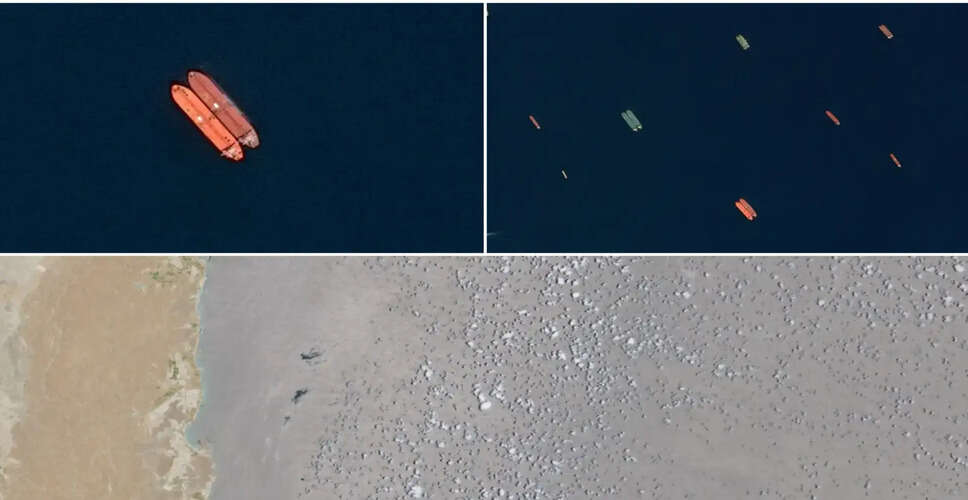

Overview of US Military Operations in the Gulf
Tehran: Recent reports indicate that the US military has been discreetly managing numerous ship-to-ship oil transfers to maintain steady energy exports from the Gulf. According to sources, US forces have utilized aerial and maritime drones, along with helicopters, to guide convoys to specific tankers near the Strait of Hormuz. This approach mirrors the shuttle system previously employed by Iran to bypass sanctions. The oil transfers are occurring at two key locations: one near Fujairah in the UAE and another close to Oman’s Sohar port, as reported by a global news agency.
Since May, the operation has involved at least 92 vessels, as evidenced by shipping data and satellite imagery. An Apache helicopter, reportedly downed by Iran on June 9, was allegedly part of this mission, leading to US retaliatory strikes on Iran. Satellite images revealed that on the day of the Apache incident, six pairs of tanker ships were clustered off Sohar. However, the specific involvement of the Apache in the operation remains unclear. A US defense official stated that no Central Command forces are engaged in offshore oil transfer operations, and both crew members of the downed helicopter were rescued by a drone boat.
The Iranian government has not responded to inquiries regarding these transfer operations. The two locations for these transfers, situated in the Gulf of Oman near the Strait of Hormuz, are under the jurisdiction of the newly established Persian Gulf Strait Authority, which oversees compliance with Iranian regulations. Ships that do not adhere to Iran’s directives risk drone and missile attacks from the Islamic Revolutionary Guard Corps (IRGC).
During the US-led operation, Fujairah port has faced repeated Iranian assaults. Recently, an “unknown projectile” struck a tanker off Oman’s coast, although the crew was unharmed, and there were no significant environmental impacts reported. It remains uncertain if the tanker was part of a ship-to-ship transfer. These transfers, while risky and inefficient, are part of efforts to restore normal oil flows from the Gulf, as stated by former President Trump, who mentioned a framework peace deal with Iran that would reopen the Strait of Hormuz.
According to a global news agency investigation published in May, Iran has developed its own system for guiding ships through the opposite side of the Strait, utilizing island checkpoints and diplomatic arrangements.
Details of Ship-To-Ship TransfersSources indicate that these transfer operations are entirely managed by the US military. Tankers are instructed to gather at a designated rendezvous point before entering the Strait of Hormuz and depart in a staggered formation, maintaining a distance of approximately 3,000 to 4,000 meters between vessels. Ships travel with their transponders turned off and lights dimmed to avoid detection. A series of waypoints allows the US military to monitor the designated tankers, with one source noting that the Americans are constantly observing.
Once the tankers clear the Strait of Hormuz and enter waters not claimed by Iran, they dock alongside Very Large Crude Carriers (VLCCs) for the oil transfers, which take between 24 and 40 hours. After the transfer, the smaller vessels return through the strait, while the fully loaded VLCCs proceed to their destinations.
This operation is feasible due to a few shippers willing to navigate through the strait to deliver oil to waiting tankers, despite the Iranian blockade. However, the operation carries significant risks, as noted by maritime experts, who warn of potential Iranian drone or gunboat attacks on transiting ships.
Iran's Historical Use of Ship-To-Ship TransfersHistorically, Iran has employed ship-to-ship techniques to circumvent sanctions, effectively concealing the oil's origin. Typically, Iran operates one pair of ships at a time to avoid detection, as its pre-war exports were relatively modest. The US-led operation, involving mass transfers, offers Gulf producers enhanced protection against Iranian retaliatory actions, enabling them to transport crude, condensate, and petroleum products to international markets.
Satellite images reviewed by the global news agency from May 2 to June 11 show ship-to-ship transfers involving state-owned Gulf tanker fleets and international vessels receiving the oil. Shipping data indicated that approximately 90 million barrels of crude oil and petroleum products have likely moved through this offshore network since early May, although this volume is still significantly lower than the pre-war average of about 20 million barrels per day through the Strait of Hormuz.
Michael Froman, president of the Council on Foreign Relations, remarked on the irony of the US adopting tactics similar to those used by countries like China, Russia, North Korea, and Iran, which have historically utilized such methods to evade sanctions.
Operations Through the Strait of HormuzShipping data analysis reveals that international tanker companies have been pivotal in the receiving segment of this operation. Among them is Greece-based Dynacom Tankers Management, which has been exploring alternative oil transport methods through the Strait since the conflict began. Dynacom’s founder emphasized the importance of freedom of navigation and hinted at the company's historical role in breaking blockades.
However, the new system introduces its own risks, as transponders are turned off, and companies are not reporting through standard channels, increasing the likelihood of collisions among vessels navigating at night without lights. Operators wishing to utilize this system must undergo a compliance screening process and provide detailed tracking histories and cargo documentation to the US Navy's Naval Cooperation and Guidance for Shipping (NCAGS) office in Bahrain.
Emirati exports play a significant role in the US transfer operation, with sources indicating that the UAE's state-owned energy giant ADNOC is one of the most active participants. The Kuwait Oil Tanker Company has also been involved, with 2.3 million barrels of crude siphoned from one of its ships off Sohar on June 6. The receiving ship, Sea Ruby, was later spotted off India’s southwest coast, heading towards China.
Experts express skepticism about the sustainability of this operation, suggesting it serves as a temporary measure during extraordinary circumstances.