
US Intelligence Report Questions Effectiveness of Military Action Against Iran
US Intelligence Assessment on Iran's Resilience
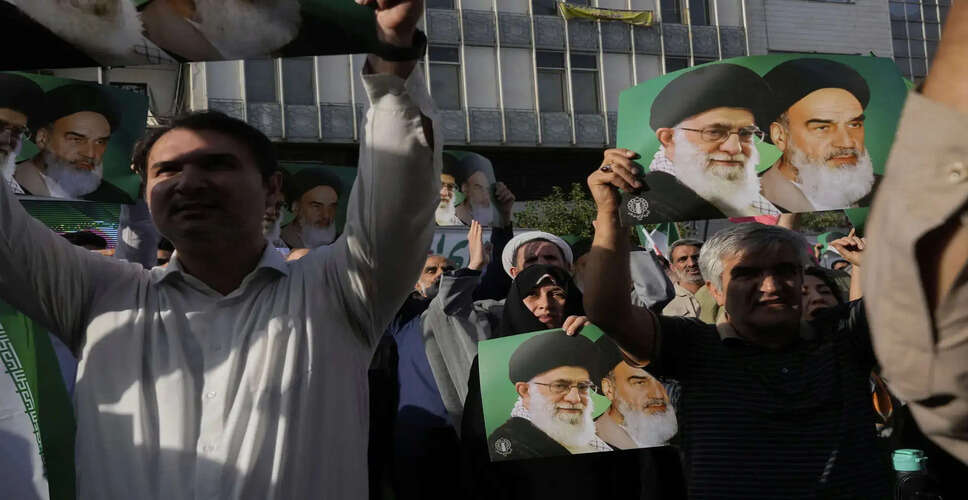
A recent classified assessment from US intelligence suggests that a significant military offensive against Iran is unlikely to dismantle the country's entrenched clerical and military leadership. This report, crafted by the National Intelligence Council (NIC), raises concerns about the ability of Iran's disjointed opposition to seize power following either a targeted or extensive military campaign by the US.
According to sources familiar with the findings, the assessment was finalized shortly before the US and Israel initiated their military operations against Iran on February 28. The analysis explored various scenarios regarding potential leadership changes after either precision strikes on Iran's leadership or a comprehensive attack on its governing bodies. Intelligence experts concluded that even in the event of Supreme Leader Ayatollah Ali Khamenei's death, the Islamic Republic's clerical and military hierarchy would likely retain control.
The report emphasized that Iran's political and security frameworks are structured to ensure the continuity of power, deeming it 'unlikely' for the fragmented opposition to take charge. The National Intelligence Council, which consists of senior analysts from the US's 18 intelligence agencies, produced this assessment.
As the conflict, which began with coordinated US-Israeli strikes, escalates to include submarine warfare in the Indian Ocean and missile interceptions near Turkey, White House spokeswoman Anna Kelly stated, 'President Trump and the administration have clearly outlined their goals with regard to Operation Epic Fury: destroy Iran’s ballistic missiles and production capacity, demolish their navy, end their ability to arm proxies, and prevent them from ever obtaining a nuclear weapon.' She added, 'The Iranian regime is being absolutely crushed.'
Experts believe this assessment reflects long-held views regarding the durability of Iran's political institutions. Suzanne Maloney, an Iran scholar and vice president at the Brookings Institution, remarked that it appears to be a well-informed evaluation of the Iranian system and its established institutions.
Interestingly, the report did not explore alternative scenarios, such as deploying US ground forces or backing ethnic Kurdish insurgencies within Iran. As the war progresses into its second week, discussions about leadership succession in Iran have intensified.
In Iran's political structure, the Assembly of Experts, a significant clerical body, is formally responsible for selecting the supreme leader. However, members of the Islamic Revolutionary Guard Corps (IRGC) and other security officials are believed to have considerable influence in this process.
Speculation has arisen regarding Mojtaba Khamenei, the son of the late supreme leader, potentially being chosen as his successor, although no official confirmation has been made. Amid ongoing hostilities, Trump has consistently called for Iran's 'UNCONDITIONAL SURRENDER' and hinted at his potential influence over the selection of the country's future leadership.
Trump criticized the younger Khamenei as 'incompetent' and a 'lightweight,' expressing a desire for Iranian leaders who would not merely 'rebuild' the nation's nuclear and missile capabilities. 'We want them to have a good leader. We have some people who I think would do a good job,' he stated in an interview with NBC News.
In response, Iranian officials have dismissed any notion of foreign interference in determining the nation's leadership. Parliament speaker Mohammad Bagher Ghalibaf asserted, 'The fate of dear Iran, which is more precious than life, will be determined solely by the proud Iranian nation, not by [Jeffrey] Epstein’s gang.'