
US Increases Military Presence in Middle East Amid Iran Tensions
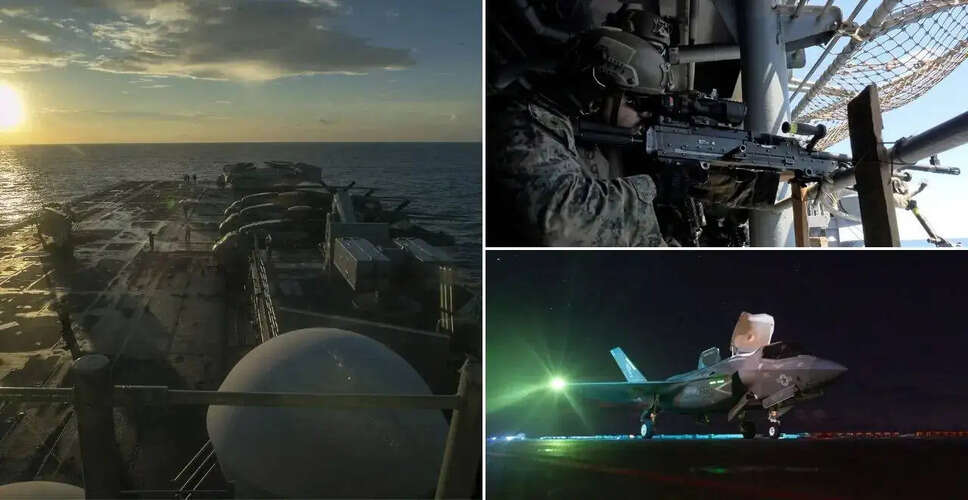

US Troop Deployment to the Middle East
The United States is sending thousands of additional troops to the Middle East as the Trump administration intensifies its stance against Iran, according to reports from US officials. This decision comes amid rising tensions and a fragile ceasefire, as detailed in a report. Approximately 6,000 troops aboard the USS George HW Bush and its accompanying vessels are being deployed to the region. An additional 4,200 troops from the Boxer Amphibious Ready Group and the 11th Marine Expeditionary Unit are anticipated to arrive later this month. This new deployment will supplement the existing 50,000 US personnel already engaged in operations aimed at countering Iran. Their arrival is expected to coincide with the end of a two-week ceasefire on April 22. With this deployment, US commanders will have three aircraft carriers in the region, including the USS Abraham Lincoln and the USS Gerald R. Ford.
Increasing Pressure on Iran
Pressure Mounts on Iran
On Sunday, Trump announced a maritime blockade targeting Iranian ports to heighten economic pressure on Tehran. The US aims to compel Iran to reopen the Strait of Hormuz, a crucial route for global oil shipments, and to halt its nuclear program through negotiations led by Vice-President JD Vance. Although discussions stalled over the weekend, Trump indicated they could resume, describing the conflict as 'very close' to resolution in an interview. White House press secretary Karoline Leavitt stated that the president has kept all options available should Iran refuse to abandon its nuclear ambitions and agree to a deal acceptable to the US. She emphasized that US officials have clearly outlined their 'redlines' and predicted that Iran's urgency for a deal would only grow under the blockade.
Retired US Navy admiral James Foggo noted that the additional forces would enhance military options if negotiations fail. He remarked, 'The more tools you have in your kit, the more diversity of options that you have,' referring to the deployment as a 'reserve capacity' should situations deteriorate. US naval forces have already intercepted six merchant vessels within the first 24 hours of the blockade, all of which were returned to Iranian ports without incident. Currently, over a dozen US warships are stationed in the Gulf of Oman and Arabian Sea, monitoring vessels navigating through the Strait of Hormuz.
Risks of Blockade Enforcement
Blockade Enforcement and Dangers
A former senior defense official indicated that US forces might conduct ship-boarding operations to seize vessels suspected of aiding Iran. Such operations, typically executed by Navy SEALs, Marines, or Coast Guard units, carry significant risks, including potential resistance from crews or attacks from Iranian drones or fast boats.
Trump cautioned on social media that any vessels approaching US forces could face destruction, stating, 'Warning: If any of these ships come anywhere close to our BLOCKADE, they will be immediately ELIMINATED… It is quick and brutal.' Officials have also indicated that the administration is contemplating more direct military actions if tensions escalate. Options being discussed include Special Operations missions to secure Iranian nuclear materials, deploying Marines to safeguard key waterways, or seizing strategic locations like Kharg Island, a significant Iranian oil export facility. Mick Mulroy, a retired Marine and former CIA officer, warned that such operations would be considerably more perilous than enforcing a blockade, stating, 'It's not going to be without consequences.' With the ceasefire deadline approaching and negotiations uncertain, US officials describe the situation as fluid.