
US and Israel Conduct Airstrike on Iran Amidst Rising Tensions
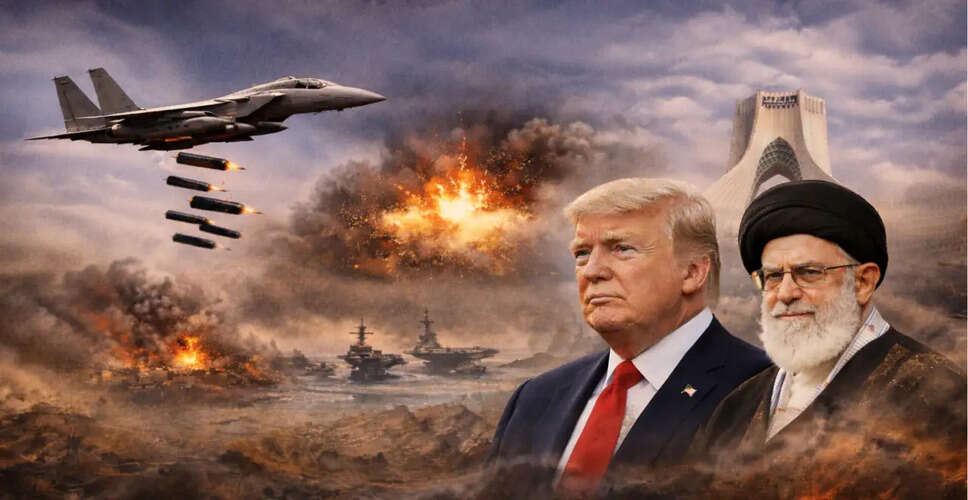
Joint Airstrike Targets Iran's Leadership
In a significant escalation, the United States and Israel executed a coordinated airstrike against Iran early Saturday, resulting in the death of Supreme Leader Ayatollah Ali Khamenei. Prior to and following the strike, US officials indicated that a primary objective was to dismantle Iran's governing structure, alongside crippling its ballistic missile and nuclear capabilities. The question arises: can this be achieved solely through airstrikes, or will the US consider deploying ground forces? When questioned about this on Monday, President Donald Trump stated he would not dismiss the possibility of sending troops into Iran if deemed necessary. He remarked, “I don’t have the yips with respect to boots on the ground — like every president says, ‘There will be no boots on the ground.’ I don’t say it,” during an interview with a media outlet.
This statement followed comments from US Defence Secretary Pete Hegseth, who confirmed that there are currently no American troops stationed in Iran, while refraining from speculating on future military deployments.
Foad Izadi, an Associate Professor at the University of Tehran, expressed skepticism about the effectiveness of ground troops, stating, “We have had boots on the ground in Iraq and Afghanistan. That was a foolish thing to do in those countries. It would be a foolish thing to do in Iran.” He warned that such actions could provide the Iranian military with opportunities to inflict casualties on American forces. He also noted that Iran had shown interest in diplomatic negotiations, yet the US had attacked during these discussions.
Experts have pointed out that air power alone is unlikely to bring about regime change without an internal uprising, citing historical precedents where similar strategies have failed. Analysts have previously suggested that air campaigns rarely lead to decisive victories, as they may weaken leadership but do not ensure its collapse without internal support.
Security expert Phillips O’Brien emphasized that a change in Iran's regime cannot be achieved solely through air strikes unless the US can persuade both the Iranian populace and elements within the current government to support such a transition. He stated, “What air power can do is attack the present regime, in some cases quite powerfully, but it cannot guarantee it will be replaced or how it will be replaced.” O’Brien also suggested that Trump would likely avoid risking American lives by deploying ground troops to support the air campaign.
Earlier, Republican Senator Tom Cotton remarked that the president does not have plans for a large-scale ground force in Iran, asserting that the US strategy will focus on an extended air and naval campaign. The US military has been enhancing its presence in the Middle East, reportedly the largest buildup since the Iraq War, with two aircraft carriers, the USS Gerald R Ford and USS Abraham Lincoln, currently in the region.
Following the confirmation of Khamenei's death, Iran retaliated by launching missiles at Israel and neighboring Arab nations, while appointing Alireza Arafi as the interim leader. Arafi, a jurist member of Iran's Leadership Council, will serve alongside President Masoud Pezeshkian and Chief Justice Gholamhossein Mohseni Ejei until a new supreme leader is elected. Iran's foreign minister, Abbas Araghchi, indicated that the election of the new leader would occur within days. Experts have noted that Iran's Islamic Republic is structured to endure despite challenges. Danny Citrinowicz from the Atlantic Council remarked, “The Iranian system is bigger than one man - removing Khamenei could harden the regime rather than weaken it.” Ali Hashem, a research affiliate at Royal Holloway, University of London, added, “The danger is not a vacuum. It's whether war and pressure push the system past the point where that resilience holds.”