
Unprecedented Trading Surge in Oil Markets Raises Concerns Over Manipulation
A Surprising Turn in Oil Trading
On March 23, at 6:49 AM New York time, a remarkable event unfolded in the global oil market. Within just one minute, around 6,200 futures contracts for Brent and West Texas Intermediate were traded, amounting to approximately $580 million (around Rs 5,373 crore). Shortly after, President Donald Trump announced on Truth Social that discussions with Tehran had been "productive" in relation to the Iran conflict, leading to a sharp decline in oil prices. Those who made those trades certainly struck gold. According to an analysis by the Financial Times using Bloomberg trading data, the volume of contracts exchanged during that minute was nearly nine times higher than the average for the same timeframe over the preceding five trading days, which was about 700 contracts. Market analysts confirmed to CBS News that this trading volume was significantly above the norm for that hour. Stephen Piepgrass, a partner specializing in futures trading at Troutman Pepper Locke, remarked, "The substantial increase in trade volume right before that announcement is certainly suspicious and warrants an investigation into the circumstances surrounding it."
Not Just a Coincidence
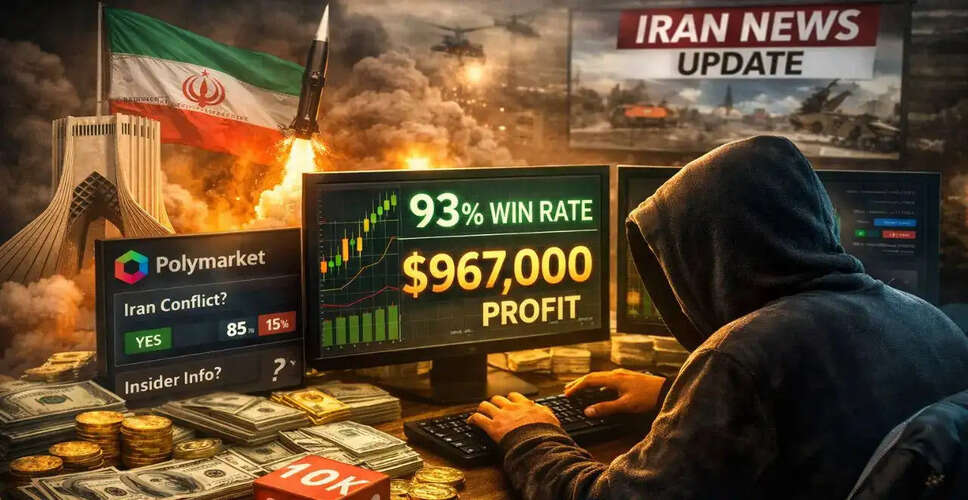
The trading activity on March 23 was not an isolated incident. A probe by the blockchain analytics firm Bubblemaps, shared exclusively with CNN, revealed that a single anonymous trader had achieved a remarkable 93% success rate on Iran-related bets on the prediction market Polymarket, earning nearly $967,000. Todd Phillips, a finance professor at Georgia State University and former advisory board member of the CFTC, commented, "Achieving win rates between 80% and 90% is simply unbelievable."
Research conducted by Professor Joshua Mitts from Columbia University and Professor Moran Ofir from the University of Haifa further documented this trend. Their findings, published through Harvard Law School's corporate governance forum, indicated that six newly created Polymarket accounts collectively earned $1.2 million by betting on the precise date of a US-Israeli strike on Iran. One account, operating under the name "Magamyman," made its first trade just 71 minutes before the strikes commenced, at a time when the market suggested only a 17% chance of an attack, ultimately netting $553,000. This pattern is not limited to Iran; as reported by Axios, one trader transformed $32,000 into over $400,000 by accurately predicting the capture of Venezuela's Nicolás Maduro before it was publicly disclosed. Additionally, a surge in bullish stock trades occurred just minutes before Trump announced a 90-day pause on tariffs. Senator Chris Murphy expressed his astonishment on X, noting that $1.5 billion in S&P 500 futures were purchased shortly before Trump's March 23 Iran announcement, labeling it as "mind-blowing corruption."
Concerns of Treason in Trading
Nobel laureate economist Paul Krugman did not hold back in his criticism. In an NPR interview on March 26, he stated, "There was nothing else occurring that could justify such large transactions at that specific moment." In a Substack post titled "Treason in the Futures Market," Krugman argued that individuals exploiting confidential national security information for personal gain could be committing treason, especially as foreign adversaries could interpret these financial movements as real-time insights into classified military strategies. Iran's parliament speaker, Mohammad-Bagher Ghalibaf, refuted any claims of negotiations, labeling Trump's assertion as "fake news" aimed at manipulating financial and oil markets, as reported by Fortune.
Regulatory Challenges
The Commodity Futures Trading Commission (CFTC), the agency responsible for overseeing these markets, appears to be ill-prepared to take action. Reports indicate that the CFTC has significantly reduced its enforcement division, including the loss of all enforcement attorneys in its Chicago office. Former CFTC whistleblower Chris Ehrman remarked to NBC that without government deterrents, allowing platforms to self-regulate is akin to "whipping them with a wet noodle." Following a public warning from US Attorney Jay Clayton regarding impending criminal cases related to prediction market activities, Manhattan's leading fraud prosecutors have met with Polymarket to discuss potential federal violations. On Capitol Hill, bipartisan legislation is advancing: Senator Murphy's BETS OFF Act aims to prohibit bets on government actions, warfare, and assassinations, while Representative Ritchie Torres has introduced the Public Integrity in Financial Prediction Markets Act of 2026. As of now, no American has faced federal charges related to insider trading on event-driven news.
Implications for India
Every fluctuation in oil prices driven by these trades directly impacts India. The country relies on imports for nearly 90% of its crude oil, with over three-quarters of its LPG transiting through the Strait of Hormuz, a route increasingly threatened by Tehran's attacks. CNBC reported that the Indian government has reduced central excise duties on petrol and diesel by Rs 10 per litre, with Petroleum Minister Hardeep Singh Puri describing it as a "huge hit" to government finances. The rupee has plummeted to a record low of 94.78 against the dollar, and the Nifty and Sensex indices have dropped approximately 10% in a month. Goldman Sachs has cautioned that India faces a combination of slower growth, rising inflation, and a depreciating currency. The Rs 5,373 crore mystery is not merely a Wall Street scandal; it illustrates how anonymous traders may be profiting from the ongoing conflict that is adversely affecting India's economy and the global market, while the regulators tasked with oversight are under-resourced and, some argue, reluctant to intervene.