
Ukraine Launches Major Drone Assault on Moscow's Kapotnya Refinery

Significant Drone Strike on Moscow
In a bold move, Ukraine executed its largest drone attack on Moscow since the onset of Russia's full-scale invasion, dramatically illustrating the ongoing conflict. The strike resulted in thick black smoke enveloping parts of the city, disrupted flights, and residents reported oily black particles raining down after a key oil refinery was targeted.
The Kapotnya oil refinery, located in southeastern Moscow and crucial to Russia's fuel processing, was hit, igniting a significant fire that sent towering smoke plumes into the skyline. Social media footage captured explosions at the facility, damage to nearby residential areas, and drones flying over Moscow in daylight.
Many locals described being jolted awake by loud explosions, feeling buildings shake, and noticing the smell of burning fuel. Reports indicated that soot and oily residue settled on cars, rooftops, and clothing as smoke drifted across the city.
Kyiv characterized the operation as retaliation for recent Russian assaults on Ukraine. President Volodymyr Zelensky has consistently warned that ongoing attacks on Ukrainian cities would increasingly bring the conflict closer to Russian soil. This latest strike also showcased the enhanced capabilities of Ukraine's domestically developed long-range drone fleet, with several drones reportedly breaching Russian air defenses around Moscow.
The Drones Involved in the Attack
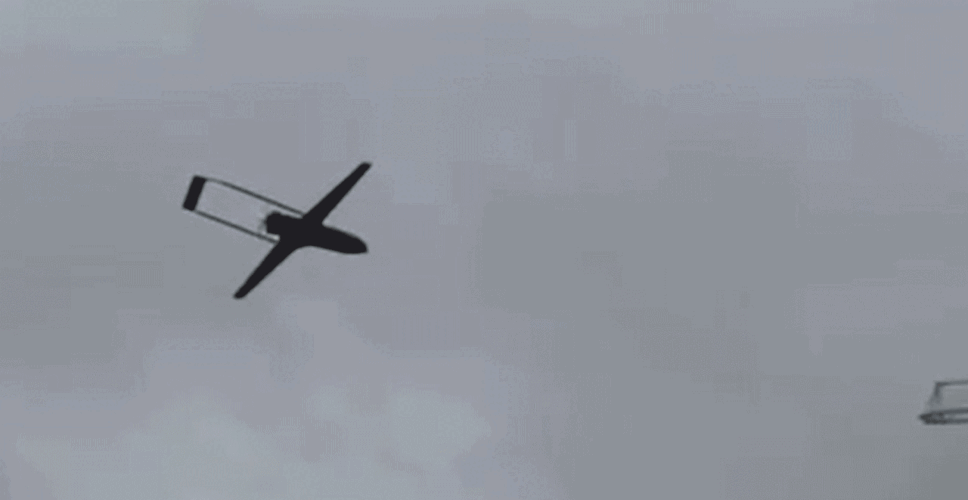
Military analysts and footage reviewed by Ukrainian media indicate that the operation utilized a combination of three long-range drones: the FP-1, the An-196 Liutyi, and the Bars UAV.
FP-1: This drone has become a key asset for Ukraine, capable of traveling between 700 and 1,500 kilometers. It can carry a significant explosive payload and is designed to target fuel depots, refineries, and military installations deep within Russian territory.
An-196 Liutyi: A fixed-wing kamikaze drone, the Liutyi has a reported operational range exceeding 1,000 kilometers and has been involved in attacks on Russian airbases and logistics centers.
Bars UAV: Notably, the Bars drone is powered by a turbojet engine, allowing it to reach speeds of up to 700 kilometers per hour. This high speed enhances its ability to evade interception and penetrate heavily defended airspace. Analysts believe footage from Moscow depicted Bars drones targeting strategic sites around the capital.
Importance of the Kapotnya Refinery
The Kapotnya refinery is a vital energy facility for Russia, supplying a significant portion of the fuel consumed in Moscow and its vicinity. It produces large amounts of petrol and diesel, making it essential to the capital's energy infrastructure.
This strike aligns with Ukraine's broader strategy to target Russia's energy sector, a crucial revenue source for Moscow's military efforts. Ukrainian forces have consistently attacked refineries and fuel depots across Russia to inflict economic damage and exert psychological pressure.
The scale of the fire from this attack made it particularly visible, with videos showing massive smoke plumes rising above the refinery, while residents reported soot-covered vehicles and dark residue falling from the sky.
A Significant Message to Moscow
Russian officials claimed that numerous Ukrainian drones were intercepted overnight, yet several managed to reach their targets. The assault caused temporary disruptions at multiple airports in Moscow and widespread chaos in the region.
For many residents of Moscow, the attack was striking not only for the damage it inflicted but also for its visibility. Unlike Ukraine, which has faced years of air raids, Moscow has seldom experienced such direct wartime conditions.
This incident highlights the rapid evolution of Ukraine's long-range drone capabilities. What began as sporadic incursions into Russian territory has developed into sophisticated operations involving various drone types, coordinated strikes, and attacks on strategically significant infrastructure deep within Russia.