
Trump Issues Ultimatum to Iran Over Ceasefire and Oil Pipeline Threat

Trump's Warning to Iran
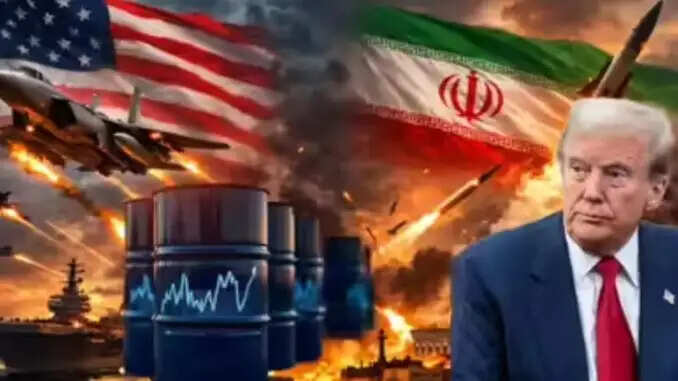
Tehran. On Sunday, U.S. President Donald Trump issued a stern warning to Iran, stating that the country has only three days to agree to a ceasefire to end the conflict, or face a catastrophic explosion in its oil pipeline.
In an interview with a news channel, Trump explained that if Iran fails to export oil, the pressure within the pipeline would increase significantly. This situation arises because the routes for shipping oil or storing it are blocked due to sanctions.
He asserted that a sudden halt in oil flow could lead to a dangerous buildup of pressure inside the pipeline, which could result in a rupture due to both technical and natural factors. According to Trump, if such an event occurs, restoring the pipeline to its original state would be nearly impossible, and its capacity would be severely diminished.
Iran's Stance on Nuclear and Hormuz Agreements
Iran has taken a firm stance regarding agreements with the U.S., stating that there will be no compromises on its nuclear program or the issues surrounding the Strait of Hormuz.
According to Iranian state media, this message was conveyed to the U.S. through Pakistan. Iran has labeled these two issues as its 'red lines' and has made it clear that no agreements will be entertained.
Furthermore, it was clarified that this is not a formal negotiation but rather a diplomatic effort to clarify its position. Iranian Foreign Minister Abbas Araghchi is operating within set boundaries to fulfill his responsibilities in this matter.
Report: Iran Offers to Reopen Hormuz, Nuclear Talks to Follow
Iran has presented a new proposal to the U.S. aimed at reopening the Strait of Hormuz and ending the conflict. According to a U.S. official and two sources familiar with the matter, this plan suggests that discussions on the nuclear issue could take place later. This information was reported by a news outlet.
The new proposal emphasizes resolving the immediate crisis first, focusing on ending the war and stabilizing the situation, with nuclear discussions to follow. This approach aims to expedite the negotiation process.
Report: Israel Deploys Iron Dome to Assist UAE
Israel has reportedly deployed its advanced air defense system, the Iron Dome, along with military personnel to the UAE during the recent conflict with Iran. This information emerged from a report citing U.S. and Israeli officials.
According to the report, this deployment was not publicly disclosed and occurred during the early stages of the conflict when the UAE was facing continuous missile and drone attacks from Iran. These attacks targeted U.S. bases and other critical locations in the Gulf region.
It is reported that Abu Dhabi requested immediate assistance from its allied nations after the threat to its vital civilian and military infrastructure increased. In response, Israel sent the air defense system to the region.
Trump Comments on China's Role in Iran
Trump stated that he does not have significant complaints about China's involvement in the Iran situation. Speaking with a news channel, he mentioned that while China could provide some assistance, its role is not substantial. He added that just as the U.S. helps other countries like Ukraine, he does not view any assistance from China as problematic.
Iranian Foreign Minister to Meet Putin
Iran's Foreign Minister Abbas Araghchi is scheduled to meet with Vladimir Putin in Moscow on Monday.
According to Iran's ambassador to Russia, Kazem Jalali, during this meeting, Araghchi will discuss ongoing talks with Russian officials, potential ceasefire agreements, and the current situation.
He will also present a report on the ongoing negotiations to end the conflict with the U.S. and Israel.
Iranian Parliament Speaker on Supply and Demand
Iranian Parliament Speaker Mohammad Bagher Ghalibaf made a cryptic post regarding the oil market and regional conditions. He stated that there is no complete advantage for any one party in the current situation.
Ghalibaf noted that factors such as the Strait of Hormuz, oil pipelines, and energy supply have not been fully utilized, while on the other hand, measures like the release of strategic oil reserves and inflation have already reduced demand.
He also hinted that further changes in oil prices are possible in the future. Additionally, referencing 'summer vacation,' he indirectly suggested that if conditions worsen, it could impact the lives of ordinary people, particularly in terms of travel and consumption.
Why Did the Iranian Foreign Minister Visit Pakistan Again Within 24 Hours?
Iran's Foreign Minister Abbas Araghchi returned to Islamabad on Sunday evening for the second time within 24 hours.
During his previous visit, he met with Pakistan's Army Chief Asim Munir and Prime Minister Shehbaz Sharif. During this meeting, Iran presented a list of its concerns and demands to Pakistan, which was to be conveyed to the U.S.
However, the matter stalled when a U.S. delegation failed to depart for Islamabad following Trump's intervention. In response, Araghchi expressed uncertainty about whether the U.S. is genuinely serious about negotiations.
Subsequently, Araghchi traveled to Oman, where he stayed for approximately 18 hours. Before returning, he spoke with the Prime Minister of Qatar and the foreign ministers of Turkey and Saudi Arabia. Reports indicate that these discussions laid the groundwork for a preliminary framework to end the conflict.
Now, Araghchi has returned to Islamabad, where he is set to meet with Asim Munir and Shehbaz Sharif once again. He will then travel to Russia to meet with President Putin.
Surge in Oil Prices Due to Stalled US-Iran Talks
The stalling of talks between the U.S. and Iran, along with a decrease in oil supply from the Strait of Hormuz, has led to a sharp rise in global oil prices.
Brent crude has surpassed $107 per barrel, while WTI crude has also risen above $96.
Brent crude is oil extracted from the North Sea (near Europe) and is considered the international benchmark, which most countries use to set oil prices.
WTI crude, or West Texas Intermediate, is oil extracted in the U.S. and is regarded as lighter and purer, making it easier to refine.
Trump Says Iran Should Contact the U.S. for Talks
Trump stated that if Iran wishes to engage in discussions, it should reach out directly to the U.S.
In a conversation with a news channel, Trump mentioned that Iran could either come to the U.S. or call, as secure lines for communication are available.
He made it clear that Iran is aware of the conditions that would be involved in any agreement and that it would not be permitted to possess nuclear weapons. Trump claimed that the ongoing conflict with Iran would soon come to an end, resulting in a victory for the U.S.
He also expressed hope that some individuals in Iran are reasonable and that he expects Iran to make the right decision.