
Trump and Xi Jinping Set for Crucial Talks Amid Technology Tensions

Upcoming Bilateral Meeting
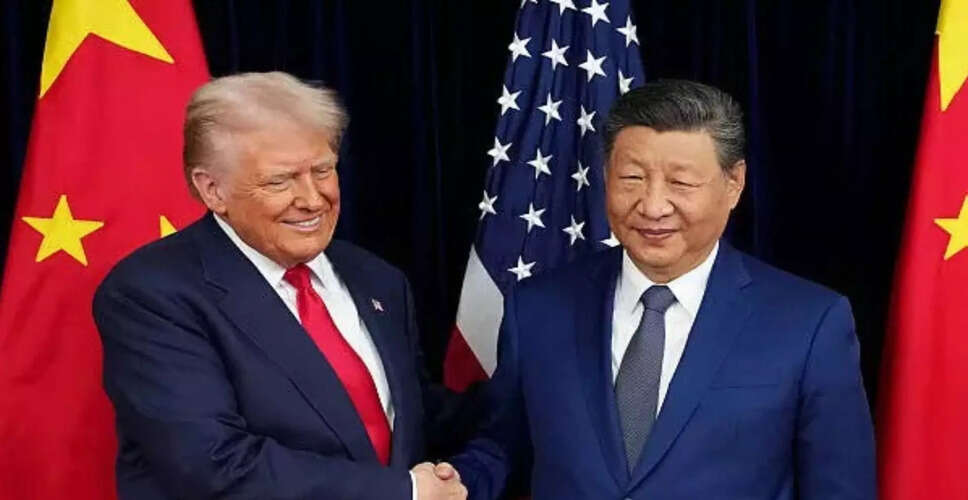
File image of US president Donald Trump and Chinese President Xi Jinping. (Photo:@crypto_exp22740/X)
Washington, Nov 18: This week, US President Donald Trump is preparing for discussions with Chinese President Xi Jinping, amidst internal disagreements within his administration regarding the limitations on China's access to advanced technology. Despite these tensions, both nations are working together to address the risks associated with artificial intelligence and are keen on maintaining their trade agreement.
Details of the Meeting
The White House has scheduled their meeting in Shenzhen for Thursday, which will be followed by a trilateral discussion involving Russian President Vladimir Putin. The Chinese Foreign Ministry has confirmed this three-way meeting for November 19.
Internal Disagreements
According to reports, the discord over technology restrictions is not limited to Treasury Secretary Scott Bessent and Commerce Secretary Howard Lutnick. Secretary of State Marco Rubio, US Trade Representative Jamieson Greer, and many members of the National Security Council are advocating for stricter limits on China's access to advanced AI chips, while Lutnick is in favor of a more lenient approach.
Concerns Over Policy Changes
There are worries among proponents of a tougher stance on China that Trump might reverse the recently imposed restrictions or use them as leverage in negotiations with Xi. However, these concerns do not confirm that Trump plans to make such concessions.
Negotiation Strategies
Former national security advisor H.R. McMaster expressed that Trump's confidence in his negotiation skills could hinder a consistent strategy towards Beijing. He remarked, "I think President Trump is often impeded by his belief that he can get the deal nobody else can get."
Recent Restrictions Announced
On Monday, the administration revealed new restrictions aimed at preventing Chinese firms from accessing advanced American computing technology through overseas data centers.
Managing AI Risks
However, the competition in technology is just one aspect of the broader relationship. Efforts to manage AI risks are also underway, including cooperation on model-testing and establishing an incident-notification channel.
Dialogue on Shared Risks
Bessent noted that Washington and Beijing have initiated discussions to mitigate shared risks and avoid misunderstandings. Plans are in place to exchange practices for evaluating advanced AI models prior to their release and to create a direct communication line for serious incidents involving their models.
Economic Strategies
Bessent further elaborated on the administration's economic strategy, stating, "our objective is to de-risk, not to decouple."
Critical-Mineral Supplies
Another challenge lies in the supply of critical minerals, which is crucial for India's manufacturing goals. A recent analysis revealed that US imports of certain rare-earth materials from China have significantly decreased since Beijing's restrictions in April 2025.
India's Dependence on China
India relies heavily on Chinese imports for permanent magnets, with a government report indicating that China accounted for a substantial percentage of India's imports in recent years. To address this, India has approved a significant scheme to boost domestic manufacturing of rare-earth permanent magnets, essential for various industries including electric vehicles and renewable energy.
Strategic Engagement with Regional Partners
Trump's interactions with India and other regional allies add a strategic layer to his visit to China. A recent briefing highlighted that a Quad meeting prior to Trump's discussions with China would serve as a reminder of Washington's strong regional alliances.
Conclusion
The upcoming talks in Shenzhen will unfold against a backdrop of strategic rivalry, economic interdependence, and efforts to manage technological risks.