
Tragic Israeli Airstrikes Claim 89 Lives in Beirut Just After Ceasefire Announcement
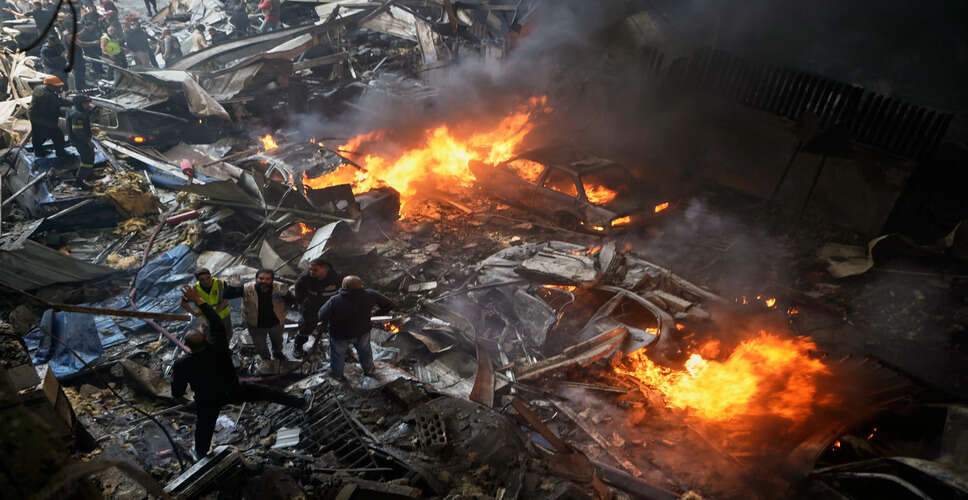

Devastating Strikes in Beirut
In a shocking turn of events, Israeli airstrikes targeted multiple densely populated commercial and residential zones in central Beirut on Wednesday afternoon, mere hours after a ceasefire was declared in the ongoing conflict involving the US, Israel, and Iran. According to Lebanon's health ministry, the assault resulted in at least 89 fatalities and left around 700 individuals injured.
US President Donald Trump, in an interview with PBS NewsHour, clarified that Lebanon was excluded from the ceasefire agreement due to the presence of the militant group Hezbollah. When questioned about the recent Israeli attacks, he remarked, "That’s a separate skirmish." Israel maintained that the ceasefire does not apply to its operations against Hezbollah, which is backed by Iran, although Pakistan, acting as a mediator, suggested otherwise.
The brief moment of relief felt by the Lebanese populace following the ceasefire announcement quickly transformed into chaos as Israel's military executed what it described as its most extensive coordinated strike in the current conflict, targeting over 100 Hezbollah sites within a span of just 10 minutes across Beirut, southern Lebanon, and the eastern Bekaa Valley.
Thick black smoke billowed over various parts of the coastal capital, where many displaced individuals from the ongoing war had sought refuge. The sound of explosions disrupted the usual hustle and bustle of the city, with ambulances rushing to the scenes of devastation. Numerous apartment buildings were struck during the assault.
Journalists from the Associated Press reported witnessing charred remains in vehicles and scattered across the ground at one of Beirut's busiest intersections in the Corniche al Mazraa neighborhood, which is a blend of commercial and residential spaces. Rescue teams utilized forklifts to clear away smoldering debris while searching for survivors.
In the immediate aftermath of the strikes, there were no indications of Hezbollah retaliating against Israel.
A Deadly Midday Barrage
While central Beirut has been a target in the past, the scale and timing of this attack were unprecedented. Israel had previously refrained from launching such extensive strikes in central Beirut since the latest Israel-Hezbollah conflict erupted on March 2. However, it has consistently targeted southern and eastern Lebanon, as well as the southern suburbs of Beirut.
Lebanon's Minister of Social Affairs, Haneed Sayed, condemned the extensive Israeli strikes in an interview, labeling it a "very dangerous turning point." She emphasized that these attacks were now occurring in the heart of Beirut, where a significant number of internally displaced individuals have taken shelter.
Sayed also mentioned that the Lebanese government is prepared to engage in negotiations with Israel to halt hostilities, a proposal previously made by the Lebanese president, to which Israel has yet to respond. "There are calls and efforts being made as we speak," she stated.
Prime Minister Nawaf Salam accused Israel of escalating tensions at a time when Lebanese officials were actively seeking a resolution, asserting that the strikes on civilian areas showed a blatant disregard for international law and humanitarian principles.
Lebanese President Joseph Aoun condemned the Israeli attacks as "barbaric."
The Israeli military claimed that its operations targeted missile launchers, command centers, and intelligence facilities, accusing Hezbollah fighters of attempting to blend into non-Shiite Muslim neighborhoods beyond their traditional strongholds.
Local residents and officials disputed the military's claims, asserting that the buildings struck were not military installations.
"Look at these crimes," remarked Mohammed Balouza, a member of Beirut's municipal council, at the site of one strike in Corniche al Mazraa. An apartment building adjacent to a popular nut and dried fruit shop had been hit. "This is a residential area. There is nothing (military) here."
An Israeli Warning and a Defiant Hezbollah
As smoke filled the air on Wednesday, Israeli Defence Minister Israel Katz issued a warning to Hezbollah leader Naim Kassem, stating that "his turn will come." In 2024, Israel had previously eliminated Hezbollah's former leader, Hassan Nasrallah, in an airstrike.
Katz characterized Wednesday's strikes as the most significant blow to Hezbollah since an attack in September 2024 that caused simultaneous explosions in pagers used by many of its members.
Prior to the recent strikes, a Hezbollah official indicated that the group was allowing mediators to attempt to secure a ceasefire in Lebanon, but emphasized, "we have not announced our adherence to the ceasefire since the Israelis are not adhering to it." This official requested anonymity due to the sensitive nature of the comments.
The Hezbollah representative stated that the group would not accept a return to the pre-March 2 status quo, during which Israel conducted near-daily strikes in Lebanon despite a nominal ceasefire being in effect since the last major Israel-Hezbollah conflict concluded in November 2024.
"We will not accept the Israelis behaving as they did before this war with regard to attacks," he asserted.
Hezbollah had launched missiles across the border shortly after the US and Israel initiated attacks on Iran on February 28, igniting a regional conflict. Israel responded with extensive bombardments of Lebanon and a ground invasion.
Israeli military chief of staff, Lt Gen. Eyal Zamir, stated that the attacks aim to safeguard Israel's northern residents, who have faced significant fire.
Since the onset of the war and prior to Wednesday's strikes, Israeli airstrikes have resulted in over 1,530 deaths in Lebanon, including more than 100 women and 130 children. The Israeli military claims to have killed hundreds of Hezbollah fighters, while over 1 million people have been displaced within Lebanon.
Earlier on Wednesday, following the announcement of the Iran ceasefire and before the Israeli strikes commenced, many displaced individuals sleeping in tents on the streets of Beirut and the coastal city of Sidon began to pack their belongings in anticipation of returning home.
Families residing in a large displacement camp along Beirut's waterfront later expressed confusion and despair over the sudden escalation.
"We can’t take this anymore, sleeping in a tent, not showering, the uncertainty," lamented Fadi Zaydan, 35, who, along with his parents, had been preparing to return to their home in the southern city of Nabatieh.