
Taiwan's Semiconductor Dominance: A Strategic Asset in Global Politics

The Crucial Role of Taiwan in Global Semiconductor Production
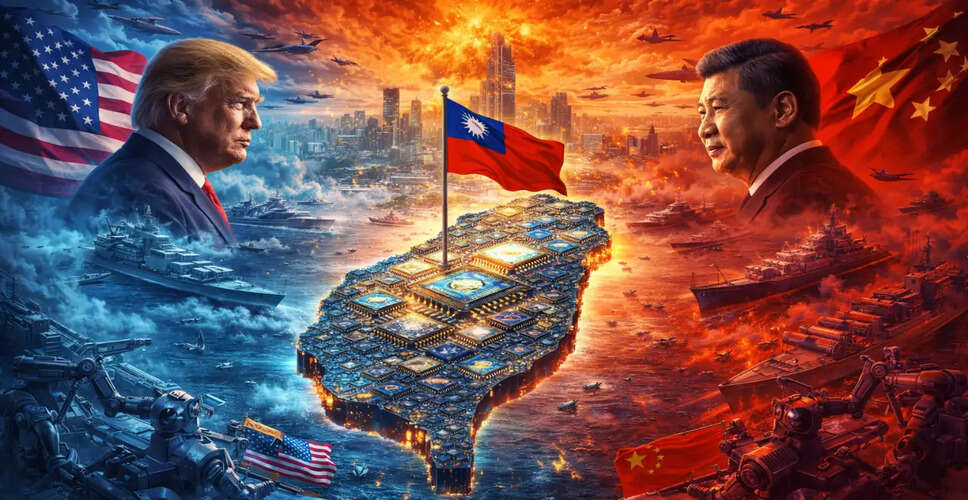
Contrary to popular belief, the most significant company in the world is not located in the United States or China. Instead, it resides on a 36,000 square kilometer island situated just 180 kilometers from the Chinese mainland, responsible for producing 90% of the globe's most sophisticated chips. This island is Taiwan, and the company is TSMC. This single entity manufactures 90% of the most advanced semiconductors worldwide, powering everything from smartphones to military aircraft like the F-35, as well as the AI systems that governments are racing to control.
China's Ambitions Regarding Taiwan
What China Actually Wants
China has long claimed Taiwan as its own, a stance it has maintained for decades, never ruling out the use of force to reclaim the self-governing island. However, the semiconductor aspect adds a dimension that transcends mere nationalism. According to a 2024 report from the Institute for Security and Development Policy, Taiwan produces 60% of the world's semiconductors and 90% of the most advanced ones. If China were to seize Taiwan, it wouldn't just acquire an island; it would gain control over the factory that fuels the global economy. Countries reliant on advanced chips for AI, defense, and economic competitiveness would suddenly find themselves negotiating with Beijing for access.
The Strategic Importance of TSMC
TSMC is responsible for over 90% of the world's advanced chips that are smaller than 5 nanometers and is the only foundry capable of producing chips at the 2-nanometer scale and below, as noted by the Truman National Security Project. These semiconductors are integral to various technologies, including smartphones, data centers, and advanced weaponry. Historian Chris Miller, in his book 'Chip War,' emphasizes that controlling advanced chips is akin to controlling oil in the 20th century, but with even greater concentration.
The US Perspective on Taiwan
The US, Taiwan And The 2027 Question
The situation in Taiwan is pivotal to the United States' strategy to counter China's expanding influence. Admiral Philip Davidson, former commander of US Indo-Pacific Command, testified in 2024 that Taiwan is a clear objective for China, with a significant threat expected within the next six years, a period now referred to as the Davidson Window. In 2023, CIA Director William Burns indicated that Xi Jinping had instructed the Chinese military to prepare for a potential invasion by 2027, although he cautioned against assuming an invasion was imminent.
Potential Global Economic Impact of a Conflict
What Happens If China Takes It
Bloomberg Economics estimates that a US-China conflict over Taiwan could cost the global economy approximately $10.6 trillion in the first year, significantly surpassing the impacts of the COVID-19 pandemic and the 2007-09 financial crisis. Taiwan is crucial for companies like Apple, which relies on the island for advanced production nodes essential for the iPhone. Furthermore, around 18% of the semiconductor needs for global automakers are met by Taiwan, putting millions of vehicles at risk.
TSMC's Contingency Measures
But Then There’s A Catch…TSMC’s Contingency Plans
However, there is a significant complication that Beijing has yet to resolve. TSMC has established contingency plans to disable its manufacturing equipment if it falls into enemy hands. While Beijing would gain control of the facilities, it would not be able to utilize them effectively. Taiwan refers to its semiconductor supremacy as a silicon shield, suggesting that any attack on Taiwan would disrupt the chip supply chain that the entire world, including China, relies on, making the cost of invasion prohibitively high. In 2023, China accounted for 53.8% of Taiwan's semiconductor exports, highlighting its dependence on Taiwanese production.