
Significant Pharaonic Tomb Unearthed Near Luxor, Egypt

Discovery of a Pharaonic Tomb
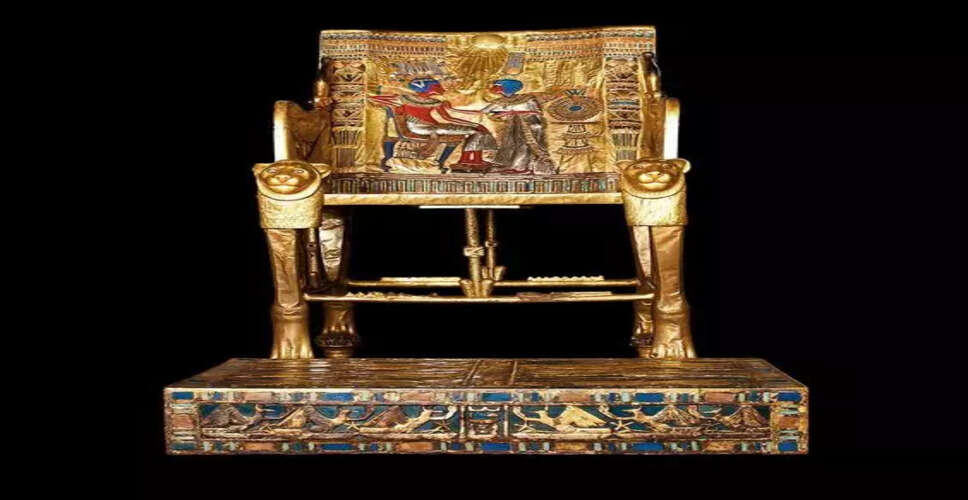
File image of newly discovered throne chair belonging to King Tutankhamun and his queen, Ankhesenamun near Luxor, Egypt(Photo: @SubRosaMagick/X)
Cairo, July 13: The Egyptian Ministry of Tourism and Antiquities has revealed the finding of a Pharaonic tomb on the West Bank of Luxor, which was uncovered during ongoing archaeological digs.
A statement from the ministry, released on Sunday (local time), indicated that this discovery was made by a Dutch archaeological team working in the Theban Necropolis.
According to Hisham Elleithy, the secretary-general of Egypt's Supreme Council of Antiquities (SCA), the tomb has been identified as belonging to "Paser," with wall reliefs suggesting it dates back to the New Kingdom period (1550 BC-1069 BC), as reported by a news agency.
Elleithy mentioned that the archaeological team will carry out thorough documentation and analysis to determine who was interred at the site and to reconstruct their histories, with the goal of placing the tomb within a broader historical and cultural framework.
Mohamed Abdel-Badie, who heads the Egyptian Antiquities Sector at the SCA, described the tomb's design, which includes an external courtyard, an inverted T-shaped rock-cut chapel, and multiple underground burial chambers, aligning with the typical style of private tombs from the New Kingdom era.
Abdel-Badie noted that the courtyard is remarkably well-preserved, featuring a mud-brick mastaba with a central niche for a funerary stela and a staircase bordered by ramps leading to the main entrance of the tomb.
The wall decorations that display Paser's name are partially hidden beneath a thin layer of debris, he explained, adding that excavated areas reveal elaborate, colorful paintings showing the deceased paying tribute to deities in shrines, along with scenes of him and his wife before a traditional offering table.
In April, the Egyptian Ministry of Tourism and Antiquities announced that a Spanish archaeological team had discovered a rare tomb dating from 30 BC to 395 AD in Egypt's central Minya province.
This find is expected to provide insights into funerary practices during the Roman and Greek periods, according to the ministry's statement.
At that site, the mission also uncovered several Roman-era mummies, some wrapped in bandages adorned with geometric designs, along with wooden coffins, three golden tongues, and one copper tongue. Evidence of gold chips used on some mummies was also discovered.
This recent discovery offers new perspectives on funerary customs in the region during the Roman and Greek eras, as stated by Hisham El-Leithy, secretary-general of the Supreme Council of Antiquities.