
Significant Disruption in Russia's Oil Exports Amid Ongoing Conflict
Major Oil Supply Disruption in Russia
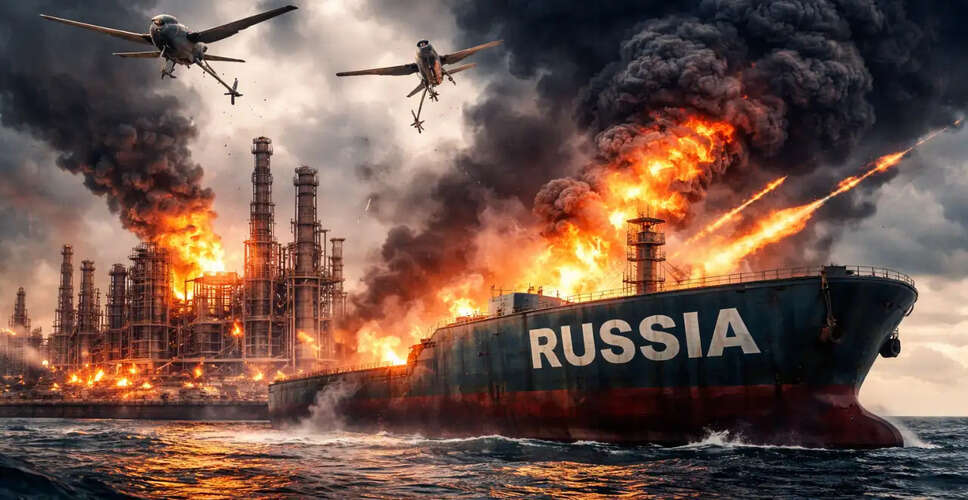
Recent calculations indicate that approximately 40% of Russia's oil export capacity has been compromised due to Ukrainian drone strikes, a controversial pipeline incident, and the seizure of tankers. This marks the most significant disruption in Russia's oil supply in its contemporary history. As the world's second-largest oil exporter, Russia faces this challenge at a time when oil prices have surged past $100 per barrel, largely influenced by the ongoing conflict in Iran. Oil plays a crucial role in Russia's economy, serving as a primary source of government revenue and bolstering its $2.6 trillion economy.
Increased Ukrainian Attacks on Oil Infrastructure
UKRAINE HAS INCREASED ATTACKS
This month, Ukraine has intensified its drone assaults on Russia's oil and fuel infrastructure, targeting key western oil export ports including Novorossiysk on the Black Sea and Primorsk and Ust-Luga on the Baltic Sea. According to market data, around 40% of Russia's crude oil export capacity, equating to roughly 2 million barrels per day, was halted following the latest attacks. This disruption affects major routes such as Primorsk, Ust-Luga, and the Druzhba pipeline, which transports oil through Ukraine to Hungary and Slovakia. Additionally, Ukraine has aimed at oil pumping stations and refineries, aiming to diminish Moscow's oil and gas revenue, which constitutes about a quarter of the Russian government's income, thereby weakening its military capabilities. In response, Russia has labeled these actions as terrorist attacks and has heightened security measures nationwide.
Impact on Ports and Export Routes
PORTS, PIPELINES AND TANKERS
Ukraine reported that Russian strikes at the end of January caused damage to part of the Druzhba pipeline, prompting Slovakia and Hungary to request a swift resumption of supplies. The Novorossiysk oil terminal, capable of processing up to 700,000 barrels per day, has been operating below its potential following a significant Ukrainian drone strike earlier this month. Concurrently, the seizure of Russia-linked tankers in Europe has disrupted approximately 300,000 barrels per day of Arctic oil exports from the Murmansk port. With western export routes facing challenges, Russia is increasingly turning to Asian markets, although these routes have limited capacity. Russia continues to supply oil to China via pipelines such as Skovorodino-Mohe and Atasu-Alashankou, along with exporting ESPO Blend oil by sea from the Kozmino port, collectively managing about 1.9 million barrels per day. Additionally, around 250,000 barrels per day are being exported from its Sakhalin projects in the Far East, with approximately 300,000 barrels per day supplied to refineries in Belarus, according to traders.