
Shafiq-ur-Rehman Mengal's Political Comeback Sparks Controversy in Balochistan
Mengal's Return: A Significant Political Signal
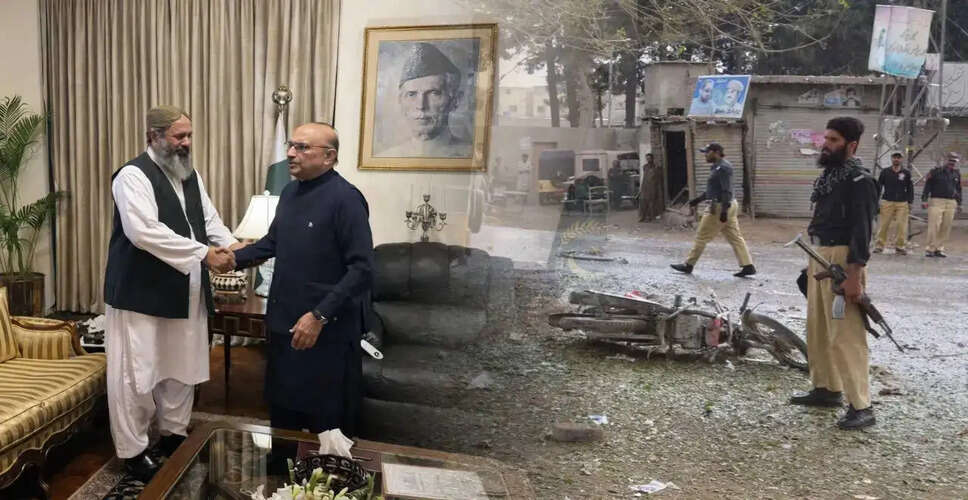
The recent re-entry of Shafiq-ur-Rehman Mengal into formal politics is being interpreted in Balochistan as more than just a typical party joining or local electoral maneuver. It is perceived as a significant political signal. In March 2026, Mengal aligned himself with the Pakistan Peoples Party after a meeting with President Asif Ali Zardari in Islamabad, receiving a ticket for the NA-256 Khuzdar by-election. This decision has escalated a local electoral contest into a broader discussion regarding the nature of political rehabilitation that Pakistan is willing to endorse in Balochistan. Mengal's return is particularly noteworthy as he is not a newcomer to the political arena; his name has been associated with one of the most tumultuous periods in Balochistan's history, characterized by militias, enforced disappearances, and complex counterinsurgency dynamics. A 2014 investigation by Herald identified him as the founder of the Baloch Musallah Difaee Tanzeem, a pro-government militia formed in 2008, which later devolved into a notorious death squad. The same report included statements from a Khuzdar lawyer who claimed that Mengal was perceived as a pawn of intelligence agencies aimed at countering Baloch militants.
The Tootak Connection and Its Implications
Tootak Still Shapes The Meaning Of Mengal’s Return
The most profound concerns surrounding Mengal's return are tied to Tootak. The mass graves unearthed there in early 2014 serve as a haunting reminder of Balochistan's politics of disappearance, and any political rehabilitation of a figure associated with that incident was bound to provoke strong reactions. According to Herald, one of the eyewitnesses who testified before Justice Muhammad Noor Meskanzai in Khuzdar claimed to have evidence that his brother, whose remains were found in the graves, had been abducted by Mengal. Jamestown's 2023 profile also highlighted eyewitness accounts linking Mengal to an abduction related to the graves, indicating that his activities had extended into Tootak. The sheer scale of the graves intensified the symbolism, with reports attributing the discovery of 169 bodies to Mengal's militia. These allegations are not trivial; they are central to the collective memory of state violence and proxy forces in Baloch political consciousness.
Controversies Surrounding Mengal's Political Induction
Militia Allegations, Sectarian Shadows And Mainstream Politics
However, the issues surrounding Mengal extend beyond Tootak. Herald's 2014 investigation revealed that the area near the graves contained an abandoned compound, firing targets, and anti-Shia propaganda, suggesting a convergence of militant and sectarian narratives. The same report cited a Khuzdar lawyer alleging that Mengal had collaborated with Lashkar-e-Jhangvi, provided refuge to Taliban and al-Qaeda operatives, and acted as a sectarian subcontractor. Jamestown later noted his strong connections with Lashkar-e-Jhangvi and other jihadist groups in the region. These serious allegations may explain the intense backlash against his induction into a mainstream national party. The political implications are further complicated by the fact that Mengal's return is through the PPP, a party historically associated with federal accommodation and democratic legitimacy. The March 2026 report also mentioned Mengal's name in connection with the Joint Investigation Team's findings related to the 2015 Safora Goth attack, where one facilitator was reportedly sheltered at his home. Critics, including Akhtar Mengal, expressed their discontent, sarcastically remarking that 'democracy is the best revenge' now seems to imply recruiting 'every top death squad you can find.'
A Test for Pakistan's Political Landscape
The implications of Mengal's political comeback extend beyond the mere granting of a party ticket to a controversial tribal figure. It raises critical questions about whether Pakistan is once again blurring the lines between political management and the coercive legacy in Balochistan. Herald reported that by the end of 2011, tensions with Mengal had led to the reported disappearance of seventeen relatives of the Qalandrani tribal chief. The investigation also described allegations that Mengal's group employed a dual strategy: executing political or ideological killings while also engaging in kidnappings for ransom. This suggests that his network was not merely a tribal self-defense group but part of a broader coercive framework. Consequently, the NA-256 by-election is poised to be scrutinized for more than just electoral outcomes; it is becoming a litmus test for whether individuals associated with disappearance politics, militia violence, and sectarian issues can be reintegrated into the respectable sphere of Pakistani politics without causing institutional embarrassment. An activist publication, The Balochistan Post, characterized Mengal in 2024 as a symbol of terror and silence in the province. While this outlet's tone is overtly activist and should be approached with caution, the emotional weight it conveys is undeniable: Mengal's name continues to evoke trauma in Baloch public memory. From Tootak to the ballot box, Mengal's return has reopened a chapter that never truly closed, reintroducing themes of enforced disappearances, militia rule, sectarian tensions, and the historical context of counterinsurgency into the political discourse. As this rehabilitation unfolds through a national party rather than a fringe group, it poses a more profound question for Pakistan: Is Balochistan being normalized through politics, or is it being managed once again through the re-emergence of figures linked to its darkest past?