
Revelations from Jeffrey Epstein Files: Controversial Email Exchange with Rothschild

New Insights from Epstein's Correspondence
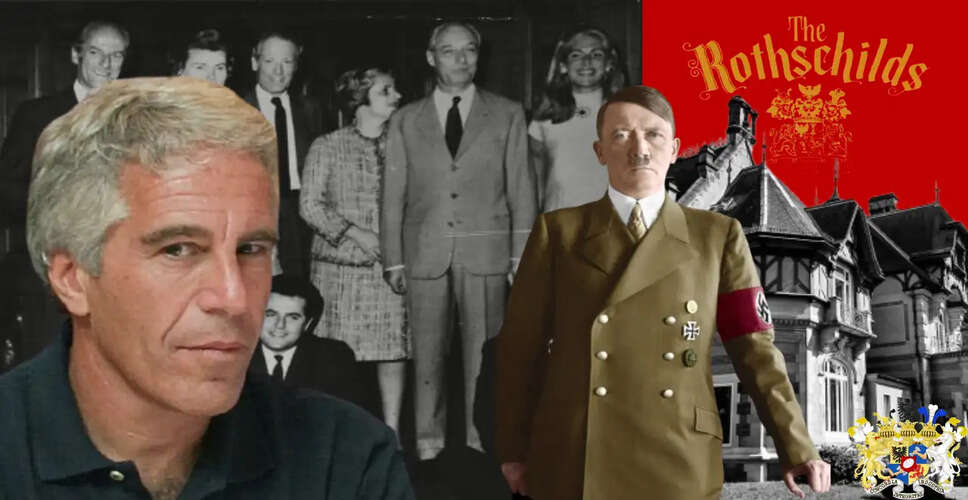
Recently unveiled documents related to Jeffrey Epstein include an email conversation with Ariane de Rothschild, the CEO of the Edmond de Rothschild Group. This exchange touches on historical claims that Adolf Hitler resided in a homeless shelter funded by notable Jewish banking families, including the Rothschilds and Epsteins. Dated December 31, 2018, this correspondence was part of a release by the US Department of Justice and has garnered attention for its rare glimpse into Epstein's interactions with a member of the Rothschild banking lineage.
The emails focus on Hitler's impoverished years in Vienna prior to World War I. Historians generally agree that during 1909 to 1913, Hitler lived in various men's hostels, surviving by selling paintings and taking on odd jobs. One prominent facility, the Meldemannstraße Men's Dormitory, was established with donations from wealthy benefactors, including several Jewish families. However, the email exchange highlights ongoing debates regarding the interpretation of these historical facts.
In the correspondence, Epstein mentioned that he learned about this narrative in a Harvard class on Hitler. He asserted that the future Nazi leader "lived in a shelter for the homeless and destitute" financed by "the Gutmanns, the Epsteins, and the Rothschilds," claiming the story to be accurate.
File Link: https://www.justice.gov/epstein/files/DataSet%2011/EFTA02608106.pdf
De Rothschild refuted this implication, labeling it as a narrative that has historically fueled conspiracy theories about her family. In her response, she remarked that such claims are "quite pathetic," suggesting they imply that generosity is unappreciated. She further noted that allegations of the Rothschild family having planned or supported Hitler's rise have been consistently dismissed by historians and lack credible evidence.
Despite her rebuttal, Epstein maintained his stance, stating, "First it turns out to be 100 percent true, Hitler was selling his clothes and artwork and living in a shelter funded by Jews. Epstein, Rothschild, and Gutmann. No conspiracy. The Epsteins were the Vienna bankers, bought their bank on the Ring hence still Palais Epstein," in a follow-up email.
This exchange is significant as it illustrates de Rothschild's clear distancing from conspiracy theories while Epstein insisted on the factual nature of the shelter's historical context. The emails do not provide evidence supporting broader conspiracy theories regarding the Rothschild family or Hitler's ascent to power, and de Rothschild's responses consistently reject such interpretations.
Financial Connections Revealed
Additional documents released by the Justice Department also indicate financial interactions between Epstein and the Rothschild Group prior to his death. One agreement, dated October 5, 2015, reportedly shows Epstein's Southern Trust Company Inc., located in the US Virgin Islands, entering into a $25 million contract with the Rothschild Group for risk analysis and algorithm-related consulting services, with Epstein listed as the president of Southern Trust.
This disclosure has reignited scrutiny over Epstein's extensive web of financial, political, and business relationships. Before his arrest, Epstein had established connections with influential financiers, academics, politicians, and business leaders across the US and Europe, many of whom have come under renewed public scrutiny following the release of court documents and investigative files.
Historical Context
Historians generally concur that Adolf Hitler faced extreme poverty during his early years in Vienna after his mother's death. During this time, he resided in homeless shelters and later in a men's dormitory while trying to make a living by selling watercolor paintings. The facilities he utilized were supported by charitable donations from affluent Jewish families—a historical irony considering Hitler's later orchestration of the Holocaust, which resulted in the deaths of six million Jews.
However, historians warn that this fact is often taken out of context or misrepresented in misleading narratives about Jewish influence over Hitler's early life. There is no credible historical evidence suggesting that Jewish benefactors knowingly aided Hitler personally or that such philanthropy influenced his later ideology or political career.
Epstein's Legacy
Jeffrey Epstein passed away in a Manhattan jail cell in August 2019 while awaiting trial on federal sex-trafficking charges involving minors. The New York City medical examiner ruled his death a suicide, although it has remained a topic of widespread speculation. Earlier, in 2008, Epstein pleaded guilty in Florida to procuring a minor for prostitution under a controversial plea agreement that faced years of criticism for its lenient terms. Since his death, thousands of pages of court records, communications, and investigative files have been released, providing further insight into his extensive network of influential contacts, although inclusion in those records does not imply wrongdoing. The latest batch of Justice Department documents offers another look into Epstein's private correspondence, revealing an unusual discussion about Adolf Hitler's early years and demonstrating how even accepted historical facts can become entangled with broader conspiracy narratives.