
Protests Erupt in Muzaffarabad Amid Rising Tensions in Pakistan-Occupied Kashmir
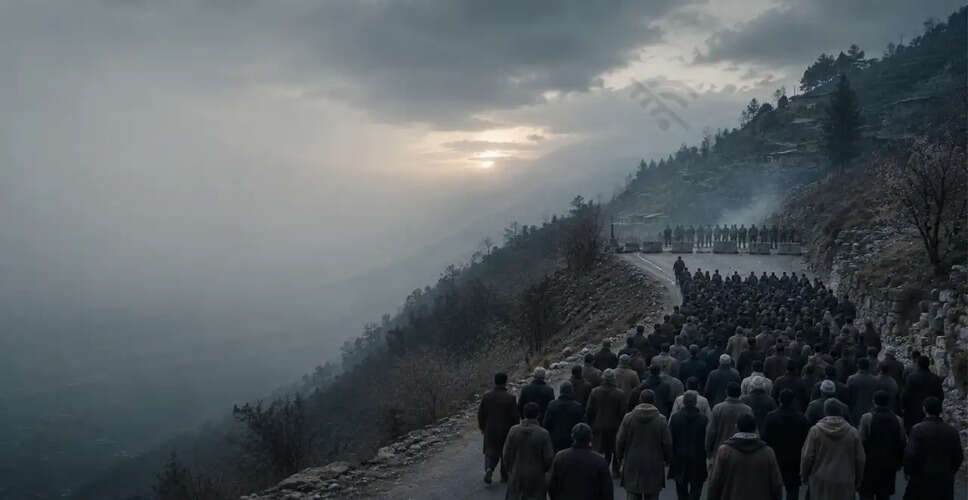

Massive Protests in Muzaffarabad
On Wednesday, a large number of demonstrators from Rawalakot, Mirpur, Kotli, and Bagh gathered in Muzaffarabad following the expiration of the Joint Awami Action Committee's ultimatum to the government. The situation escalated when Pakistani Rangers opened fire on protesters in Sudhanoti and Mathiyal Mera, resulting in the deaths of at least eight individuals, as reported by local sources. The clashes also claimed the life of one Ranger. Authorities employed tear gas and live ammunition to disperse crowds across eight districts. Over the past month, more than twenty people have lost their lives in these confrontations, with over 16,000 security personnel deployed throughout Pakistan-occupied Kashmir, and communication services remain disrupted in several regions.
This scenario raises a critical question: what is happening here? A populace is being controlled by military forces that answer to a government they did not elect. Political leaders are either imprisoned, hunted, or labeled as terrorists. The internet is cut off, preventing the outside world from witnessing the situation, while essential supplies like food and medicine are restricted. This is not merely a governance issue; it reflects the behavior of an occupying force when the occupied cease to comply.
Understanding the March's Objectives
What the march is actually about
The JAAC's 38-point charter initially appears to address local grievances, such as affordable wheat flour, reasonable electricity tariffs, and effective public services. However, the focus has shifted from economic issues to constitutional demands. The charter calls for the release of detained activists, restoration of internet access, and essential supplies. Most notably, it seeks the abolition of the 12 seats reserved for 'refugees' in the 53-member PoK Assembly. These seats, filled by constituencies from within Pakistan, allow Islamabad's major parties to outvote local representatives. What began as a protest over flour prices is now challenging the mechanisms of external control, which has made Islamabad increasingly anxious.
Islamabad's Response
How Islamabad answered
The past five weeks can be viewed as a series of escalating actions. Negotiations with a federal ministerial team broke down in late May. On June 5, the AJK government designated the JAAC as a terrorist organization under the Anti-Terrorism Act of 2014, placing a bounty of Rs 10 million on four of its leaders. The territory's Supreme Court upheld the refugee seats on June 7, effectively closing off legal avenues for change, and a communications blackout ensued. On June 8 and 9, strikes led to at least 11 fatalities and over 70 injuries. By June 19, around 150 individuals were classified as terror suspects. The movement's prominent figure, Shaukat Nawaz Mir, was arrested on June 30, followed by sedition charges. On the eve of the march, the Rangers responded to the expired ultimatum with live ammunition across eight districts.
The JAAC claims that the crackdown has only strengthened their resolve, warning that ignoring their charter could escalate the agitation into a broader movement for representation. The public has already found its voice; during a recent gathering at Rawalakot's Eidgah Ground, schoolchildren waved white flags and chanted a poignant couplet: 'Behind this terrorism stands the uniform.'
Implications of Upcoming Elections
The next 24 hours — and the damage already done
Three potential outcomes emerge from today's march. Islamabad could attempt to quell dissent again, using the Rs 23 billion subsidy package from May 2024 as a model, though its failure is evident. Alternatively, it could escalate the situation, but each violent response since June has only drawn larger crowds. Lastly, the JAAC might follow through on its threats, transforming the agitation from a 38-point charter into a full-fledged demand for representation, shifting the focus from basic needs to governance and authority.
Regardless of the path taken, one fact is clear: Pakistan's long-standing claim to the United Nations regarding Kashmir's occupation now faces a counterargument, one that Pakistan has inadvertently crafted through its brutal treatment of the people it has governed for decades. On this point, one must believe Pakistan: the occupation in Kashmir is real, and it is Pakistan's. The residents under this rule are making their voices heard, even in the face of violence.