
Predictions of Global Change: Insights from Notable Seers

Famous Prophecies and Their Implications
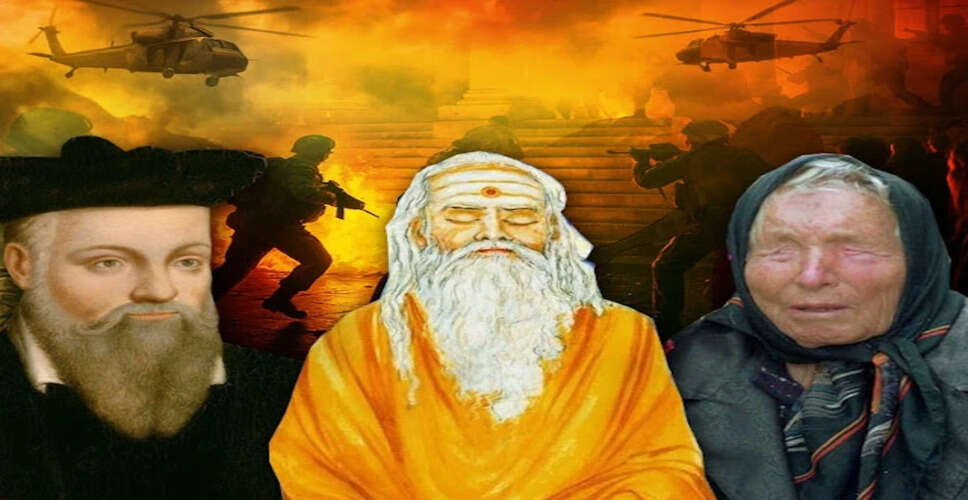
The prophecies of renowned figures like Nostradamus from France, Indian seer Achyutananda Das, and Bulgarian mystic Baba Vanga are well-known, yet few pay attention to a specific prediction that stands out.
What is this significant prophecy? Both Nostradamus and Achyutananda predict a massive asteroid will fall from space, potentially submerging several nations. They also foresee the birth of a great leader in India who will transform the world. All three seers agree on the occurrence of a third world war. According to Baba Vanga, this great conflict will elevate the dragon to the status of the world's superpower, but we will focus on a different prophecy.
This prophecy is unavoidable: Nostradamus states, 'The religion named after the seas will flourish faster than those dependent on the moon, instilling fear in them, 'A' and 'A' will be wounded.' (x-96)... 'After a long period of communal strife, all religions and castes will adopt a single ideology.' (6-10). 'In a region surrounded by three seas, a leader will emerge who will declare a holiday on Thursday. His fame and power will grow, and no one will match his strength on land or sea.' (Century 1-50). 'People will unite against the red, but conspiracies and deceit will be thwarted.' 'The leader from the East will leave his country, crossing the mountains of Italy and observing France. He will unleash his wrath upon all, soaring above air, water, and ice.'
Achyutananda predicts that all will become devotees of Lord Krishna. Russia will transform into a Hindu nation, with many coming from Russia to visit Jagannath and offer gold. The prophecy suggests that a saint, who will be unmarried, will hold the reins of the country. He will be the supreme protector and will establish Sanatan Dharma globally. This will occur when the divine king of Odisha is in power.
Annie Besant proclaimed Hinduism as the supreme religion of the world, calling it the mother of all faiths. She found a perfect harmony between science and religion within Hinduism, asserting that without Hinduism, India has no future.
French Nobel laureate philosopher Romain Rolland regarded Hinduism as the best, stating, 'I have studied all faiths in Europe and Central Asia, but Hinduism stands out as the greatest... I believe the entire world will one day bow before it. India is the only place where the living have realized their dreams since ancient times.'
Arthur C. Clarke, the futurist, predicted that just as the UN headquarters is in the USA, the headquarters of a united planetary government might be on Mars or Jupiter. By 1981, India would become powerful, sparking a revolutionary idea that would influence the world. India's religion and spirituality would gain global acceptance, and by the end of the 20th century, one nation would surpass all others in scientific advancement, particularly due to its religion and philosophy.
Peter Harkous, a prominent seer of this century, stated that the wave of spirituality and religiosity rising in India would spread across the globe.
French scholar Cruiser remarked that if there is a nation on Earth entitled to declare itself the cradle of humanity or the witness of early civilization, it is indeed India.
Jules Verne, the science fiction writer, predicted a war between India and Pakistan, leading to the creation of Bangladesh. Ultimately, Pakistan would become a small island, with parts absorbed by Afghanistan and a free Balochistan emerging. India would reclaim land taken by China, and Tibet would gain independence. By then, China would develop nuclear capabilities, and prosperous nations would gain extensive knowledge about planets like Mars and Pluto, with humanity reaching Venus and Mars. India would rise as a powerful nation, gaining respect worldwide.
Leo Tolstoy (1828-1910) believed that Hinduism and Hindutva would one day rule the world due to their combination of knowledge and wisdom.
Albert Einstein (1879-1955) stated that Hindus have achieved what Jews could not, and that Hindutva holds the power to establish peace.
Johann Goethe (1749-1832) expressed that everyone will eventually accept Hinduism, recognizing it as the true religion.
Herbert Wells (1846-1946) predicted that until the effective realization of Hindutva, countless generations would suffer oppression, but one day the world would be drawn to it, leading to a day of peace and prosperity.
Huston Smith (1919-2016) remarked that the belief we hold dear is Hindutva, and opening our hearts and minds to it will benefit us.
Michael Nostradamus (1503-1566) foresaw that Hindutva would become the ruling religion in Europe, with a famous city becoming the Hindu capital.
Bertrand Russell (1872-1970) noted that he learned that Hindutva is destined to become the religion of all humanity, spreading throughout Europe and giving rise to significant thinkers.
Gosta Lobon (1841-1931) stated that Hindus advocate for peace and reform, inviting Christians to appreciate the faith of reform.
Bernard Shaw (1856-1950) predicted that the world would one day accept Hinduism, even if under a metaphorical name.