
Political Controversy Surrounds Gordie Howe International Bridge Opening

Delay in Bridge Opening Sparks Accusations
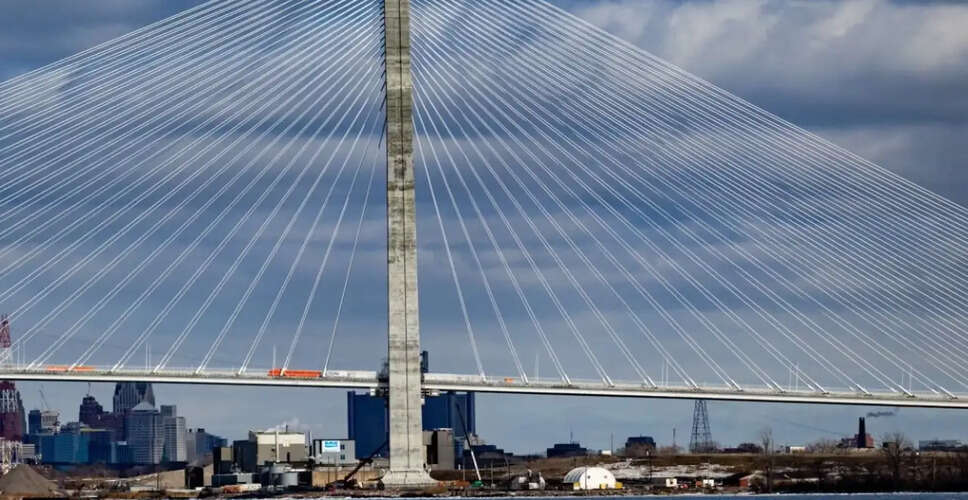
Democratic representatives have criticized the Trump administration for allegedly postponing the inauguration of the $4.7 billion Gordie Howe International Bridge, which connects Detroit and Windsor, Ontario. They claim this delay was orchestrated to favor billionaire donor Matthew Moroun, who operates a competing border crossing. Initially, the bridge was set to open in early June, but a planned ribbon-cutting event was unexpectedly canceled due to disagreements between U.S. and Canadian officials. On July 10, Canada announced that an agreement had been reached, rescheduling the opening for July 27.
Democrats Raise Concerns Over Delay
The delay has faced backlash from Democratic lawmakers, including Michigan's Representative Rashida Tlaib, who accused the Trump administration of hindering the project to safeguard Moroun's business interests. The Gordie Howe International Bridge, funded by Canada, is intended to alleviate congestion and enhance trade between the U.S. and Canada. It took eight years to complete and is set to be jointly managed by Michigan and Canadian authorities.
Revised Toll Agreement
Under the newly announced agreement, any reduction in tolls below regional averages will now require U.S. government approval, as reported by media sources. Previously, the Canadian government had the authority to set toll prices. Critics argue that this new arrangement favors Moroun, whose Ambassador Bridge has historically controlled commercial traffic between Detroit and Windsor. The Ambassador Bridge sees approximately three million trucks each year, with tolls reportedly reaching up to $100 per truck. Despite its significance, the 93-year-old bridge has been criticized for severe congestion, long wait times, and outdated infrastructure, raising safety concerns and calls for an alternative route.
Longstanding Opposition from Moroun
Matthew Moroun took over the Ambassador Bridge from his late father, Manuel Moroun, who spent decades opposing the construction of the Gordie Howe Bridge through various legal and political means. Reports indicate that Matthew Moroun contributed $1 million to a Trump political action committee in January. Following this, he met with U.S. Commerce Secretary Howard Lutnick, after which President Trump publicly questioned whether the new bridge should open without further concessions from Canada. House Oversight Committee members Robert Garcia and Rashida Tlaib have initiated an investigation into the reasons behind the delay. In a letter to Moroun, they suggested that he may have leveraged his political donations to jeopardize American commerce for his company's benefit. Neither Moroun's Detroit International Bridge Company nor the White House has responded to requests for comments.
Political Implications
This controversy has emerged as a significant campaign issue in Michigan as the 2026 midterm elections approach. Democratic Senate candidate Abdul El-Sayed has accused Republicans of fostering political favoritism, framing the situation as one of "collusion" and "corruption." Meanwhile, officials from the Department of Homeland Security have confirmed that personnel are prepared to staff the U.S. inspection plaza once the bridge becomes operational.
Trade Tensions Complicate Matters
The dispute over the bridge coincides with broader trade tensions between Washington and Ottawa. President Trump has consistently argued that the U.S. should receive more compensation for the project, despite a 2012 agreement that allows Michigan and Canada to jointly own and operate the bridge while sharing toll revenues after Canada recoups construction costs. This disagreement has unfolded alongside larger disputes over tariffs and the future of the U.S.-Mexico-Canada trade framework, with analysts suggesting that the bridge negotiations have become entangled with these broader trade discussions. Michigan Democrats contend that the delays have negatively impacted businesses reliant on efficient cross-border trade, while Republicans assert that the administration is acting in the interest of U.S. economic welfare. As the Gordie Howe International Bridge is now anticipated to open later this month, the political controversy surrounding this major infrastructure project is likely to remain in the spotlight.