
North Korea's Nuclear Ambitions Intensify Amid Global Tensions

North Korea's Nuclear Aspirations
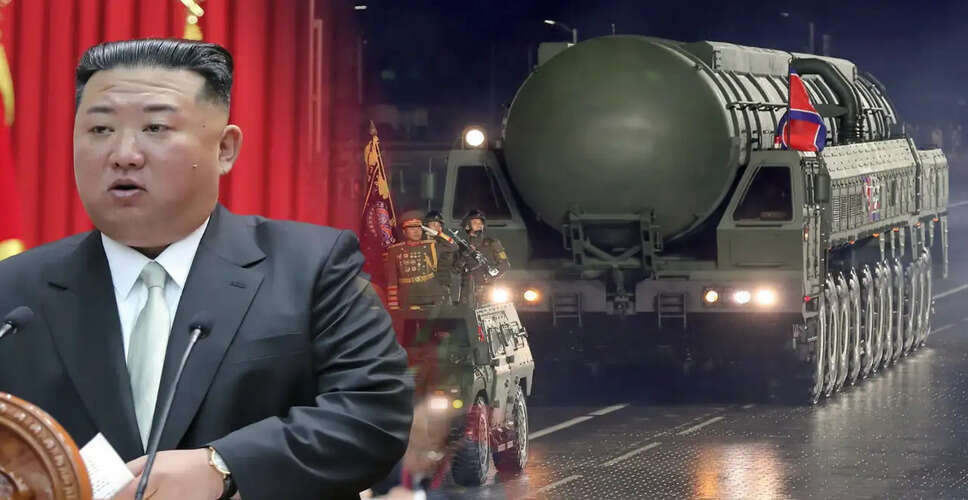
North Korea has reaffirmed its commitment to advancing its nuclear capabilities. Recent reports from state media indicate that Kim Jong Un visited a newly operational facility dedicated to producing nuclear materials, where he commended the progress made in weapons-grade nuclear production. He urged officials to pursue what he termed an "exponential" growth of the nation’s nuclear arsenal. This development occurs amidst rising geopolitical tensions, with conflicts spanning from Eastern Europe to the Middle East, prompting major powers to focus on strategic deterrence.
Details of Kim Jong Un's Announcement
What Did Kim Jong Un Announce?
The Korean Central News Agency (KCNA) reported that Kim received updates on enhanced production methods that utilize advanced technologies, significantly boosting output. Officials informed him that North Korea's ability to produce weapons-grade nuclear material has more than doubled in the last five years. Kim directed authorities to further increase production to align with the country’s long-term strategic goals, asserting that escalating external threats necessitate a more robust nuclear deterrent. He also led a meeting aimed at fortifying the nation’s nuclear capabilities, where new directives were issued for both qualitative and quantitative enhancements of North Korea's atomic arsenal.
Reasons Behind North Korea's Nuclear Expansion
Why Is North Korea Expanding Its Nuclear Programme?
North Korea has consistently maintained that its nuclear arsenal is vital for its national security. Kim emphasized that the expansion is crucial due to a prolonged standoff with what he refers to as "hostile forces," primarily targeting the United States, South Korea, and their allies. Over recent years, North Korea has ramped up missile tests and weapon development, unveiling advanced ballistic missiles capable of striking targets throughout Asia and potentially reaching the continental United States. The latest developments indicate that Pyongyang is now equally focused on increasing the stockpile of nuclear materials necessary to equip these delivery systems.
Transition to a Larger Nuclear Arsenal
A Shift Towards Larger Nuclear Forces
While North Korea has long sought nuclear capabilities, recent statements suggest a shift from merely possessing atomic weapons to developing a significantly larger and more varied arsenal. Analysts have pointed out that the increased production of fissile materials would enable the country to create more warheads for tactical battlefield weapons, submarine-launched missiles, and long-range strategic systems simultaneously. The focus on both "quality and quantity" indicates an effort to establish a more adaptable deterrence strategy capable of addressing various military scenarios.
Implications for Regional Security
What It Means For Regional Security
Kim's recent statements are likely to escalate concerns throughout Northeast Asia. In response to North Korea's expanding missile capabilities, South Korea, Japan, and the United States have enhanced their defense collaboration, conducting joint military exercises and improving missile defense integration. This announcement also arrives at a time when the global non-proliferation framework is under increasing pressure, with several regional conflicts raising doubts about the future significance of nuclear deterrence in international security. By publicly displaying expanded production facilities and advocating for an "exponential" increase in nuclear forces, Pyongyang seems determined to assert that its strategic weapons program remains a fundamental aspect of its national policy.