
North Korea Tests New Missile Engine Amid Rising Tensions in West Asia
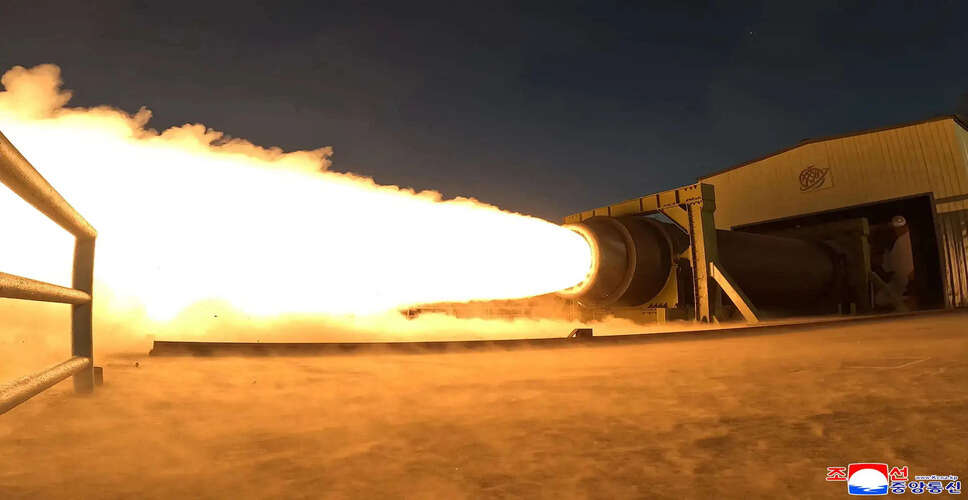
North Korea's Missile Development Advances
In the context of escalating conflicts in West Asia, North Korea has successfully conducted a test of a missile engine designed to potentially strike the US mainland. The test was overseen by North Korean leader Kim Jong Un, who evaluated a high-thrust, solid-fuel engine as part of a new five-year defense enhancement initiative aimed at bolstering the nation’s strategic strike capabilities.
Reports suggest that this test signifies Kim's ambition to expand and modernize North Korea's missile arsenal, which could reach the United States, according to sources. State media highlighted Kim's remarks on the test, describing it as a significant advancement in the country's military capabilities.
During the test, Kim also reviewed training exercises for special operations forces and inspected a new main battle tank. The Korean Central News Agency noted that the upgraded engine, made from composite carbon fiber, achieved a maximum thrust of 2,500 kilotons, an increase from the 1,971 kilotons recorded in a previous test.
Kim emphasized the importance of this engine test in enhancing the nation’s strategic military strength. Analysts believe that the increase in engine power may be linked to efforts to equip missiles with multiple warheads, thereby improving their chances of overcoming US defense systems.
This announcement follows Kim's recent address to North Korea's Parliament, where he reaffirmed the country's commitment to being a nuclear power and criticized the US for what he termed global 'state terrorism and aggression,' likely referencing the ongoing conflict in the Middle East.
Both South Korea and the United States are reportedly keeping a close watch on North Korea's advancements in weaponry. Since the breakdown of high-stakes negotiations with former US President Donald Trump in 2019, North Korea has intensified its efforts to expand its nuclear capabilities. In a recent Workers’ Party congress, Kim indicated a willingness to engage in dialogue with Trump but insisted that the US must abandon its demands for North Korea's nuclear disarmament as a prerequisite for discussions.