
NASA's Artemis II Crew Makes Historic Splashdown After Lunar Flyby
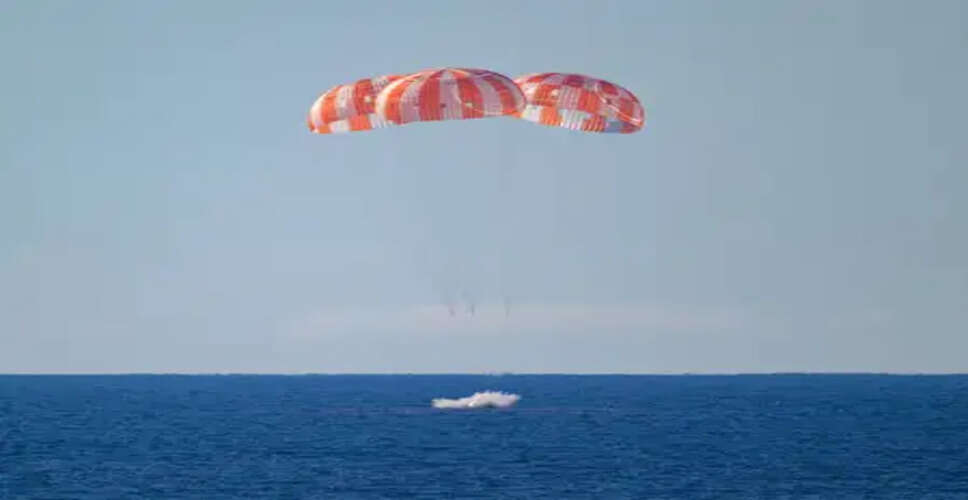

Historic Return of Artemis II Crew
Washington: In a moment filled with applause and excitement, the four astronauts from NASA's Artemis II mission successfully splashed down in the Pacific Ocean, marking humanity's first lunar flight in over half a century.
Amit Kshatriya, the Indian-origin NASA Associate Administrator, addressed the media shortly after the crew's return near San Diego at 8:07 AM Eastern Time, stating, "The path to the moon is open, but the work ahead is greater than the work behind."
This mission, featuring Commander Reid Wiseman, pilot Victor Glover, Christina Koch, and Canada's Jeremy Hansen, was the first crewed lunar flyby since Apollo 17 in December 1972, when astronauts Eugene Cernan and Harrison Schmitt explored the moon's surface for three days.
Flight director Rick Henfling confirmed that the Artemis II astronauts were "happy and healthy and ready to return to Houston."
Artemis II was the inaugural crewed mission to utilize NASA's Space Launch System rocket and Orion crew module, showcasing the agency's capability to send astronauts beyond Earth's orbit and safely bring them back.
Kshatriya noted, "Yesterday, flight director Jeff Radigan mentioned we had less than a degree of an angle to hit after traveling a quarter of a million miles to the moon, and their team achieved it. This is not luck; it reflects the hard work of 1,000 people."
The mission covered a distance of 700,237 miles, reached a peak speed of 24,664 mph, and landed within one mile of its target after entering Earth's atmosphere from 1,957 miles away, according to Henfling.
Looking ahead, NASA plans to land humans on the moon and establish a habitat that will serve as a launchpad for future missions to Mars and beyond.
The crew's triumphant return not only unveiled parts of the moon's far side that had never been seen by humans but also witnessed a total solar eclipse.
As they emerged from their bobbing capsule into the sunlight, Henfling expressed relief when the side hatch of the Orion Integrity opened after the splashdown.
"We all breathed a sigh of relief once the hatch opened. That’s when we brought the team in," he shared.
"We exchanged a few words with the flight controllers, then turned to the families to wave and give them a thumbs up, watching as each astronaut was hoisted onto helicopters. It was a remarkable day."
Henfling admitted to feeling "anxiety" as the astronauts re-entered Earth's atmosphere but remained confident in their extensive training leading up to this historic mission.
NASA has indicated that the Artemis III mission is "right around the corner" following this groundbreaking lunar journey.
"The next mission is imminent, and we will apply the lessons learned from Artemis II," Henfling stated.
"We gained valuable insights into flying people in space, both in terms of vehicle operations and managing a control room for a deep space mission. When the time comes, we will resume specific training with our core group of about 30 highly capable flight directors.
"I believe anyone assigned to the next mission will achieve success just like us," Henfling concluded.