
Myanmar's Controversial Election: A Struggle for Legitimacy Amidst Civil War
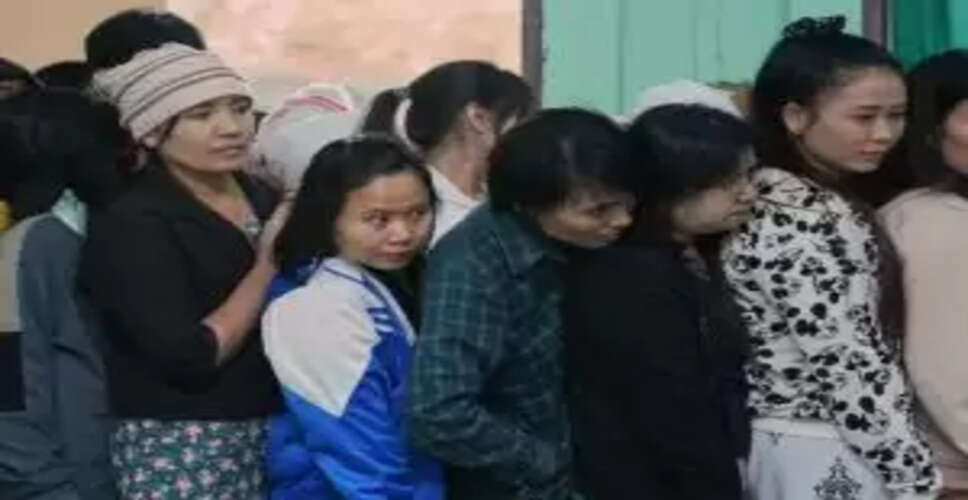
Voting Under Military Oversight
Yangon: On Sunday, voters participated in the first phase of Myanmar's general election, the first in five years, conducted under the watchful eye of the military government amidst ongoing civil conflict.
The final election results will be revealed after two additional voting rounds scheduled for later in January. Observers anticipate that Min Aung Hlaing, the general who has maintained strict control since the military coup in 2021, will likely take on the presidency.
The military regime has framed this election as a step back towards democratic governance; however, its legitimacy is questioned due to the prohibition of popular opposition parties and allegations of coercion against voters.
Over 4,800 candidates from 57 different parties are vying for positions in both national and regional legislatures, yet only six parties are competing on a national level with a chance to influence Parliament.
The Union Solidarity and Development Party, which enjoys military backing, stands out as the most formidable contender.
Voting is structured in three phases, with the initial round occurring in 102 of Myanmar's 330 townships. The second phase is set for January 11, followed by the third on January 25, with final results expected by February.
Critics argue that this election serves merely to create an illusion of legitimacy for military rule, which began with the ousting of Aung San Suu Kyi's elected government in February 2021. The military barred her National League for Democracy party from continuing after it won a significant victory in the 2020 elections.
Opponents contend that the election results will lack credibility due to the exclusion of major political parties and the suppression of free speech in a repressive environment.
The anticipated success of the military-aligned Union Solidarity and Development Party casts doubt on any genuine transition to civilian governance, according to critics and independent analysts.
Tom Andrews, the UN-appointed human rights expert for Myanmar, criticized the election, stating, "An election organized by a junta that continues to bomb civilians, jail political leaders, and criminalize dissent is not an election — it is a theatre of the absurd performed at gunpoint."
Western nations have upheld sanctions against Myanmar's military leaders due to their undemocratic actions and the violent conflict against their adversaries.
Voter sentiments were mixed on Saturday.
Khin Marlar, a 51-year-old voter from Yangon’s Kyauktada township, expressed her hope for peace, stating she felt compelled to vote despite having fled her village in the central Mandalay region due to ongoing violence.
"I am voting with the hope that I can return to my village when it is safe," she shared with the Associated Press.
Another voter from southern Mon state, who wished to remain anonymous for fear of military reprisal, indicated she felt pressured to vote due to intimidation from local authorities.
"I have to go and vote even though I don’t want to, because soldiers came to our village with guns to pressure us yesterday," she explained. Reports from independent media and rights organizations have indicated that such coercive tactics were employed to ensure voter turnout.
Aung San Suu Kyi, the former leader of Myanmar, is not participating in the elections as she is currently serving a 27-year prison sentence on charges widely regarded as politically motivated. Her party, the National League for Democracy, was dissolved in 2023 after it refused to comply with new military regulations.
Other political parties have also opted not to register or participate under what they consider unfair conditions, leading opposition groups to call for a voter boycott.
Amael Vier, an analyst with the Asian Network for Free Elections, highlighted the lack of real choice, noting that 73% of voters in 2020 supported parties that no longer exist.
Mobilizing opposition is challenging under the military's oppressive regime. The Assistance Association for Political Prisoners reports that over 22,000 individuals are currently imprisoned for political reasons, and more than 7,600 civilians have lost their lives at the hands of security forces since the military takeover in 2021.
Armed resistance emerged following the military's violent crackdown on peaceful protests against its 2021 coup, resulting in a civil war that has displaced over 3.6 million people, according to UN estimates.
A newly enacted Election Protection Law imposes severe penalties and restrictions on public criticism of the electoral process.
In this context, both the military and its adversaries anticipate that power will likely remain with Senior Gen Min Aung Hlaing, who orchestrated the 2021 coup.